Family Troglodytidae
Bay Wren
Cantorchilus nigricapillus
In Spanish: Soterré Castaño
- Resident
A loud duetting wren of Caribbean thickets, far easier to hear than see.
The Bay Wren is a small bird with a big voice, and in Costa Rica it belongs to the Caribbean side. One guide describes it as a small wren that may be the loudest of its kind.
It is an expert skulker, but its distinctive calls draw attention to it. In Costa Rica a pair can be heard singing a fast duet just before sunrise from hidden spots in the underbrush.
On a trip we build, the places to look include the Silencio Road, forest edge near Arenal and the far north around Caño Negro. Start with your ears, and the wren will often tell you where it is.
How to find it
Listen first, since the calls draw attention to a bird that rarely sits in the open. Start with water: Bay Wrens often stay close to it, and the species is often easiest to find along watercourses in forested areas. Look in dense, low thickets along streams, overgrown clearings, roadsides and secondary forest understory with plenty of undergrowth. Heliconia patches are worth checking. Birders around Arenal and foothill rainforest spots on the Caribbean slope hear Bay Wrens chattering at the forest edge. At Caño Negro, one birding group found Bay Wren territory from a boat.
How to recognise it
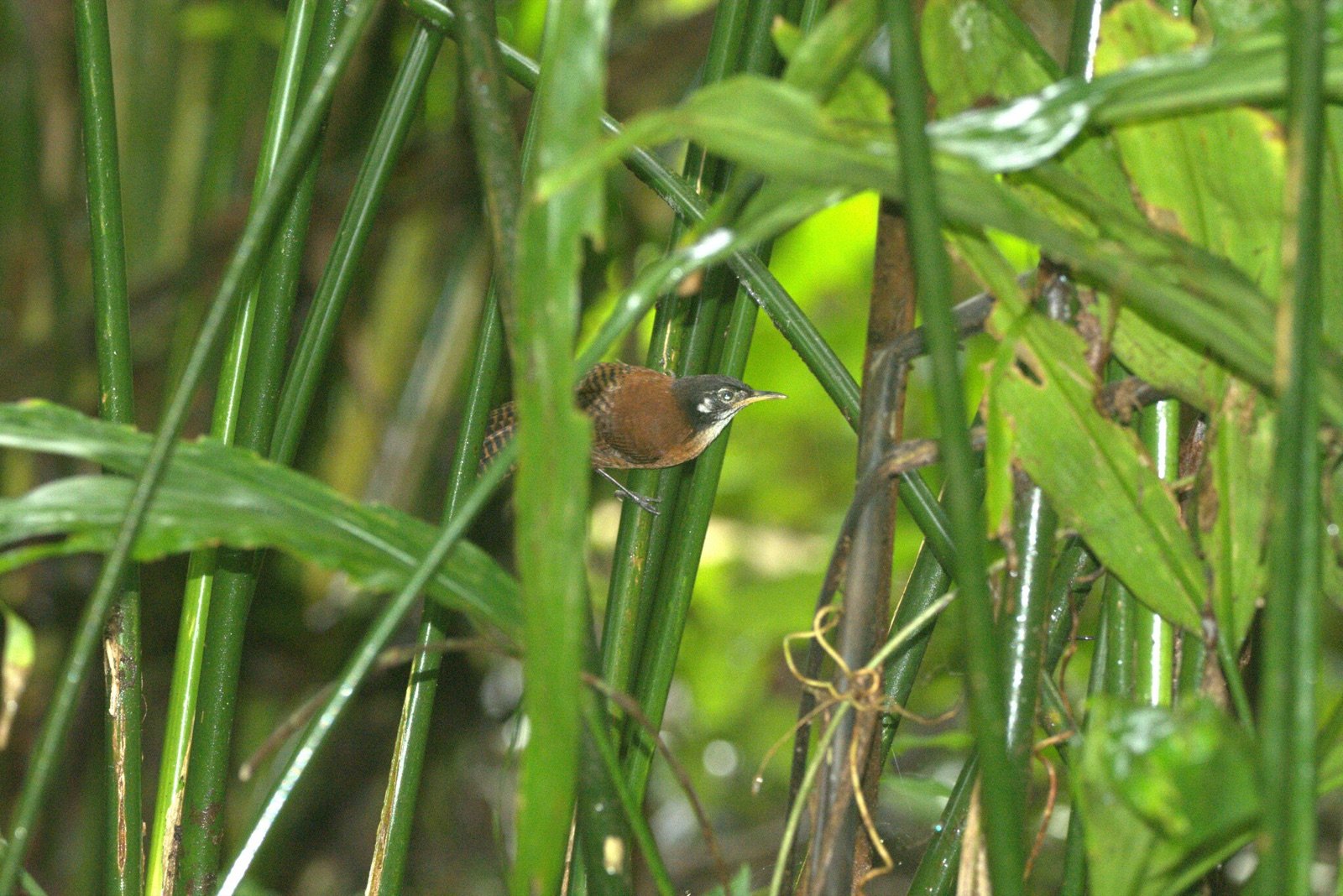
The Bay Wren has rufous-brown upperparts, a mostly black head with white ear patches, and a white throat. The underparts vary by region, so do not be thrown if the belly differs from a picture you have seen.
It is small, about 12.6 to 15.6 cm long, and weighs roughly 17.7 to 26.3 grams. One guide says its looks are like a babbler from Southeast Asia.
Because it keeps to dense cover, a glimpse of the black head with its white ear patches is often the detail that settles the identification.
What it sounds like
Behaviour and diet
The diet seems to be entirely invertebrates. Bay Wrens glean from foliage and branches and probe hanging vegetation and vine tangles, which keeps them low and inside cover.
Breeding in Costa Rica runs from March to October. Both sexes build an elbow-shaped nest with an entrance tube, and the clutch is usually two or three eggs.
Birders report them chattering at the forest edge. At a Caribbean foothill patch near La Selva, Bay Wrens sang often from thick undergrowth by a stream but would not show themselves, so expect to be patient.
Where it lives
In Costa Rica the Bay Wren lives on the Caribbean side. The Costa Rican race ranges from northeastern Nicaragua through the Caribbean lowlands of Costa Rica into western Panama. A Costa Rica birding blog calls it a common resident of second growth on the Caribbean slope.
Across its range the species lives in lowlands and foothills up to about 750 meters. It favors dense secondary growth and forest edge, often near streams, and is especially fond of dense Heliconia patches.
When to see it
Just before sunrise is when a pair can be heard singing a fast duet. Breeding in Costa Rica runs from March to October.
Similar birds
The Stripe-breasted Wren shares Caribbean foothill forest with the Bay Wren. Its breast has black and white stripes, which no other Costa Rican wren has, and its song is also a loud duet from dense cover.
The Riverside Wren is a close relative that replaces the Bay Wren on the southern Pacific side. It moves in small, noisy groups along forested creeks and streams from Carara southward, and was once treated as a subspecies of the Bay Wren.
Names and lore in Costa Rica
Costa Ricans call the Bay Wren Soterrey Castaño. Other countries use different Spanish names: cucarachero ribereño in Colombia, charralero cabecinegro in Nicaragua, and sotorrey castaño in Panama.
Status and conservation
The official Costa Rica list marks the Bay Wren as a resident species (R).
Photography tips
Expect glimpses rather than open views. Wait quietly near a streamside thicket or Heliconia patch where a pair has been calling, and be ready for a brief look at the black head with white ear patches.
How we know this 16 sources, each read on the date shown
- Wikipedia read 2026-11-04
https://en.wikipedia.org/wiki/Thryothorus_nigricapillus - EcoRegistros read 2026-11-04
https://www.ecoregistros.org/ficha/Cantorchilus-nigricapillus - Birdingcraft read 2026-11-04
https://birdingcraft.com/wordpress/2024/06/07/costa-rica-birding-a-whole-lot-of-wrens-going-on/ - BirdForum (Birdingcraft) read 2026-11-04
https://www.birdforum.net/threads/birdingcrafts-costa-rica-patch.131932/ - Birdingcraft read 2026-11-04
https://birdingcraft.com/wordpress/2014/08/14/big-cool-wrens-of-costa-rica/ - Canopy Tower read 2026-11-04
https://canopytower.com/bay-wren/ - BirdNote read 2026-11-04
https://www.birdnote.org/podcasts/birdnote-daily/costa-rica-winter-sunrise - Cornell Birds of the World read 2026-11-04
https://birdsoftheworld.org/bow/species/baywre1/cur/introduction - Carolina Birds (Birds of the World: Wrens) read 2026-11-04
https://carolinabirds.org/HTML/Wren.htm - Birda read 2026-11-04
https://app.birda.org/species-guide/28658/Bay_Wren - Birdwatching in Costa Rica (AOCR list) read 2026-11-04
https://birdwatchingincostarica.com/bird-lists/ - Field Guides Birding Tours trip report, Costa Rica 2024 read 2026-11-04
https://fieldguides.com/triplists/cos24.html - Field Guides Birding Tours trip report, Costa Rica 2020 read 2026-11-04
https://fieldguides.com/triplists/cr220.html - Costa Rica Focus read 2026-11-04
https://www.costaricafocus.com/bird-species/stripe-breasted-wren/ - Birds of Colombia, Birds of Costa Rica read 2026-11-04
https://www.birdsofcolombia.org/costarica/Cantorchilus.html - Wikipedia (Spanish) read 2026-11-04
https://es.wikipedia.org/wiki/Cantorchilus_nigricapillus