Family Alcedinidae
Belted Kingfisher
Megaceryle alcyon
In Spanish: Martín Pescador Norteño
- Migrant
The only migrant among Costa Rica's six kingfishers, here in the northern winter
The Belted Kingfisher is the only migrant among Costa Rica's six kingfisher species. The other five are resident, so this is the one that comes and goes with the northern winter.
It is a fairly common migrant, most often on the Atlantic (Caribbean) coast, and it is locally common in winter around Río Frío and along coastal areas. Look for a blue-grey, shaggy-crested bird perched over water.
On a trip we build, a day in a wildlife refuge of the northern lowlands can bring all the kingfishers together, and the Belted is the winter-only one of the set.
How to find it
Listen for the call first, because the loud rattle is usually heard before the bird is seen. When you hear it, scan the water edges. Look for it perched on branches that overhang rivers and canals. Wait patiently and you may see it plunge in after a fish. Boat trips on rivers can bring you close to birds that are hard to approach on land. A fallen branch over the water is worth checking, as one bird showed on the Tárcoles River in March 2024.
How to recognise it
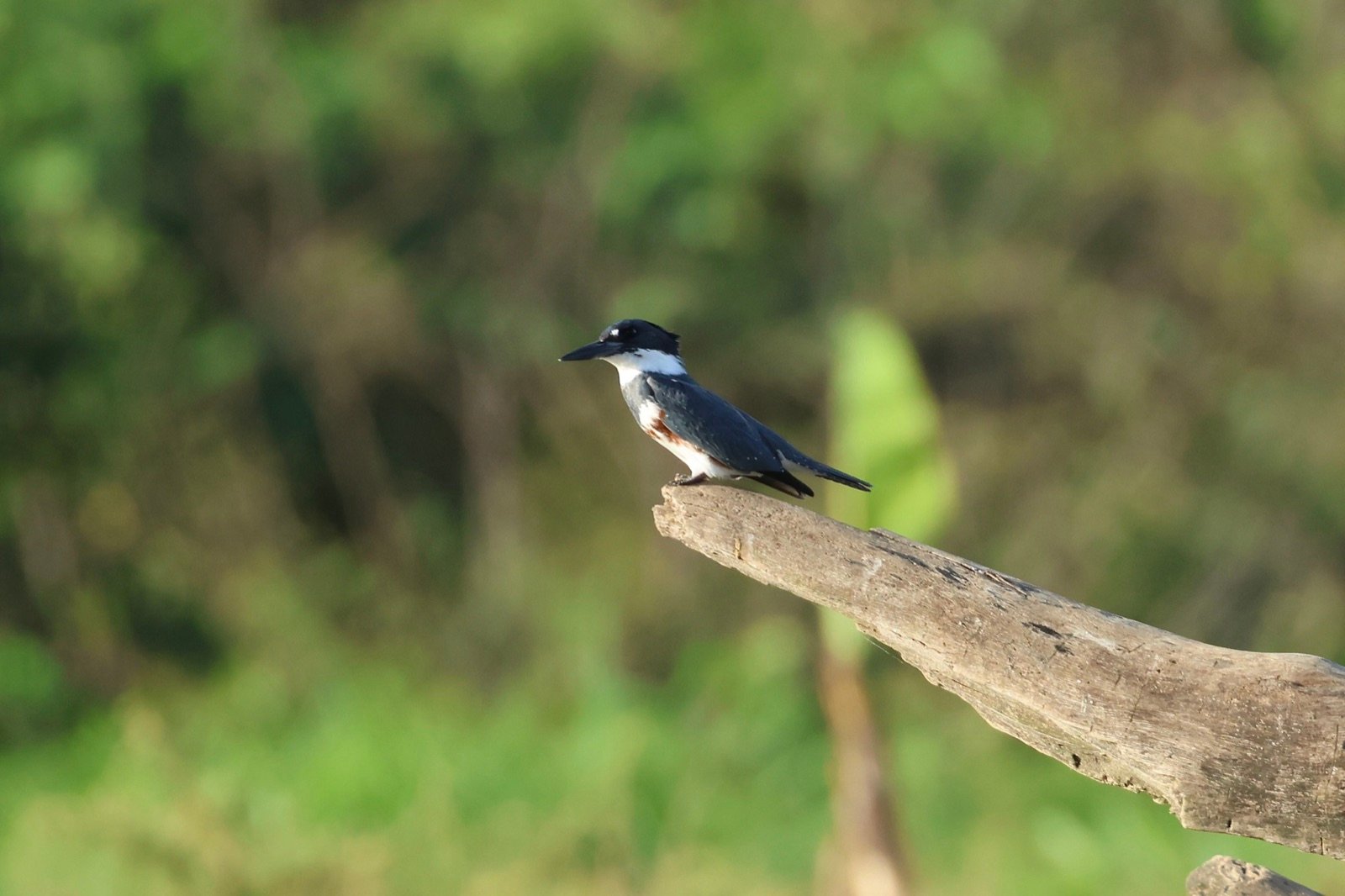
Both sexes have a slate-blue head, a white collar, a blue breast band and white underparts. The head carries a shaggy crest, and males are described as showing a ragged crest that gives the head a tousled look. The bill is black with a grey base.
The female is more brightly coloured than the male. She has a rufous band across the upper belly that extends down the flanks.
In flight, a white spot at the base of the outer primaries is striking. The bird measures about 30 cm and weighs about 150 g. The chest is mostly white, which helps separate it from the larger Ringed Kingfisher.
What it sounds like
Behaviour and diet
On arrival in autumn, each bird sets up its own territory, with lots of chasing and chattering. The larger Ringed Kingfisher sometimes pushes it out.
It hunts by diving for fish from a high perch or after hovering over the water. Birds patrol up and down rivers and shorelines with a top-heavy shape and quick flight.
Where it lives
The Belted Kingfisher uses coasts, river banks, lakes and estuaries. Belted and Ringed Kingfishers are both fairly common in lowland areas around rivers, lakes, streams and coasts across the country.
It is most often reported on the Atlantic (Caribbean) coast, and it is locally common in winter around Río Frío and along coastal areas. It has also been recorded on Isla del Coco.
When to see it
It is a winter visitor. Birds arrive in mid-September and leave in late April, sometimes early May.
Similar birds
The Ringed Kingfisher is much bigger (about 16 inches against 13) and has a rufous chest, while the Belted has a mostly white chest. Light and distance make size hard to judge, but both are big and blue-grey, while the smaller Chloroceryle kingfishers are green. The Amazon Kingfisher is only slightly smaller (11 inches against 13) and very common, so in some light check for the Belted's blue-grey instead of green.
Names and lore in Costa Rica
Costa Rican sources call it martín pescador norteño, or simply martín pescador, which is the general name for kingfishers in the country.
Status and conservation
The AOCR list marks it as a migrant (M), and it is a fairly common winter visitor and the only migrant among Costa Rica's six kingfishers.
Photography tips
A photographer found that boat tours on the Río Frío and the Tárcoles River let her get close to birds that are hard to approach on land. She found Costa Rican kingfishers far less skittish than Belted Kingfishers at home. Perches that overhang rivers and canals are the places to wait.
How we know this 15 sources, each read on the date shown
- Aves de Costa Rica read 2026-11-04
https://www.avesdecostarica.com/Megaceryle-alcyon.html - Field Guides trip list, Costa Rica 2024 read 2026-11-04
https://fieldguides.com/triplists/cos24.html - Birds for Beer read 2026-11-04
https://birdsforbeer.com/2021/05/20/belted-kingfisher-our-only-migrant-kingfisher/ - Howler Magazine read 2026-11-04
https://howlermag.com/kingfisher-bird-in-costa-rica/ - Ecos del Bosque read 2026-11-04
https://ecosdelbosque.com/fauna/megaceryle-alcyon - Costa Rica Guide read 2026-11-04
https://costa-rica-guide.com/photos/wildlife-reserves/cano-negro-photos/attachment/belted-kingfisher-2/ - Birds Colombia (Wikipedia text) read 2026-11-04
https://birdscolombia.com/2022/03/15/martin-pescador-norteno-belted-kingfisher-megaceryle-alcyon/ - Birds Outside My Window read 2026-11-04
https://www.birdsoutsidemywindow.org/2026/02/18/kingfisher-sweep-in-costa-rica/ - Cornell All About Birds read 2026-11-04
https://www.allaboutbirds.org/guide/Belted_Kingfisher/overview - Audubon Field Guide read 2026-11-04
https://www.audubon.org/field-guide/bird/belted-kingfisher - Birda read 2026-11-04
https://app.birda.org/species-guide/10671/Ringed_Kingfisher - Field Guides read 2026-11-04
https://fieldguides.com/triplists/cos19.html - Exotic Birding read 2026-11-04
https://www.exoticbirding.com/costarica/paloverde/checklist.html - Naturalist Journeys read 2026-11-04
https://www.naturalistjourneys.com/pdf/trip-reports/299-201801-central_america-costa_rica-species_list.pdf - Linda Murdock Photography read 2026-11-04
http://gustaviatex.com/blog/2019/10/23/costa-rica-finding-the-river-birds