Family Thamnophilidae
Bicolored Antbird
Gymnopithys bicolor
In Spanish: Hormiguero Bicolor
- Resident
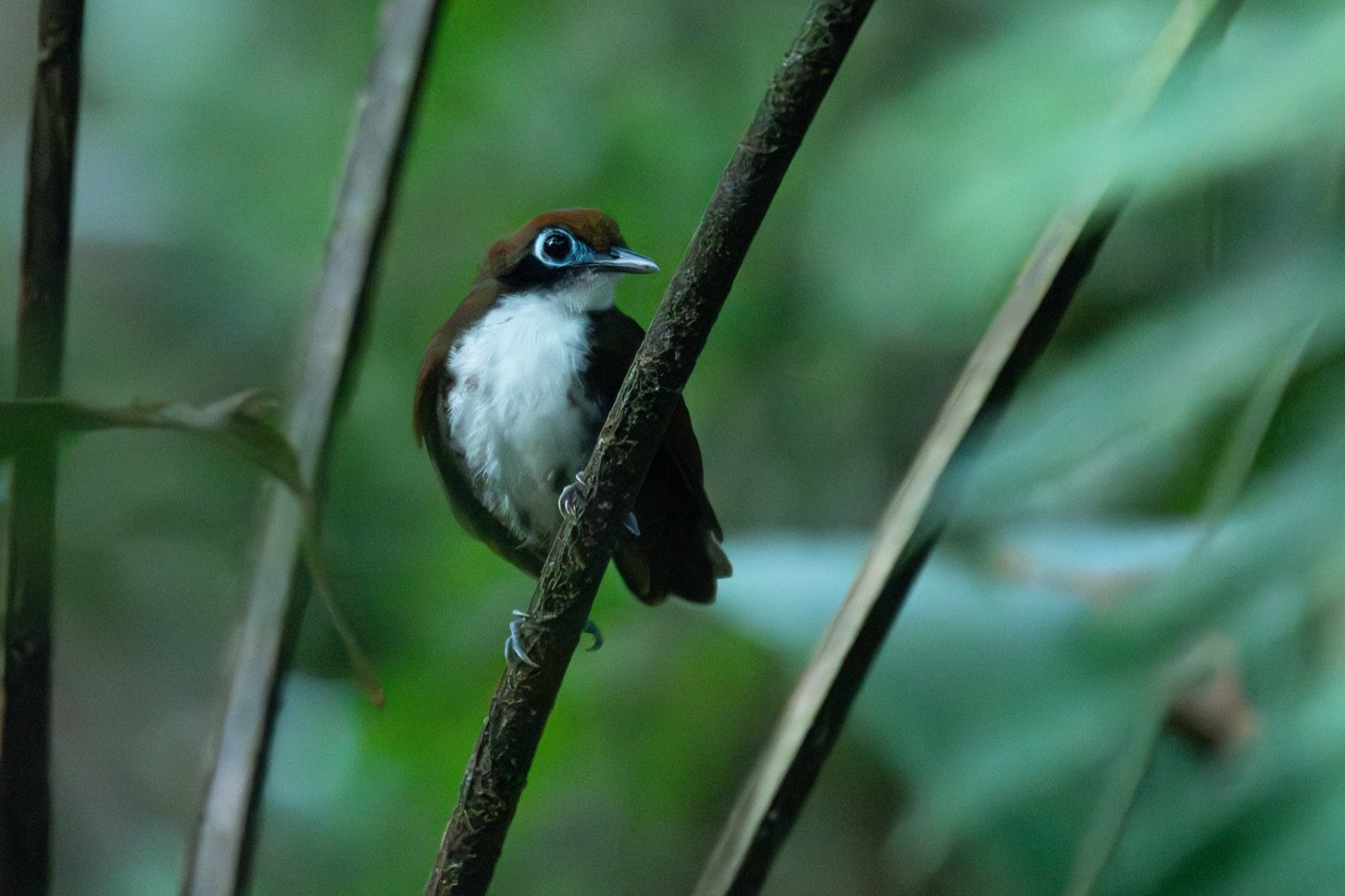
A small ant-follower of lowland forest, snowy white below, rufous above.
The Bicolored Antbird (Hormiguero Bicolor) makes its living by following army ants. It does not eat the ants. It snatches the insects and small animals that flee the swarm, and it is one of the most common ant-followers in Costa Rica's lowland forests.
That habit changes how you look for it. Rather than searching for a bird, you search for a swarm, and the antbirds are usually there.
On a trip we build, guests meet it in lowland rainforest around Sarapiquí, on guided walks that follow army ant swarms.
How to find it
Look low in mature forest for pairs or small groups following an army ant swarm, and listen for the scolding call. If you find army ants in the forest, you will probably see this antbird, because it follows them persistently. Other ant-following birds in the Caribbean lowlands use the calls of Bicolored and Ocellated antbirds to locate swarms, and you can do the same. If you hear antbird calls from the trail but see nothing, stepping about 12 feet into the forest toward the shaking vegetation gave birders good views of Bicolored, Spotted and Ocellated antbirds.
How to recognise it
This is a small antbird, about 14 to 15 cm long. The marks are easy to list:
Snowy white underparts.
Rufous-brown upperparts.
A dark mask on the cheek.
Bare blue-gray skin around the eye, which shows as a pale blue eyering.
Males and females look alike, so there is no sex difference to learn. It can be hard to see well, so the eyering and the contrast between white below and rufous above are the things to look for when it clings to a low stem in the shade.
What it sounds like
Recording: Eric Schmidt, CC BY 4.0, source, read 4 Nov 2026.
Behaviour and diet
It is an obligate ant-follower, so it depends on army ant swarms. It takes the insects, other arthropods, and small frogs and lizards that flee the advancing ants, and it does not eat the ants themselves. It keeps to the forest understory. At swarms it clings to low vertical stems, which sets it apart from the Black-faced Antthrushes that run back and forth in front of the swarm. In Costa Rica it breeds mostly from April to September. The species is monogamous, and the nest is a cup of dead leaves, often set in the top of a stump.
Where it lives
In Costa Rica it lives mainly in lowland and foothill evergreen forest and nearby mature second growth, staying almost entirely in the undergrowth. It reaches about 1,600 m elevation. The Costa Rican subspecies, olivascens, occurs on both the Caribbean and Pacific slopes. It is reported from Braulio Carrillo, Corcovado and La Amistad national parks and La Selva Biological Reserve, and it also occurs in private reserves built around ecotourism lodges.
When to see it
In Costa Rica it breeds mostly from April to September.
Similar birds
It looks much like the White-cheeked Antbird, but its crown and upperparts are browner and less ruddy, and the patch behind the eye is dull brown in the Costa Rican form. At a swarm, the smaller Spotted Antbird has a bold white-spotted breast and reddish back. It hops around the edge of the swarm and chips constantly.
Names and lore in Costa Rica
The Spanish name used in Costa Rica is Hormiguero Bicolor. Other Spanish names listed for the White-cheeked and Bicolored group include Hormiguero del Monte and Hormiguero cachetiblanco.
Status and conservation
It is a resident species on the AOCR list (R), and BirdLife International rates it Least Concern.
Photography tips
Swarms move, so patience helps. When calls reach you from the trail, step quietly toward the shaking vegetation, as birders did about 12 feet into the forest to get good views. Look at low vertical stems, where the antbirds perch and cling beside the swarm.
How we know this 13 sources, each read on the date shown
- Wikipedia read 2026-11-04
https://en.wikipedia.org/wiki/Bicolored_antbird - Flickr (Macaulay Library species text) read 2026-11-04
https://www.flickr.com/photos/crunchie-carruthers/53747578296 - Bird-Lens read 2026-11-04
https://www.bird-lens.com/2025/01/25/the-thrill-of-being-in-an-army-ant-swarm-antbirds-in-costa-ricas-lowland-forests/ - Birds of the World read 2026-11-04
https://hbw.com/species/bicolored-antbird-gymnopithys-bicolor - EcoRegistros read 2026-11-04
https://www.ecoregistros.org/ficha/Gymnopithys-bicolor - Father Son Birding read 2026-11-04
https://fathersonbirding.com/category/antbirds/ - Birds of the World (Cornell) read 2026-11-04
https://birdsoftheworld.org/bow/species/bicant2/1.0/introduction - ResearchGate (Caribbean slope study) read 2026-11-04
https://www.researchgate.net/publication/267964373_Localization_of_army-ant_swarms_by_ant-following_birds_on_the_Caribbean_slope_of_Costa_Rica_Following_the_vocalization_of_antbirds_to_find_the_swarms - STRI Panama Biota read 2026-11-04
https://panamabiota.org/stri/taxa/index.php?taxauthid=1&taxon=3160&clid=8 - Avibase read 2026-11-04
https://avibase.bsc-eoc.org/species.jsp?avibaseid=59B2EED1440011B6 - Birding Craft read 2026-11-04
https://birdingcraft.com/wordpress/tag/bicolored-antbird/ - Birda read 2026-11-04
https://app.birda.org/species-guide/15976/Bicolored_Antbird - Birding Craft read 2026-11-04
https://birdingcraft.com/wordpress/tag/bicolored-antpitta/