Family Thamnophilidae
Spotted Antbird
Hylophylax naevioides
In Spanish: Hormiguero Moteado
- Resident
A small, busy antbird that hops at the edge of army ant swarms
The Spotted Antbird (Hormiguero Moteado) is a small forest bird that makes its living around army ants. In Costa Rica it lives on the Caribbean slope, and it also reaches a small part of the Pacific slope in the northwest.
Its habits tell you where to look. It eats the prey that flees the ants, so finding a swarm in lowland rainforest is the surest way to find the bird.
The Sarapiquí area is a place to look for it, and its song is among the sounds to listen for on forest walks there.
How to find it
Look for army ant swarms in lowland rainforest. The antbirds gather around the swarm's edge and perch low, so scan the periphery rather than the middle. Standing at a swarm in the Sarapiquí lowlands gives a reliable chance of seeing antbirds. Listen for the constant chipping and the whistle-and-ti song, which can lead you to the birds. Forest trails in the Sarapiquí area are where its song is listed among the sounds to listen for.
How to recognise it
This is a small bird, about 11 cm long. Think compact and low to the ground.
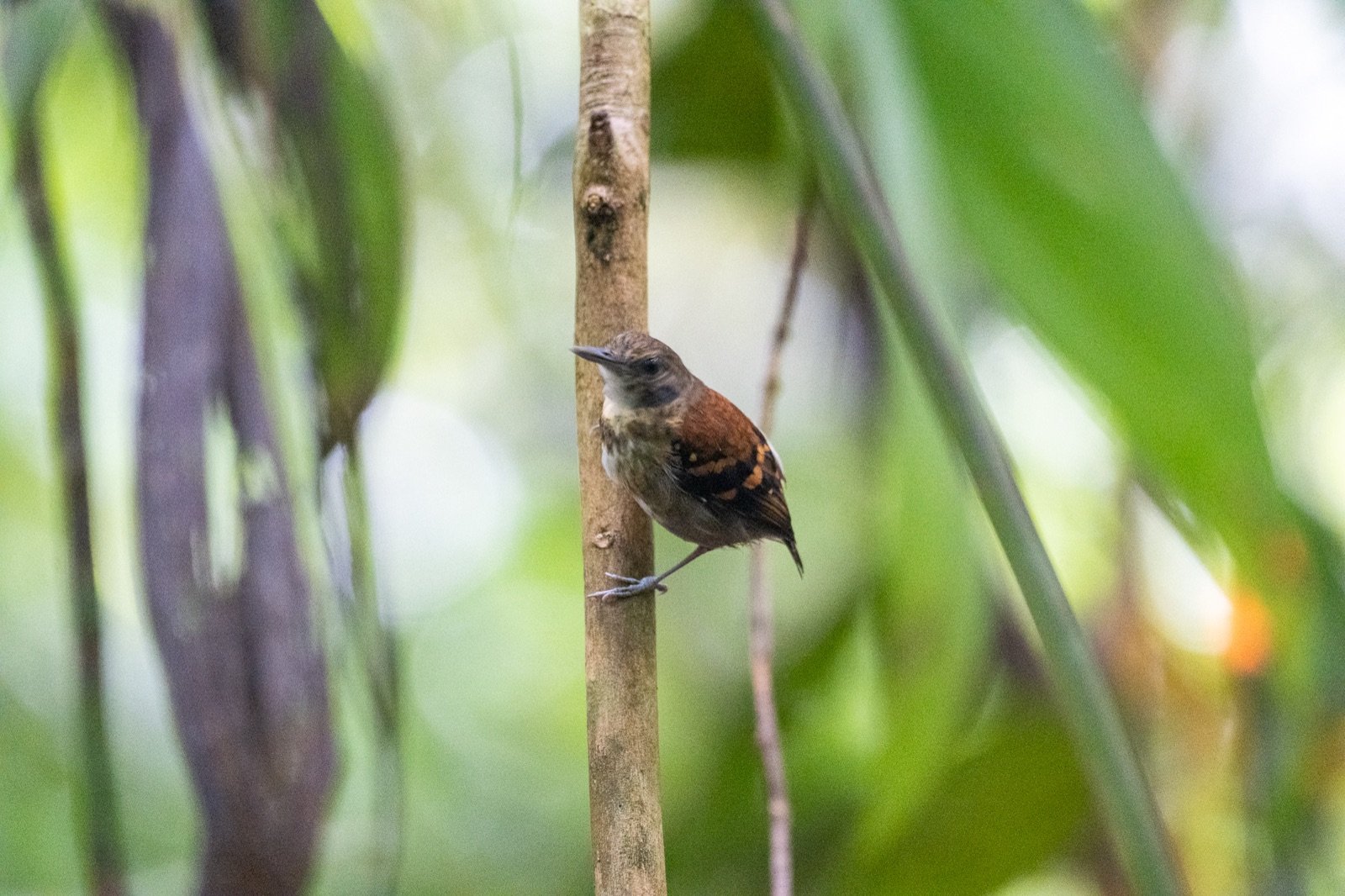
The male has a black throat and a white breast and belly, with large black spots across the chest. The key marks to look for:
- a white-spotted breast
- a warm reddish-brown back
- black markings on the face
Size helps when several antbirds share one swarm. At army ant swarms in Sarapiquí it appears alongside the larger Bicolored Antbird, which is black and white with pale bluish bare skin around the eye. The Spotted Antbird is much smaller, with that spotted breast and reddish back.
What it sounds like
Recording: Eric Schmidt, CC BY 4.0, source, read 4 Nov 2026.
Behaviour and diet
The Spotted Antbird is an ant-follower that eats prey fleeing the army ants. One account calls it obligate, depending on the swarms, while another calls it a facultative follower that takes about half its prey this way. It often joins the mixed flocks that follow swarms.
At a swarm it is active, hopping around the edge and chipping constantly. This contrasts with the quieter Ocellated Antbird. Because it is small, it ranks low in the pecking order at a swarm. Away from the action it is seen in pairs, family groups or alone, foraging low in the vegetation.
Where it lives
It is fairly common in the understory of humid forest and nearby secondary forest, below about 900 m elevation. In Costa Rica it lives on the Caribbean slope, and it reaches a small part of the Pacific slope in the northwest.
It has been photographed near Sarapiquí in Heredia, in Arenal Volcano National Park in Alajuela, and at Sky Adventures Park. It has also been seen at army ant swarms in the Sarapiquí area of the Caribbean lowlands.
When to see it
Breeding is tied to the early wet season, for example April to July in Costa Rica.
Similar birds
At swarms, compare size and pattern. The Bicolored Antbird is larger, black and white, with pale bluish bare skin around the eye. The Ocellated Antbird is often in the same swarm and dominates the other attendees. The related Spot-backed Antbird lives in Amazonia, not Costa Rica, and has a similar song with a different cadence.
Names and lore in Costa Rica
In Costa Rica and Honduras the bird is called Hormiguero Moteado. In Panama and Colombia it is called Hormiguero Collarejo, and in Nicaragua Hormiguerito Moteado.
Status and conservation
The AOCR list marks it as a resident (R), and BirdLife International rates it Least Concern.
Photography tips
Standing at an army ant swarm in the Sarapiquí lowlands gives a reliable chance to photograph antbirds. Spotted Antbirds hop along the swarm edge, so watch the periphery.
How we know this 16 sources, each read on the date shown
- Wikipedia read 2026-11-04
https://en.wikipedia.org/wiki/Spotted_antbird - EcoRegistros read 2026-11-04
https://www.ecoregistros.org/sheet/Hylophylax-naevioides - Bird-Lens read 2026-11-04
https://www.bird-lens.com/2025/12/16/spotted-antbirds-following-the-army-ants-in-costa-ricas-lowland-forests/ - Birds in Focus read 2026-11-04
https://www.birdsinfocus.com/show.php?absID=16239&text=Spotted+Antbird&location=Sky+Adventures+Park&nsort=location&nsortindex=2 - Wikipedia (Spanish) read 2026-11-04
https://es.wikipedia.org/wiki/Hylophylax_naevioides - Bird-Lens read 2026-11-04
https://www.bird-lens.com/2025/01/25/the-thrill-of-being-in-an-army-ant-swarm-antbirds-in-costa-ricas-lowland-forests/ - Birds Colombia read 2026-11-04
https://birdscolombia.com/2020/05/26/hormiguero-collarejo-spotted-antbird-hylophylax-naevioides/ - Namaterra read 2026-11-04
https://namaterra.com/observacion-de-aves/viaje-de-observacion-de-aves-estacion-biologica-la-selva/ - PLOS ONE via PMC read 2026-11-04
https://pmc.ncbi.nlm.nih.gov/articles/PMC4005748/ - Cornell Birds of the World read 2026-11-04
https://birdsoftheworld.org/bow/species/spoant1/cur/introduction - Costa Rica Focus read 2026-11-04
https://www.costaricafocus.com/birding-braulio-carrillo-national-park-a-complete-guide/ - Exotic Birding read 2026-11-04
http://www.exoticbirding.com/costarica/braulio-carrillo/checklist.html - Costa Rica 2017 trip report read 2026-11-04
https://jgonzalezvaldivieso.wordpress.com/costa-rica/ - Planet Birds read 2026-11-04
http://planetbirds.blogspot.com/2012/05/spotted-antbird.html - Canopy Tower read 2026-11-04
https://canopytower.com/ocellated-antbird/ - Featherscan read 2026-11-04
https://www.featherscan.com/birds/spotted-antbird