Family Thamnophilidae
Ocellated Antbird
Phaenostictus mcleannani
In Spanish: Hormiguero Ocelado
- Resident
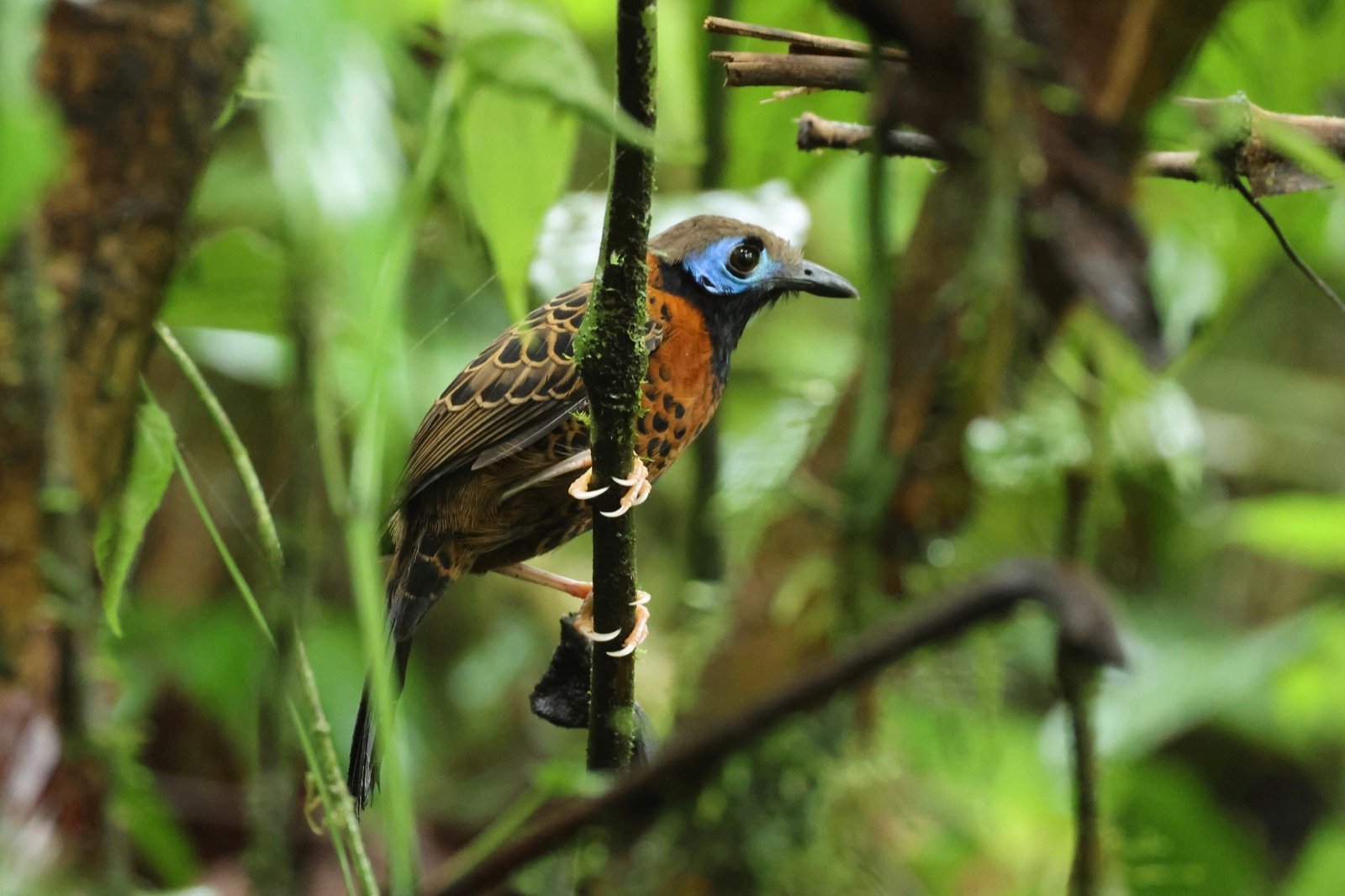
Electric blue face, found at army ant swarms in Caribbean slope rainforest
The Ocellated Antbird (Hormiguero Ocelado) is a large antbird, about 19 cm long, with a big bare blue patch of skin around the eye. One Costa Rican birder calls it a whole big blue face, not just an eyering.
It is an obligate army ant follower, so finding the bird means finding a swarm. In Costa Rica it lives on the Caribbean slope, and in the north it also reaches the Pacific slope.
On a trip we build, guides listen for antbird calls on the trail, then step quietly off it toward the shaking vegetation. That is how visitors meet this bird in good rainforest.
How to find it
Listen for antbird calls to locate an army ant swarm, then look for the bird. Swarm birds such as this one are hard to see otherwise, because they stay in dark understory. Guides often listen for Bicolored Antbird calls on the trail, then step quietly off it toward the shaking vegetation. One birding report says it is not hard to see in good rainforest if you find a swarm. Expect to glimpse it as moving vegetation or partly hidden. Because ant colonies move constantly, several pairs feed at the same swarm, while each pair's territory stays fixed.
How to recognise it
This is a large antbird, about 19 cm long, and larger than other antbirds in its range. Look for these marks:
Bright electric blue facial skin, a big bare patch around the eye.
A black throat.
A scaly-looking olive and gold body with a pale scalloped pattern.
Together they mean it is unlikely to be mistaken for any other species. In the forest you will often see only part of it, because it tends to show as moving vegetation or a partly hidden shape in the dark understory. At swarms it often pumps its tail up and down, clings to upright stems close to the ground and hops from perch to perch, watching for fleeing prey.
What it sounds like
Recording: Niels Krabbe, CC BY-SA 4.0, source, read 5 Nov 2026.
Behaviour and diet
It eats insects and other small prey flushed by the ants, not the ants themselves, and rarely feeds away from swarms. It usually forages in pairs or family groups, perched within about a metre of the ground, often near the front of the swarm, and sallies out after prey.
At La Selva it often reached swarms before other ant-following birds. Birds travel in groups between ant colonies, and uninformed birds follow informed ones. Mates use the song to keep in contact, and males use it in contests with other males. One Costa Rican birder says some birds do cool acrobatics at the swarm.
Where it lives
In Costa Rica it lives on the Caribbean slope, and in the north it also reaches the Pacific slope. It reaches about 1,200 m elevation. It prefers old-growth lowland and foothill forest but also uses mature secondary forest, staying almost entirely in the undergrowth. The Zeledonia list gives its regions as the Caribbean lowlands and the northern Pacific-side zone.
Similar birds
At swarms it is almost always seen with Bicolored and Spotted Antbirds, and Zeledon's Antbird joins them in Costa Rica. It dominates the other birds there. Ocellated is the one with bright electric blue facial skin and a scaly-looking olive and gold body.
Names and lore in Costa Rica
The Costa Rican Spanish name is Hormiguero Ocelado. Army ants are called hormigas arrieras, also guerreras or marabuntas, in Costa Rican Spanish.
Status and conservation
The AOCR list marks it as a resident (R), and BirdLife International rates the species Least Concern.
Photography tips
One birder got a photo near Virgen del Socorro. He says you usually see it hidden, but if you wait long enough it comes into view. Once you find a swarm, stay patient and let the bird come to you.
How we know this 18 sources, each read on the date shown
- Zeledonia (Chaves-Campos 2012) read 2026-11-04
https://dialnet.unirioja.es/descarga/articulo/7505372.pdf - Birding Craft read 2026-11-04
https://birdingcraft.com/wordpress/2014/06/06/birding-in-costa-rica-you-have-a-good-chance-at-seeing-ocellated-antbird/ - 10,000 Birds read 2026-11-04
https://www.10000birds.com/for-the-love-of-ants.htm - Birds Colombia (Spanish Wikipedia text) read 2026-11-04
https://birdscolombia.com/2018/05/24/hormiguero-ocelado-ocellated-antbird-phaenostictus-mcleannani/ - Wikipedia read 2026-11-04
https://en.wikipedia.org/wiki/Ocellated_Antbird - Canopy Tower read 2026-11-04
https://canopytower.com/ocellated-antbird/ - Birdlens (Wikipedia text) read 2026-11-04
https://birdlens.secondwindltd.xyz/en/birds/8c49e91cc7 - Ant colony tracking study (ResearchGate) read 2026-11-04
https://www.researchgate.net/publication/225239981_Ant_colony_tracking_in_the_obligate_army_ant-following_antbird_Phaenostictus_mcleannani - Eagle-Eye Tours read 2026-11-04
https://www.eagle-eye.com/blog/best-ways-to-find-birds-in-the-tropics/ - EcoRegistros read 2026-11-04
https://www.ecoregistros.org/ficha/Phaenostictus-mcleannani - PLoS ONE (PMC) read 2026-11-04
https://www.ncbi.nlm.nih.gov/pmc/articles/PMC2779863/ - Birding Craft read 2026-11-04
https://birdingcraft.com/wordpress/tag/bicolored-antpitta/ - Birds of the World (public summary) read 2026-11-04
https://birdsoftheworld.org/bow/species/oceant1/cur/introduction - Where to Watch Birds and Other Wildlife in the World read 2026-11-04
https://www.wheretowatchbirdsandotherwildlifeintheworld.co.uk/costarica.html - Costa Rica Focus read 2026-11-04
https://www.costaricafocus.com/birding-san-jose-province-costa-rica-a-complete-guide/ - Birds & Wildlife tours read 2026-11-04
https://birdswildlife.com/costarica-theultimatetour-feb22nd-11thmarch2025/ - Exotic Birding checklist read 2026-11-04
http://www.exoticbirding.com/costarica/checklist.html - Tom Horn Art read 2026-11-04
http://www.tomhornart.com/tomsite/ocellatedantbird.html