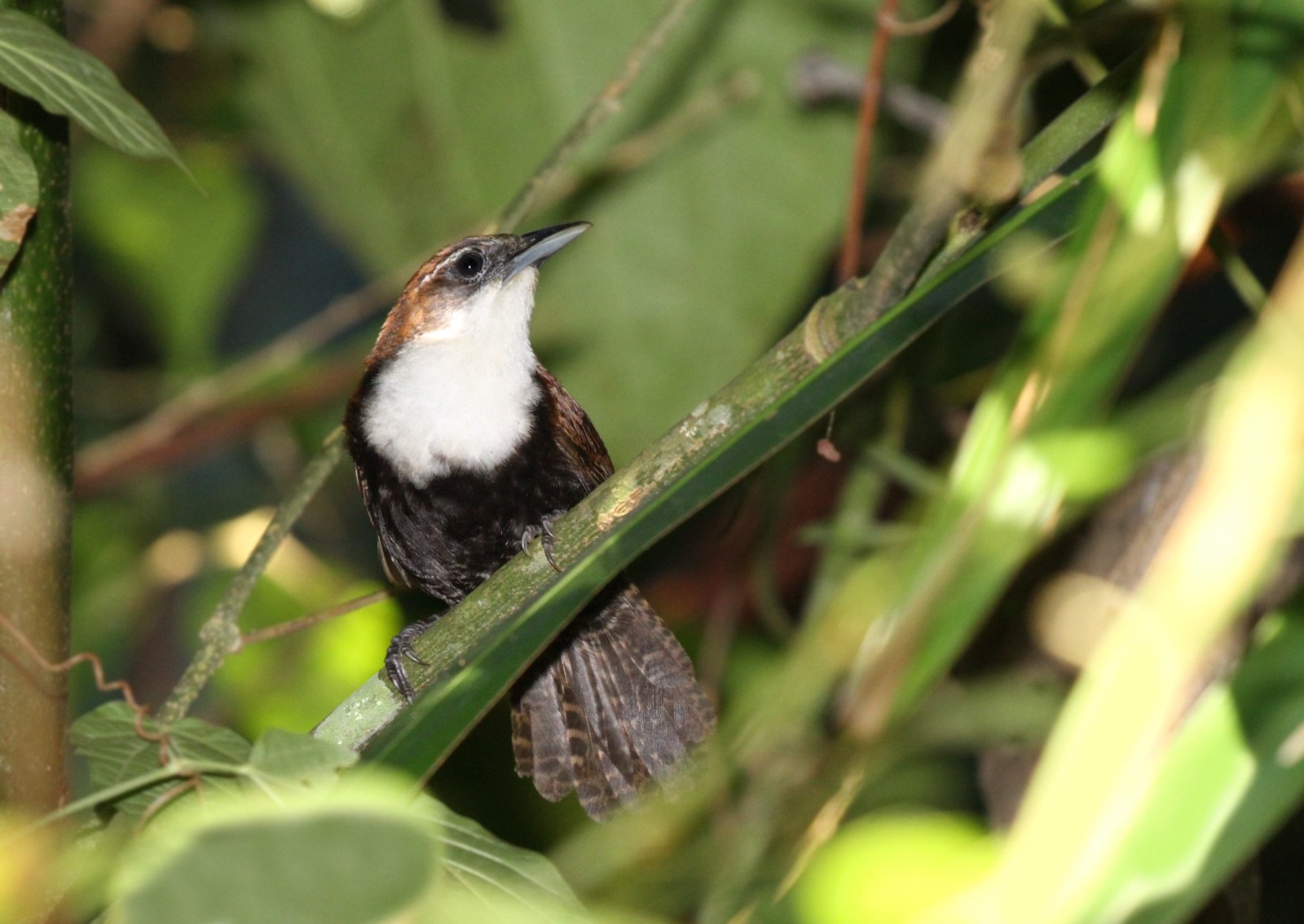
 Black-bellied Wren
Family Troglodytidae
Black-bellied Wren
Pheugopedius fasciatoventris
In Spanish: Soterré Vientrinegro
- Resident
- Regional endemic
A chestnut wren that duets from tangles in the southern Pacific lowlands
The Black-bellied Wren (Soterré Vientrinegro) is a bird you meet with your ears first. Both sexes call often, even though the bird is notoriously hard to see, and pairs sing rich, liquid duets from tangled vegetation.
The AOCR list treats it as a resident and a regional endemic (R-END). In Costa Rica the form melanogaster lives on the Pacific side, from the Gulf of Nicoya southward, and it is locally common in the Golfo Dulce region and the lower Terraba valley.
On a trip we build in the south, it is a lesson in patience: learn the song, listen along forest edges and streams, and let the bird come into view.
How to find it
Listening for its duets near forest edges and streams is the best way to locate it. Learn its song before you go, since it hides in dense second growth. Solitary wrens like this need to be called in or tracked down by song. Playback is technically illegal in official protected areas, so there you need extra patience. Focus on heliconia and calathea thickets close to water, and on vine tangles at forest edges. Expect effort: one group saw it only after considerable work in vine tangles.
How to recognise it
Adults have a rich chestnut back and a white line over the eye. A white bib runs from the chin to the upper breast. Males are clearly larger than females.
The belly is where Costa Rica differs. The southern Costa Rican form, melanogaster, has an unmarked black belly. The other two subspecies, in Panama and Colombia, show white barring on the belly, so field guide pictures of barred birds may not match what you see here.
Young birds are duller than adults. They have a gray patch, not a white one, from chin to breast, and some yellow in the bill.
What it sounds like
Recording: rawcomposition, CC0 1.0, source, read 4 Nov 2026.
Behaviour and diet
It forages for small arthropods in tangled vines and in hanging clumps of dead leaves. It also forages in the canopy and subcanopy.
Pairs hold a territory of about one hectare all year, so a bird heard in one spot is likely to be there again. The nest is a domed structure built by both sexes, usually low in vine tangles at forest edges. In Costa Rica it is ball-shaped, with a side entrance under a small hood, woven loosely from heliconia leaf strips 1 to 2 m up in a heliconia stand.
Where it lives
It lives at lowland forest edges, in degraded forest and along stream sides. It favours heliconia and calathea thickets near streams and rarely ventures into the dense second growth beside them.
In Costa Rica it ranges from sea level to about 500 m, while across its whole range it reaches up to about 1000 m. The form melanogaster lives on the Pacific side, from the Gulf of Nicoya southward, and its range continues through western Panama to the Canal Zone.
When to see it
A Spanish-language natural history text says it probably breeds between May and July in Costa Rica. It does not give a best season for seeing it.
Similar birds
Riverside Wren is another skulking wren with a barred belly, and it turns up in the same southern Pacific areas. Both are tough to see, so check the belly and bib. Remember that the Black-bellied Wren of southern Costa Rica has an unmarked black belly.
Names and lore in Costa Rica
Costa Rican sources call it soterrey vientrinegro. In Panama it is sotorrey ventrinegro, and in Colombia cucarachero buchinegro. Another Spanish name is ratona de vientre negro.
Status and conservation
The AOCR official list treats it as a resident and a regional endemic (R-END), and the IUCN rates it Least Concern, locally common from Costa Rica through Panama to western and northern Colombia.
How we know this 20 sources, each read on the date shown
- Birds of the World (Cornell Lab) read 2026-11-04
https://birdsoftheworld.org/bow/species/blbwre1/cur/introduction - Birda species guide read 2026-11-04
https://app.birda.org/species-guide/28544/Black-bellied_Wren - Birds Colombia (quoting Birds of the World) read 2026-11-04
https://birdscolombia.com/2018/07/21/cucarachero-buchinegro-black-bellied-wren-pheugopedius-fasciatoventris/ - Wikipedia (Spanish) read 2026-11-04
https://es.wikipedia.org/wiki/Pheugopedius_fasciatoventris - Wikipedia read 2026-11-04
https://en.wikipedia.org/wiki/Black-bellied_wren - AOCR Lista Oficial de las Aves de Costa Rica read 2026-11-04
https://listaoficialavesdecostarica.wordpress.com/lista-oficial/lista-oficial-online/ - BirdForum Opus read 2026-11-04
https://www.birdforum.net/opus/Golfo_Dulce_Forest_Reserve - BirdWatching read 2026-11-04
https://bwm.birdwatchingdaily.com/locations-travel/featured-destinations/unknown-costa-rica/ - Birding Craft read 2026-11-04
https://birdingcraft.com/wordpress/2014/08/ - Birding Craft read 2026-11-04
https://birdingcraft.com/wordpress/2024/06/07/costa-rica-birding-a-whole-lot-of-wrens-going-on/ - Field Guides trip report 2019 read 2026-11-04
https://fieldguides.com/triplists/cr119.html - Field Guides trip report 2024 read 2026-11-04
https://fieldguides.com/triplists/cr124PRINT.html - Flickr post quoting Costa Rican natural history text read 2026-11-04
https://www.flickr.com/photos/jobando/39018210155 - Flickr photo caption (Spanish natural history text) read 2026-11-04
https://www.flickr.com/photos/jobando/39206343114 - Exotic Birding read 2026-11-04
http://www.exoticbirding.com/costarica-bird-tours/grand-birding-tour/description.html - Birding Craft (reader comment) read 2026-11-04
https://birdingcraft.com/wordpress/2014/08/14/big-cool-wrens-of-costa-rica/ - Costa Rica Focus read 2026-11-04
https://www.costaricafocus.com/hotspot/corcovado-national-park/ - Field Guides trip list 2018 read 2026-11-04
https://fieldguides.com/triplists/cr118.html - Field Guides trip list 2024 read 2026-11-04
https://fieldguides.com/triplists/cos24.html - Field Guides trip list 2023 read 2026-11-04
https://fieldguides.com/triplists/cr123.html