Family Troglodytidae
Rufous-breasted Wren
Pheugopedius rutilus
In Spanish: Soterré Carimoteado
- Resident
A chestnut-chested wren that sings nonstop from tangled vines.
The Rufous-breasted Wren (Soterré Carimoteado) is a small wren of vine tangles, hard to see and easy to hear. It keeps under dense foliage, yet it sings almost without pause while it forages.
On a trip we build, birders meet it at Carara National Park, where it skulks in tangled vines along riverside and viny forest edges. It has also been heard in Monteverde and on southern Costa Rica tours.
Listening is the way in: follow the whistled phrases, then look low.
How to find it
Start by listening, because it sings almost nonstop. Follow the whistled phrases coming from vine tangles near forest edges, then look low. Riparian zones and the viny forest edge are good places to try, and one Carara guide says it never stops trying to be heard. Tour leaders watch for pairs joining mixed flocks at Carara, though another group found the wrens tended to stay higher up in the trees there. Be patient: one tour group at Carara's Sendero Meandrico had to work hard for a look, but most people eventually connected with one or more of them.
How to recognise it
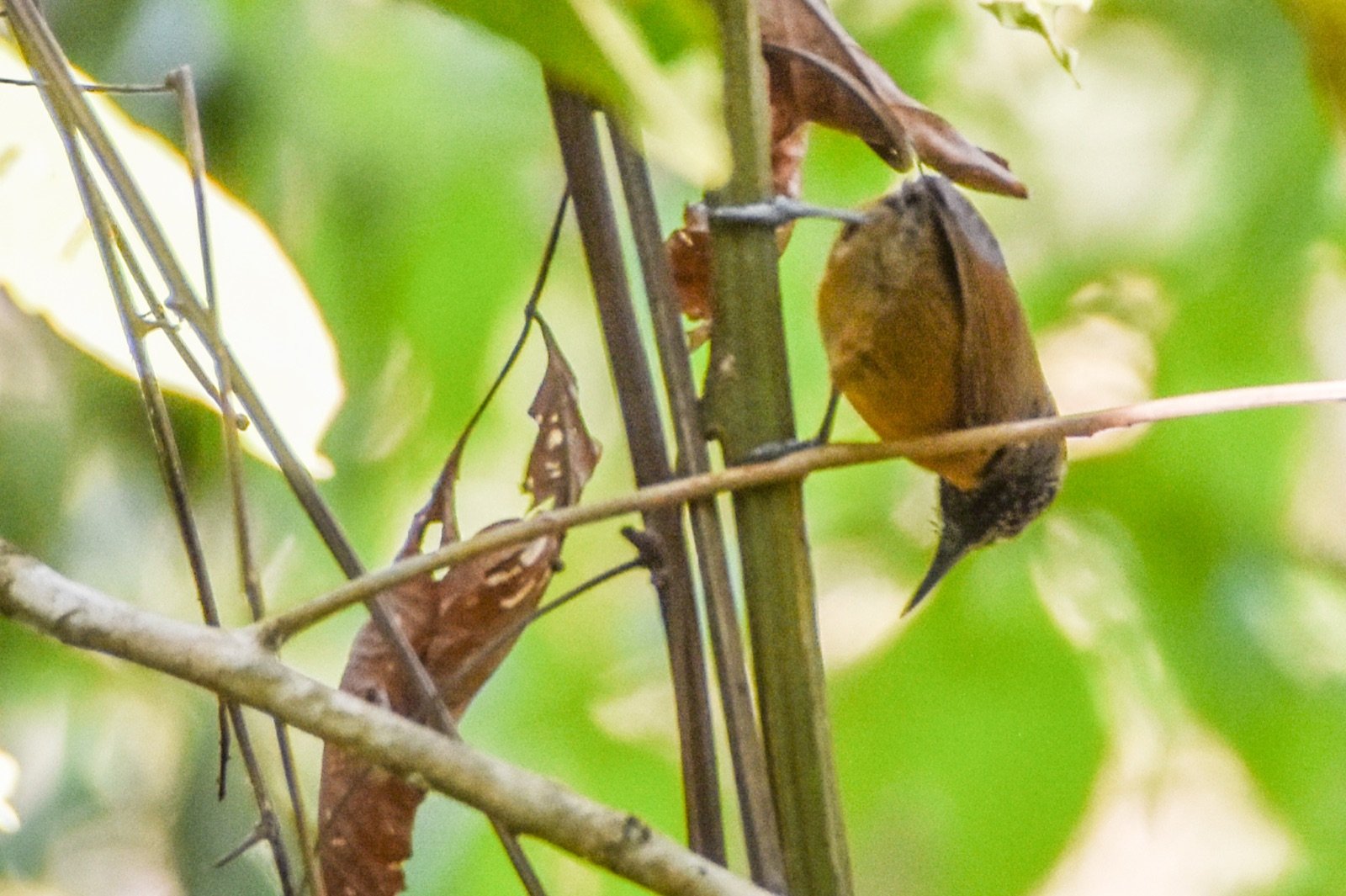
This is a small wren, about 14 cm long, and the bright chestnut chest is the first thing to look for.
The face and throat are speckled black and white.
A white eyebrow stripe, edged in black above, runs over the eye.
The back is warm brown.
The tail is grayish brown with strong dark bars.
The belly is paler, brownish white, and the flanks are brown.
The bill is short and thin.
Juveniles are duller than adults and their facial markings are less distinct, so they can be harder to separate from other wrens.
What it sounds like
Recording: Eric Schmidt, CC BY 4.0, source, read 4 Nov 2026.
Behaviour and diet
Rufous-breasted Wrens are usually seen in pairs or family groups. They forage low, on the ground and in lower branches with tangled vines, and rarely go high in trees. They eat mostly small invertebrates such as spiders, beetles, bugs and flies, with some small seeds and, occasionally, a small lizard or frog. At Carara, pairs have been seen foraging with mixed flocks on a couple of occasions, giving excellent looks.
Where it lives
Across its range this wren lives in vine tangles and dense bamboo, along forest edges and field borders, and in gardens in humid areas. It breeds in forest undergrowth and thickets, and also uses broken-up forest and secondary growth. In Costa Rica it is mostly found in foothills and middle elevations, but it reaches sea level around Carara. The local subspecies, hyperythrus, lives on the Pacific slope. It has also been recorded in rural, cultivated areas at Tacares, Grecia, in Alajuela, which shows it uses farmland in the Central Valley foothills.
When to see it
One source says it breeds in Costa Rica from April to July.
Similar birds
In viny forest edge and riparian zones it shares habitat with the Rufous-and-white Wren, whose quick, hollow whistled song can be confused with it by ear. Use the face speckling and rufous chest to tell them apart by sight. The same face pattern and rufous breast separate it from the similar-sized House Wren. Its close relatives are the Spot-breasted and Speckle-breasted Wrens, and the three form a superspecies.
Names and lore in Costa Rica
Costa Rica's Spanish name is soterrey carimoteado, which the AOCR writes as Soterré Carimoteado. Other countries use other names, such as cucarachero pechirrufo in Colombia and sotorrey pechirrufo in Panama. Costa Ricans may call wrens in general cucaracheros, meaning cockroachers, but that is a general term and not specific to this species.
Status and conservation
The official Costa Rican list (AOCR) marks it as a resident species, and it is classed as Least Concern across its range.
Photography tips
Its habit of joining mixed flocks at Carara has given some groups excellent looks, so watch for pairs moving with other birds. Listen for the song first, then scan low in the vine tangles where it forages.
How we know this 20 sources, each read on the date shown
- Wikipedia read 2026-11-04
https://en.wikipedia.org/wiki/Rufous-breasted_wren - Alchetron (Wikipedia-based) read 2026-11-04
https://alchetron.com/Rufous-breasted-wren - UWI St. Augustine Life Sciences fact sheet read 2026-11-04
https://sta.uwi.edu/fst/lifesciences/sites/default/files/lifesciences/documents/ogatt/Pheugopedius_rutilus%20-%20Rufous-breasted%20Wren.pdf - Asturian Wikipedia read 2026-11-04
https://ast.wikipedia.org/wiki/Pheugopedius_rutilus - Cloudbridge Nature Reserve bird list read 2026-11-04
https://www.cloudbridge.org/wp-content/uploads/2020/04/Bird-Species-List-Costa-Rica-13-April-2020.pdf - UNED Biosonidos read 2026-11-04
https://biosonidos.uned.ac.cr/node/2634 - Birda species guide read 2026-11-04
https://app.birda.org/species-guide/28594/Rufous-breasted_Wren - AOCR Lista Oficial Online read 2026-11-04
https://listaoficialavesdecostarica.wordpress.com/lista-oficial/lista-oficial-online/ - Birding Craft read 2026-11-04
https://birdingcraft.com/wordpress/2014/08/ - Field Guides trip list 2023 read 2026-11-04
https://fieldguides.com/triplists/cos23b.html - Field Guides trip list 2024 read 2026-11-04
https://fieldguides.com/triplists/cos24.html - Field Guides trip list 2019 read 2026-11-04
https://fieldguides.com/triplists/cr119.html - EcoRegistros read 2026-11-04
https://www.ecoregistros.org/site/lugar.php?id=8674 - Field Guides trip list 2018 read 2026-11-04
https://fieldguides.com/triplists/cos18.html - Birding Craft read 2026-11-04
https://birdingcraft.com/wordpress/2024/06/07/costa-rica-birding-a-whole-lot-of-wrens-going-on/ - Birds Colombia (Wikipedia text) read 2026-11-04
https://birdscolombia.com/2018/09/06/cucarachero-pechirrufo-rufous-breasted-wren-pheugopedius-rutilus/ - Wikipedia (es) read 2026-11-04
https://es.wikipedia.org/wiki/Pheugopedius_rutilus - Macaulay Library read 2026-11-04
https://macaulaylibrary.org/asset/224277701 - Flickr read 2026-11-04
https://www.flickr.com/photos/antpitta/36323824362 - Animalia.bio read 2026-11-04
https://animalia.bio/rufous-breasted-wren