Family Cardinalidae
Black-faced Grosbeak
Caryothraustes poliogaster
In Spanish: Picogrueso Carinegro (Sarapiqueña)
- Resident
A loud, chunky flock leader of the Caribbean lowland forest.
The Black-faced Grosbeak is a small, stocky bird that tends to announce itself before you see it. In Costa Rica it is common in the Caribbean lowlands and foothills, from sea level up to about 900 meters, and it often feeds in flocks of up to 20 birds.
For a beginning birder it is a rewarding species to learn. Hear it first, raise your binoculars and check what is following it, because you may be looking at a mixed flock.
Birders meet it around the lawns and trails at La Selva, near Sarapiqui, and in the forests of the Caribbean slope.
How to find it
Listen for the calls of Black-faced Grosbeaks and Carmiol's Tanagers, which together usually point to a mixed flock moving through the forest. Follow the sound along the trail. When you hear the grosbeaks, raise your binoculars and check whether other species are following. A birder advises staying with the flock and not leaving the trail. On a March 2024 tour it was called surprisingly common around the lawns at La Selva, though the same trip list notes that in some years it can be quite hard to find.
How to recognise it
This is a small, stocky seed-eating bird, about 16 cm long and about 30 g. Adults have a black bill and a gray belly and rump, while the back, wings and tail are olive.
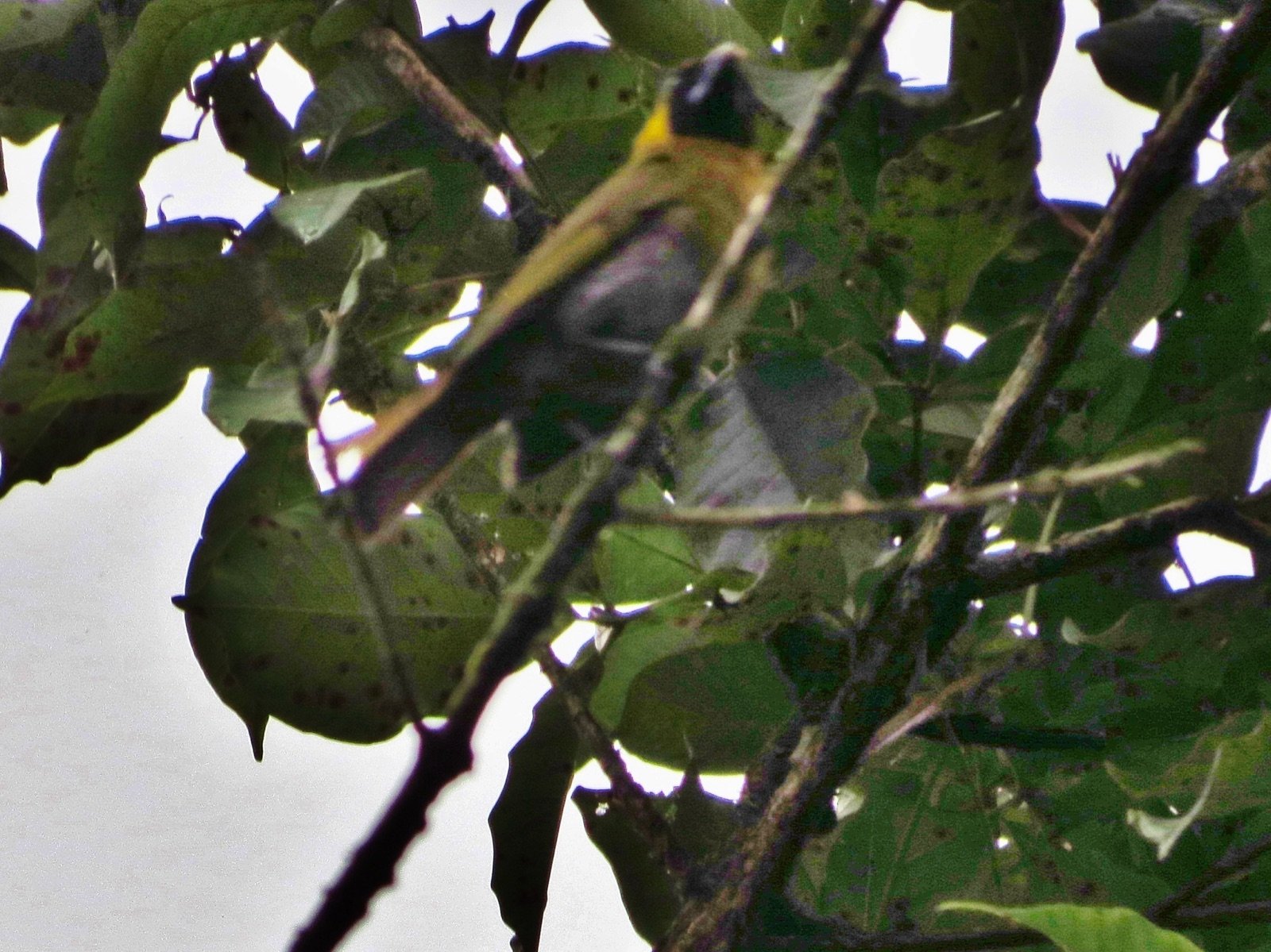
In Costa Rica the black face, yellow head and breast, and gray belly make it distinctive.
Costa Rican birds belong to the subspecies scapularis. It is smaller than the northern nominate form, and its scapulars and lower back are olive-green like the upper back, where the nominate form has slate gray.
What it sounds like
Recording: River Ahlquist, CC BY 4.0, source, read 4 Nov 2026.
Behaviour and diet
This is a chunky, social bird. It forages in small, often noisy groups, usually moving through the upper and middle levels of the forest and through fruiting trees.
In the Caribbean lowlands it is one of the noisy species that often travels with other birds, and birders call it an active flock leader. One group watched a flock made up mostly of Black-faced Grosbeaks that also held woodcreepers, a trogon, a woodpecker and many tanagers, all moving together through the forest at Quebrada Gonzalez.
Where it lives
In Costa Rica it is common in the Caribbean lowlands and foothills, from sea level up to about 900 meters. Records come from Heredia, from Braulio Carrillo National Park, from Tenorio Volcano National Park in Alajuela, from El Zota in the Caribbean lowlands and from the Cano Negro area in the far north.
Across its range it lives in the canopy and middle levels of dense wet forest, tall second growth, woodland edges and clearings, from sea level to about 1000 meters. Mixed flocks are biggest in mature humid forest.
When to see it
It is a resident and not a migrant. It breeds from April to June in Costa Rica, and another account gives April to July.
Similar birds
The similar Yellow-green Grosbeak replaces it in eastern Panama and South America, so the two do not overlap in Costa Rica. Here, the black face, yellow head and breast, and gray belly make the Black-faced Grosbeak distinctive.
Names and lore in Costa Rica
The official Costa Rican Spanish name is Picogrueso Carinegro. The AOCR list adds the local nickname Sarapiqueña, which points to the Sarapiquí region of the Caribbean lowlands.
Status and conservation
It is listed as R (resident) on the AOCR list, rated Least Concern by BirdLife International and considered common in Costa Rica.
Photography tips
Let the voice lead you. Follow the calls along the trail to the flock, then watch the upper and middle levels of fruiting trees, where it forages. Stay with the flock rather than leaving the trail.
How we know this 15 sources, each read on the date shown
- Diversidad y un poco de todo read 2026-11-04
https://www.diversidadyunpocodetodo.com/picogrueso-carinegro-caryothraustes-poliogaster/ - Animalia.bio (from Wikipedia) read 2026-11-04
https://animalia.bio/black-faced-grosbeak - Bird Watching Costa Rica read 2026-11-04
https://www.birdwatchingcostarica.com/ave/black-faced-grosbeak/ - EcoRegistros read 2026-11-04
https://www.ecoregistros.org/ficha/Caryothraustes-poliogaster - Macaulay Library read 2026-11-04
https://macaulaylibrary.org/asset/170866961 - Avibase read 2026-11-04
https://avibase.bsc-eoc.org/species.jsp?avibaseid=67E7F82B - Wikipedia read 2026-11-04
https://en.wikipedia.org/wiki/Black-faced_Grosbeak - Birdingcraft read 2026-11-04
https://birdingcraft.com/wordpress/2014/10/24/a-few-hours-birding-at-quebrada-gonzalez-costa-rica/ - Eagle Eye Tours read 2026-11-04
https://www.eagle-eye.com/blog/best-ways-to-find-birds-in-the-tropics/ - Birdingcraft read 2026-11-04
https://birdingcraft.com/wordpress/tag/birding-mixed-flocks-in-costa-rica/ - Field Guides trip list read 2026-11-04
https://fieldguides.com/triplists/cos24.html - Field Guides trip list read 2026-11-04
https://fieldguides.com/triplists/cr223PRINT.html - Birdwatching in Costa Rica bird list read 2026-11-04
https://birdwatchingincostarica.com/bird-lists/ - Oiseaux.net read 2026-11-04
https://www.oiseaux.net/en/oiseaux/black-faced.grosbeak.html - Birds of the World summary via mccuration.com read 2026-11-04
https://mccuration.com/black-faced-grosbeak-gallery/