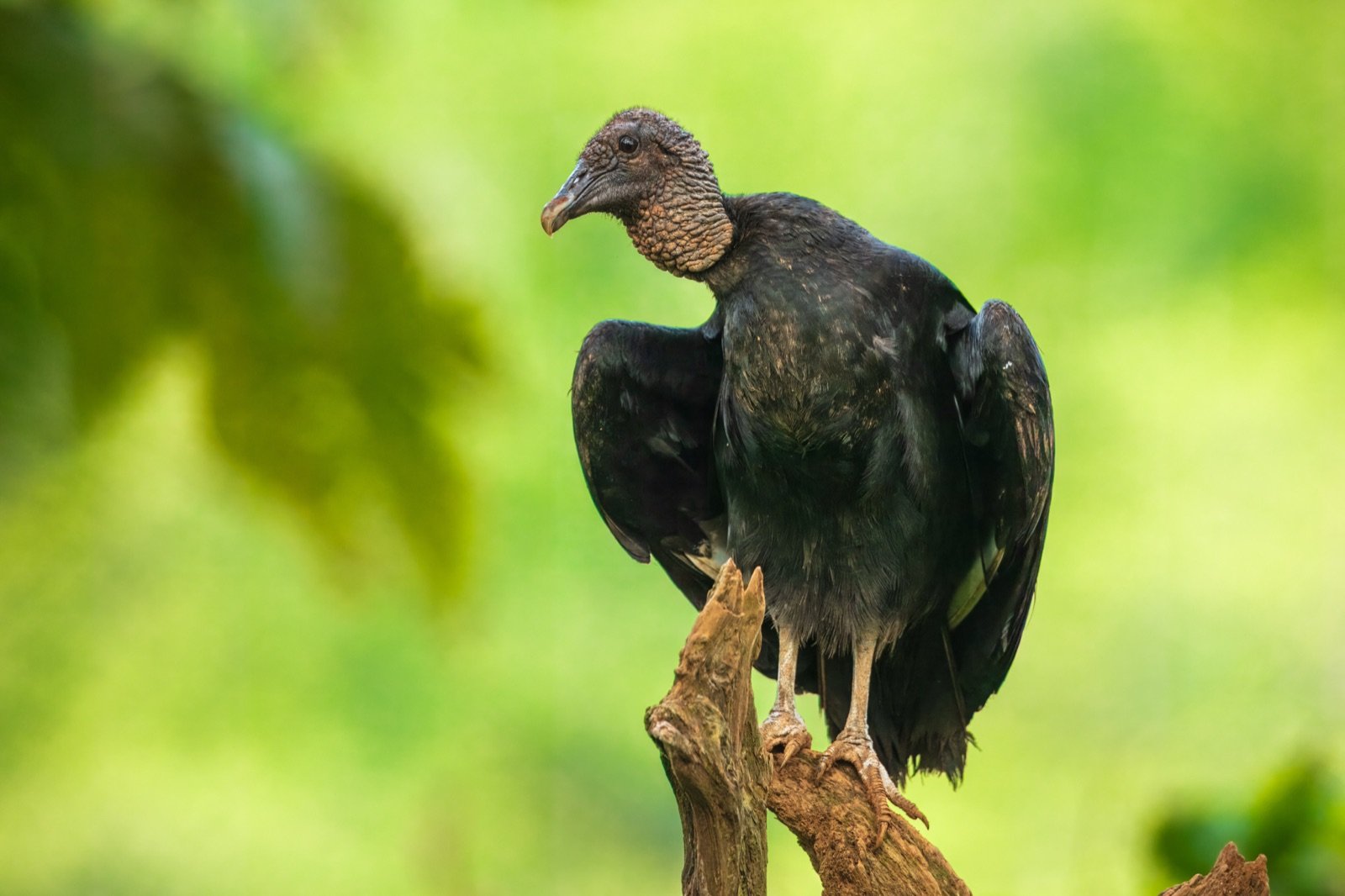
 Black Vulture
Family Cathartidae
Black Vulture
Coragyps atratus
In Spanish: Zopilote Negro (Zoncho, Gallinazo)
- Resident
Zopilote Negro: the short-tailed black vulture seen over towns and open country.
The Black Vulture, zopilote negro in Spanish, is a familiar sight almost anywhere in Costa Rica, so you will very likely see one on any trip. It is usually soaring over towns and open country, or perched in rural areas where food is more plentiful and nobody chases it off.
It is easy to overlook because it is so common, but it rewards a second look. On a birding drive near Tarcoles, a group spotted a King Vulture soaring in a kettle of Black Vultures, so on a trip we build, checking the birds overhead can turn up the rarer vulture.
For a beginner it is a good bird to learn first. Once you know its short square tail and white wingtip patches, the other vultures of the country become much easier to separate.
How to find it
Look for them soaring over towns and open country, or gathered at carcasses and rubbish dumps. Rural areas are especially good, because food is more plentiful there. Early on cool mornings, look for flocks perched in roost trees or on structures, often with wings spread to catch the sun. Scan any kettle of vultures carefully, since a King Vulture may be among them. A guided tour in the Deep South found the species common and widespread, so you do not need a special effort to find it.
How to recognise it
Adults are all black except for a white patch under the wing at the base of the primary feathers. The head is bare, wrinkled and blackish, and the legs are whitish.
In flight the tail looks short and square and the wings are broad. White wingtip patches look like spread fingers.
Compared with the Turkey Vulture, the Black Vulture has a bigger head, longer neck, more upright stance and sturdier build. Great Black-Hawks and other Buteogallus hawks have tail bands and a yellow cere and legs, which Black Vultures do not.
What it sounds like
Behaviour and diet
Black Vultures feed mainly on carrion. They find food by sight, not smell, and often follow Turkey Vultures to carcasses and then chase them off. They are aggressive, social and opportunistic, and groups crowd and jostle around large carcasses and at rubbish dumps.
Communal roosts can hold hundreds of birds. Some are used for decades and are often occupied all year in mild climates such as Costa Rica's. When soaring, they hold their wings flat, rock little and flap more often, and they gather in a big spiral group called a kettle.
Where it lives
Black Vultures live across Costa Rica from the coast up into the high mountains. They become uncommon or rare above about 2000 m.
In Costa Rica they are usually seen flying over towns and open country, and they are scarcer over forested areas. In rural areas they are a common sight, soaring or perched. A birder reported them at most low to middle elevation areas across the country.
When to see it
Breeding is reported from November to March, and in Guanacaste they breed in the rainy season.
Similar birds
When soaring, the Turkey Vulture (zonchiche) holds its wings in a V and rocks side to side, while the Black Vulture holds them flat, rocks little and flaps more often. Seen in flight, the Black Vulture also has a very short tail, a pale patch under the outer primaries and a slightly smaller size than the Turkey Vulture and the Lesser Yellow-headed Vulture. Young King Vultures are larger than Black Vultures, have no white in the primaries and have a shorter tail.
Names and lore in Costa Rica
Costa Ricans call it zopilote negro, zoncho or gallinazo. Zoncho is the name used in Costa Rica and Nicaragua, while Panama uses gallote. The word zopilote comes from the Nahuatl tzopilotl, and one explanation of the name refers to the way a flying vulture seems to carry carrion hanging from its claws.
Status and conservation
The AOCR lists it as a resident (R), and the IUCN rates the species Least Concern with a stable population.
Photography tips
After rain, perched Black Vultures spread their wings to dry, which makes a good moment for a wing-spread photo. They regularly sit on bare branches of dead trees, often alongside Turkey Vultures, so you can compare the two species side by side.
How we know this 22 sources, each read on the date shown
- Flickr (Costa Rican natural history text, INBio style species account) read 2026-11-04
https://www.flickr.com/photos/jobando/26446629954 - Tico Times read 2026-11-04
https://ticotimes.net/2023/07/29/costa-rica-wildlife-meet-the-black-vulture - Costa Rica Insights read 2026-11-04
https://costaricainsights.wordpress.com/2013/01/29/costa-ricas-vultures-so-prevalent-they-could-be-the-national-bird/ - Animalia.bio read 2026-11-04
https://animalia.bio/black-vulture - Charlie Doggett's Costa Rica photo gallery read 2026-11-04
https://charliedoggett.smugmug.com/BIRDS/Costa-Rica-Birds-by-Species/Black-Vulture/i-S3ZtdTK - All About Birds, Cornell Lab read 2026-11-04
https://www.allaboutbirds.org/guide/Black_Vulture/overview - Birda species guide read 2026-11-04
https://app.birda.org/species-guide/82757/American_Black_Vulture - Birds Colombia (citing Wikipedia) read 2026-11-04
https://birdscolombia.com/2016/06/04/gallinazo-negro-coragyps-atratus/ - El Norte Hoy read 2026-11-04
https://elnortehoycr.com/2019/11/17/video-escuche-el-extrano-sonido-de-un-polluelo-de-zopilote-cabeza-negra/ - The Tico Times read 2026-11-04
https://ticotimes.net/2024/08/11/no-foul-fowl-vultures-play-an-important-role - Howler Magazine read 2026-11-04
https://howlermag.com/vultures-in-costa-ria/ - Birds, Tours & Threads trip report read 2026-11-04
https://birdsbybijs.com/2024/02/trip-report-costa-rica-central-sur-2024-birding-tour/ - Field Guides trip report read 2026-11-04
https://fieldguides.com/triplists/cr118.html - Contenido Tico read 2026-11-04
https://contenidotico.com/biodiversidad/aves/zopilote-negro/ - Wikipedia (Spanish) read 2026-11-04
https://es.wikipedia.org/wiki/Coragyps_atratus - Hawk Mountain survey paper read 2026-11-04
https://www.hawkmountain.org/download/?id=4948&dl=1 - Costa Rica Guide read 2026-11-04
https://costa-rica-guide.com/photos/national-parks-photos/turrialba-volcano-photos/attachment/img_1331/ - The Firefly Forest read 2026-11-04
https://fireflyforest.net/firefly/2006/06/27/black-vultures/ - Reflections of the Natural World read 2026-11-04
https://reflectionsofthenaturalworld.com/2024/09/12/black-vulture-pura-vida-birds-and-birding/ - Area de Conservacion Guanacaste read 2026-11-04
https://www.acguanacaste.ac.cr/paginas-de-especies/insectos-2/729-cathartidae/5768-i-sarcoramphus-papa-i-cathartidae - Ecos del Bosque read 2026-11-04
https://ecosdelbosque.com/fauna/coragyps-atratus - Aves de Costa Rica read 2026-11-04
https://avesdecostarica.com/Coragyps-atratus.html