Family Cardinalidae
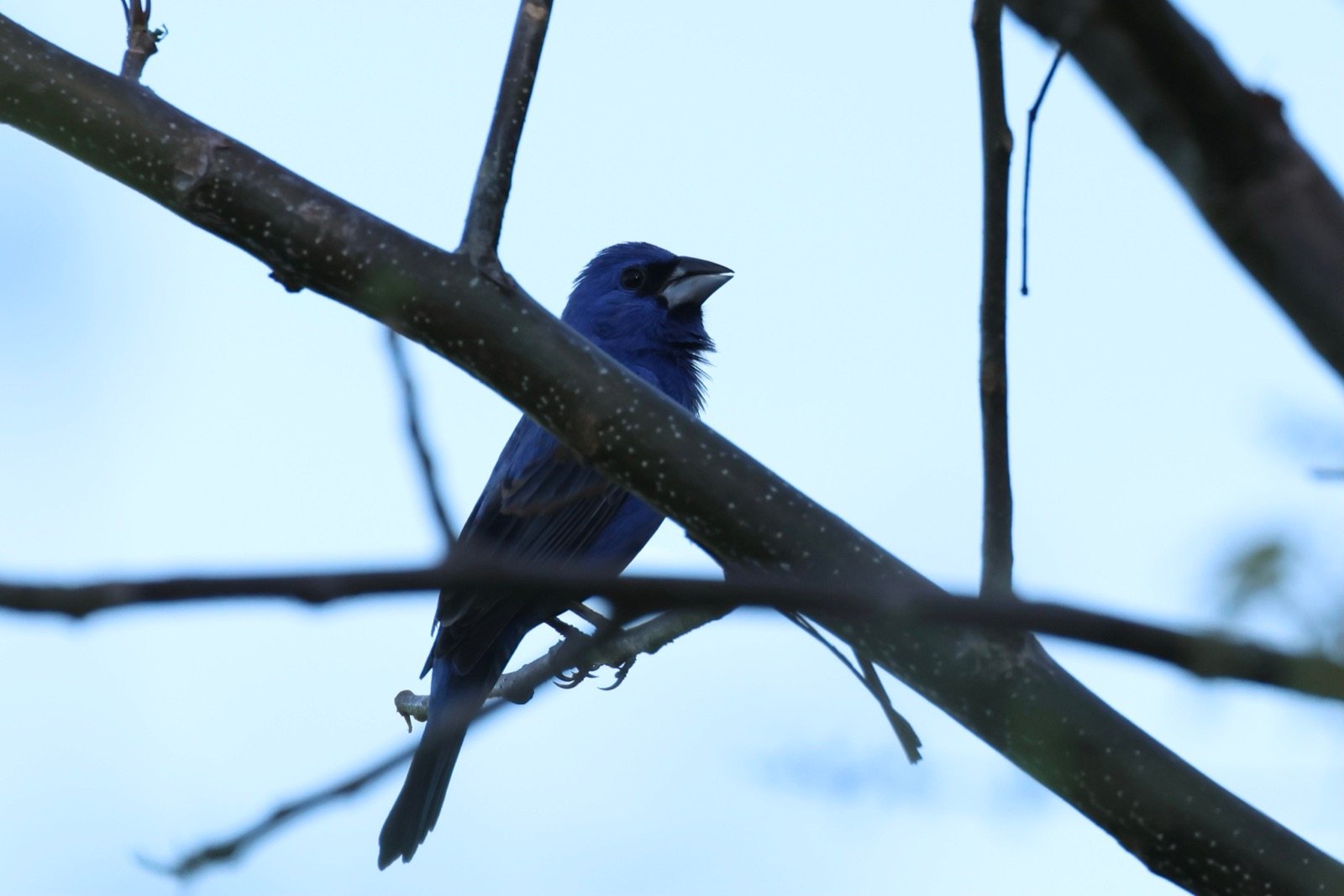
Blue Grosbeak
Passerina caerulea
In Spanish: Picogrueso Azul (Alondra)
- Resident
Violet blue finch of brushy fields, with two chestnut wingbars
The male Blue Grosbeak (Picogrueso Azul, also listed as Alondra) is bright violet blue with a black patch in front of the eye. Two cinnamon to chestnut wingbars set him apart from other blue birds.
It is a bird of open, brushy country rather than deep forest. Resident birds are uncommon to fairly common in the dry northwest lowlands, and they also live in the western Central Valley, including the west side of San José (Pavas).
On a trip we build from the Central Valley toward Carara National Park, a stop in scrubby dry forest can give a male before the rainforest birding begins.
How to find it
Skip thick, mature forest and look in more open, brushy habitat instead. Roadside brushy fields are a good bet: one resident birder hears and sees them at many such sites, and a pair turned up in weedy lots beside a building site. Fence wires make good perches, and one male called from barbed wire as soon as a group stepped out of the car. Water helps in the dry season, since a Costa Rican naturalist recorded Blue Grosbeaks on camera traps at dry-season puddles in Guanacaste. Two males have also been seen feeding in young Guanacaste trees just off the beach at Playa Guiones on a drizzly morning before 6 am.
How to recognise it
Males are bright violet blue with a black patch in front of the eye. They have two cinnamon to chestnut wingbars, which set them apart from other blue birds.
The bill is two-toned, black above and silvery below. The bird is about 16.5 cm long.
Females are olive brown above, with faint streaking on the back in resident birds. Immatures look like adult females but show a blue tint on the rump and tail, a more rufous front wingbar and a blotchy underside.
Migrant birds constantly flick and partly fan their tails, which can help you spot them in brush.
What it sounds like
Behaviour and diet
The Blue Grosbeak eats seeds and small insects taken from low vegetation or the ground. It also makes short flights after flying insects, and it visits roadsides and stream edges for grit.
Resident birds usually travel in pairs. Migrants are solitary or in small groups, and they keep flicking and partly fanning the tail. Females have been seen gathering nest material in May, June and July.
Where it lives
It uses farmland with scattered trees and hedgerows, second growth, open woodland, deciduous forest edges and dry thorny scrub.
Resident birds are uncommon to fairly common in the dry northwest lowlands. They reach about 1100 m on the foothills of the northern mountain ranges. A resident population lives in the northern Pacific region and the western Central Valley, and one birder found it common in the Central Valley and the northwest.
When to see it
Some northern migrants pass through in fall, mostly along the Caribbean coast, and are rare inland from October to November. A very uncommon winter visitor in the northwest and Caribbean lowlands, winter birds leave in mid April.
Similar birds
The male Indigo Bunting is the main look-alike. It is smaller, with a sparrow-sized bill and no obvious wingbars, while the grosbeak has a big triangular bill. Females and immatures resemble female Indigo Buntings but are much larger. Costa Rican lists call the Indigo Bunting Azulillo Norteño.
Names and lore in Costa Rica
Costa Ricans call it Picogrueso Azul, and the AOCR list adds the nickname Alondra, the local name that appears next to it on Costa Rican bird lists.
Status and conservation
The AOCR list marks it as both resident and migrant (R,M), and it is described as a common resident with some northern birds wintering here.
Photography tips
Scan fence wires and barbed wire for a singing male, which often perches in the open. Dry-season puddles in Guanacaste are worth watching, as camera traps have recorded the bird there. For migrants, look for the constant tail flicking and partial fanning in brush.
How we know this 9 sources, each read on the date shown
- Aves de Costa Rica read 2026-11-04
https://www.avesdecostarica.com/Passerina-caerulea.html - The Tico Times read 2026-11-04
https://ticotimes.net/2024/05/16/costa-rica-birding-meet-the-blue-grosbeak - Birding Craft read 2026-11-04
https://birdingcraft.com/wordpress/2020/06/02/blue-grosbeaks-and-birding-news-from-costa-rica-june-2020/ - Flickr (Costa Rica bird photo with natural history notes) read 2026-11-04
https://www.flickr.com/photos/jobando/36810932761 - World Bird Photos read 2026-11-04
https://www.worldbirdphotos.com/photo/grosbeak-blue-passerina-caerulea-male-costa-rica/ - St. Louis Audubon read 2026-11-04
https://stlouisaudubon.org/bird-of-the-week-july-26/ - Museo Nacional de Costa Rica read 2026-11-04
https://www.museocostarica.go.cr/nuestro-trabajo/investigaciones/historia-natural/gam/aves/ - Birding Craft read 2026-11-04
https://birdingcraft.com/wordpress/tag/blue-grosbeak/ - Wikipedia read 2026-11-04
https://en.wikipedia.org/wiki/Passerina_caerulea