Family Cardinalidae
Indigo Bunting
Passerina cyanea
In Spanish: Azulillo Norteño (Indris)
- Migrant
A small winter visitor, mostly brown here, in weedy fields and open second growth.
The Indigo Bunting, Azulillo Norteño in Spanish, is a small songbird of the cardinal family that spends the northern winter in Costa Rica. A Costa Rican natural history account puts it here from early or mid October until late April.
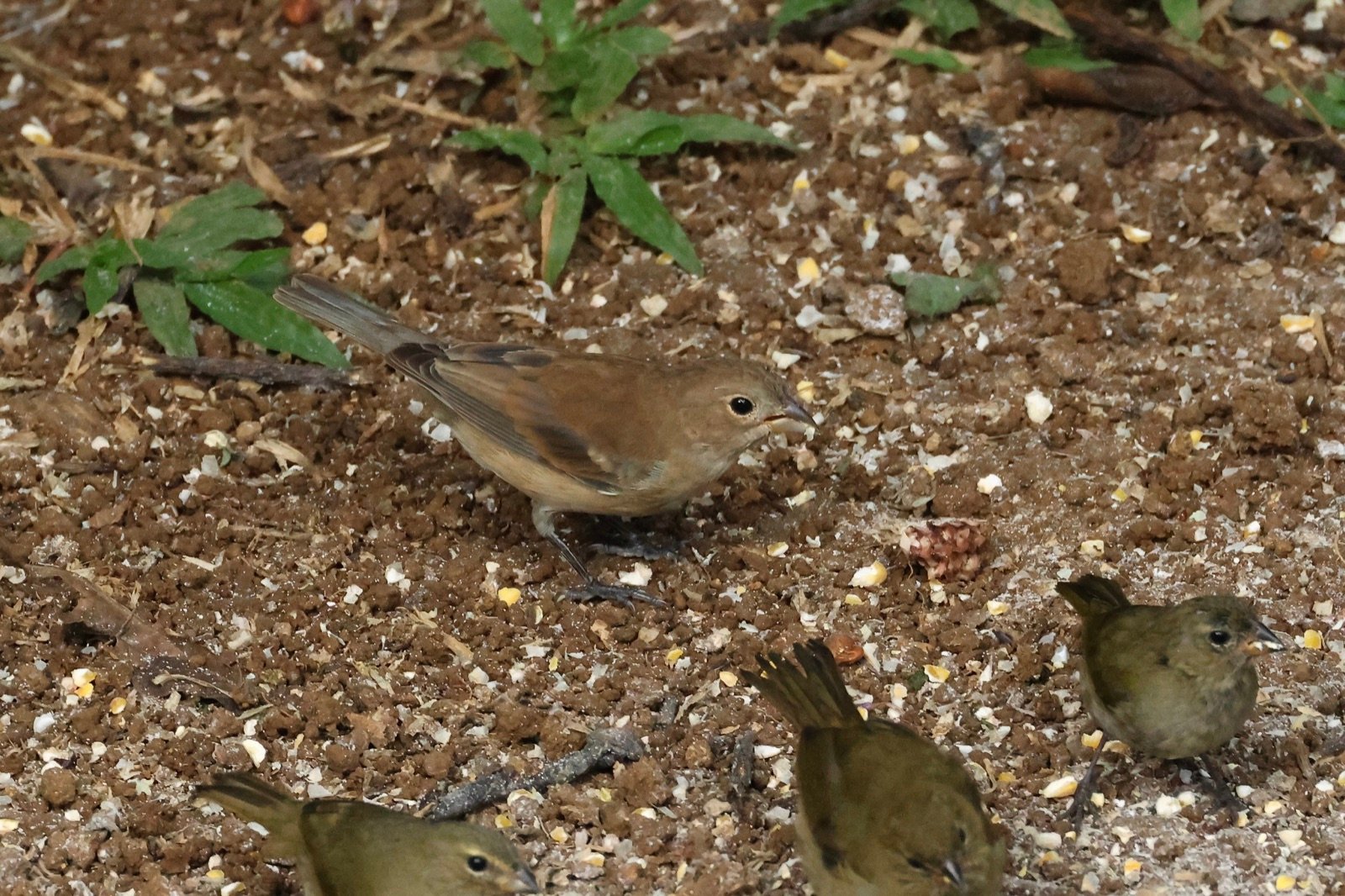
Most males you meet here will not look like the deep blue bird of the field guide cover. In fall and winter the male looks mostly brown, because brown edges overlap his blue feathers, and females are brown all year.
That makes it a good bird for a beginner to learn. Look for flocks in weedy fields and open edges, and let a scattering of blue on a brown body give it away. Costa Ricans know it locally as indre or Indris.
How to find it
Look in weedy crops, savanna edges and freshly harvested farm fields rather than in deep forest. Young, partly open second growth is also worth a slow scan. The drier Pacific side and the Central Valley hold the most birds. Scan the ground and the grass stems, where it feeds, and watch for flocks of 20 or more. Where guinea grass has dropped its seed, look for birds feeding below. Later in the dry season, check wetter areas too, and watch for blue on the rump of otherwise brown birds.
How to recognise it
The Indigo Bunting is a small songbird, about 11.5 to 13 cm long, with a short, cone-shaped bill. A Costa Rican account calls it slimmer than most seed-eating finches and buffy overall.
Birds seen in Costa Rica during the northern winter are usually in non-breeding plumage:
- Males look mostly brown, with a scattering of blue, mostly on the rump.
- Females are brown all year.
- The female is much less streaked below than the female Blue-black Grassquit.
The breeding male is deep blue with black wings and tail edged in bright blue. That blue comes from feather structure, not pigment, so in strong light it can shift from deep royal blue to turquoise.
What it sounds like
Behaviour and diet
In winter the Indigo Bunting eats mostly small grass seeds, plus berries, buds and some insects. It feeds on the ground and also takes seeds from grass stems. In Costa Rica in winter it feeds on the ground on guinea grass seeds once the grass has dropped them.
It is sometimes seen alone or in small groups, but more often it forms flocks of 20 birds or more. Flocking is typical of its wintering grounds generally.
Where it lives
On its wintering grounds from Mexico to Colombia, the species uses weedy fields, savanna edges, low second growth and semi-open forest.
In Costa Rica it is found in weedy crops, savanna edges, freshly harvested farm fields, and young, partly open second growth. It is most numerous in the drier parts of the Pacific side and in the Central Valley. As the dry season goes on, birds move toward wetter areas. It occurs from sea level to about 1500 m.
When to see it
It is present from early or mid October until late April. Skutch noted that most leave Central America in the first half of April, and few are seen after mid-month.
Similar birds
Blue Grosbeak is larger, with a much heavier bill and clear brown or cinnamon wingbars. The Indigo Bunting has a smaller bill and lacks obvious wingbars. Rusty wing bars mark the grosbeak in every plumage, and it is a duller blue. The female bunting is much less streaked below than the female Blue-black Grassquit.
Names and lore in Costa Rica
The AOCR Spanish name is Azulillo Norteño, and a bird list from Cloudbridge Nature Reserve gives the local name Indris. Costa Ricans are also said to know it as indre, and azulito norteño is used in Costa Rica and Colombia.
Status and conservation
The AOCR list marks it as M, a migrant, and a Costa Rican account calls it a migratory winter resident.
How we know this 14 sources, each read on the date shown
- Wikipedia read 2026-11-04
https://en.wikipedia.org/wiki/Indigo_bunting - Wikipedia (Spanish) read 2026-11-04
https://es.wikipedia.org/wiki/Passerina_cyanea - Cornell Birds of the World read 2026-11-04
https://birdsoftheworld.org/bow/species/indbun/cur/foodhabits - Bird Watching Costa Rica read 2026-11-04
https://www.birdwatchingcostarica.com/ave/indigo-bunting/ - Cloudbridge Nature Reserve bird list read 2026-11-04
https://www.cloudbridge.org/wp-content/uploads/2020/04/Bird-Species-List-Costa-Rica-13-April-2020.pdf - Historia Natural de Costa Rica (via Flickr) read 2026-11-04
https://www.flickr.com/photos/jobando/32687707282 - Audubon Field Guide read 2026-11-04
https://www.audubon.org/field-guide/bird/blue-grosbeak - Cornell Lab, All About Birds read 2026-11-04
https://www.allaboutbirds.org/guide/Indigo_Bunting/sounds - Acompáñame blog read 2026-11-04
http://podemos-juntos.blogspot.com/2013/08/azulillo-norteno-indigo-bunting.html - Bent, Life Histories of North American Birds read 2026-11-04
http://birdsbybent.com/ch91-100/indbunting.html - Veloso Tours read 2026-11-04
https://www.veloso.com/costa-rica/reasons-to-visit/costa-rica-bird-life/ - Animal Diversity Web read 2026-11-04
https://animaldiversity.org/accounts/Passerina_cyanea/ - Birds Colombia read 2026-11-04
https://birdscolombia.com/2022/12/12/azulillo-norteno-indigo-bunting-passerina-cyanea/ - BioDB read 2026-11-04
https://biodb.com/species/indigo-bunting/