Family Cardinalidae
Painted Bunting
Passerina ciris
In Spanish: Azulillo Sietecolores (Arcoiris, Siete Colores)
- Migrant
A violet, green and red winter visitor to the dry Pacific side.
The adult male Painted Bunting has a violet-blue head, a yellowish-green back, a pinkish-red rump and bright red underparts, with a red-pink eye ring. Costa Rican species accounts call him unmistakable, and Costa Ricans know the bird as Azulillo Sietecolores, a name that points to all those colors at once.
It is a Nearctic migrant, an uncommon and local winter resident on the Pacific side, present from late October to late March. It breeds in the southern USA and northern Mexico, so every bird here is a visitor that has traveled south.
For a beginning birder the male is a gift, because nothing else looks like him. The challenge is patience, since this is a nervous and shy bird of scrub and thickets.
How to find it
Start on the Pacific side, in dry country with scrub and thickets. Singing males are the easiest to see, so look for them on exposed perches at the edges of scrub and forest. Be patient and quiet, because the birds are shy. A waterhole in dry country is a good place to wait: a biologist using camera traps in Guanacaste records it only at one of the last puddles of water in the dry season. Abandoned pastures, tall grass and river-edge cane are also worth a slow look.
How to recognise it
The adult male is about 13 cm long. Look for these marks:
A violet-blue head.
A yellowish-green back.
A pinkish-red rump.
Bright red underparts.
A red-pink eye ring.
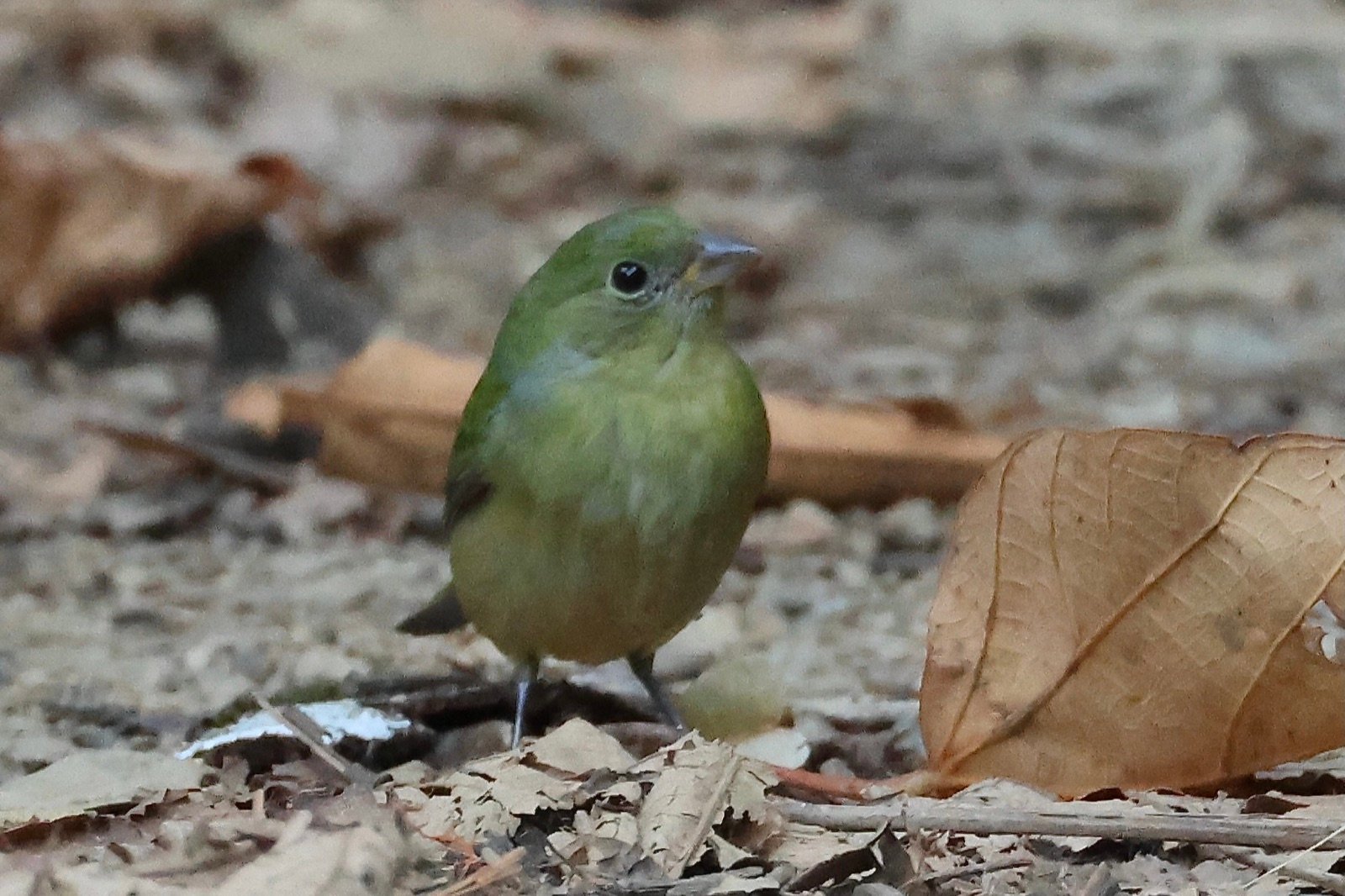
Females are plain green above and yellowish below, with no streaks. They look greener and more yellow than other seedeaters, a useful clue when no colorful male is around. Immatures resemble the female but are duller and browner above.
What it sounds like
Behaviour and diet
The Painted Bunting eats seeds, some fruit and insects. It often travels alone or in small groups, for example when visiting waterholes in dry areas. The species is nervous and shy, and singing males are the easiest to see.
In Costa Rica, males may accompany a female as if already paired as early as March.
Where it lives
In Costa Rica it uses dense cover in secondary growth with scrub, abandoned pastures, tall grass, or stands of river-edge cane. It is recorded from sea level up to 1350 m in the Central Valley.
It is mainly a bird of the Pacific side, found chiefly in the Tempisque river basin, around the Gulf of Nicoya, and in the Térraba region. A Costa Rican field-guide blurb says it lives on the Pacific slope and pushes over into the western Central Valley.
When to see it
It is present from late October to late March, and one writer says it can be found in thickets and low secondary growth until early April. Birders saw it in early January 2024 in dry habitats near open reservoirs and dry forest patches.
Similar birds
The bright adult male cannot be confused with anything else. Females and immatures are plain green with no streaks, unlike the brownish plumage of other buntings. Do not mix it up with the Mil Colores (Stilpnia larvata), whose name sounds similar but is a different bird.
Names and lore in Costa Rica
Costa Ricans know it as Azulillo Sietecolores, also called arcoiris or siete colores, names that refer to the male's many colors. Siete colores means seven colors. Some bird keepers value it for its plumage and keep it as a cage bird.
Status and conservation
The AOCR list marks it as a migrant (M), and BirdLife International rates the species Least Concern.
Photography tips
Be patient and quiet, because the birds are shy. Look for males singing from exposed perches near forest edges or fields. A waterhole in dry country is a good place to wait in the dry season.
How we know this 13 sources, each read on the date shown
- Flickr post quoting Costa Rican species account (Spanish) read 2026-11-04
https://www.flickr.com/photos/jobando/31852266784 - Birds of the World (Cornell Lab) read 2026-11-04
https://birdsoftheworld.org/bow/species/paibun/cur/breeding - World Bird Photos read 2026-11-04
https://www.worldbirdphotos.com/photo/bunting-painted-passerina-ciris-male-costa-rica/ - EcoRegistros read 2026-11-04
https://www.ecoregistros.org/ficha/Passerina-ciris - Animalia (Wikipedia-based summary) read 2026-11-04
https://animalia.bio/pinted-bunting?letter=p - EcuRed read 2026-11-04
https://www.ecured.cu/Azulillo_pintado - A.M. Costa Rica read 2026-11-04
https://amcostarica.com/Wild%20Costa%20Rica-%20Azulillo%20Siete%20Colores%20bird%20022225.html - The Tico Times read 2026-11-04
https://ticotimes.net/2024/01/07/costa-ricas-painted-bunting-a-spectacle-of-natures-colors - Trek.zone Wildlife in Costa Rica read 2026-11-04
https://trek.zone/en/costa-rica/animals/painted-bunting - Birding Craft read 2026-11-04
https://birdingcraft.com/wordpress/2024/01/04/2024-starting-another-year-of-birding-in-costa-rica/ - The Tico Times read 2026-11-04
https://ticotimes.net/2015/04/07/4-things-not-to-miss-during-bird-migration-season - BirdFact read 2026-11-04
https://www.birdfact.com/birds/painted-bunting - Port Isabel South Padre read 2026-11-04
https://www.portisabelsouthpadre.com/2020/04/05/creatures-among-us-the-painted-bunting-a-joy-to-birders/