Family Vireonidae
Blue-headed Vireo
Vireo solitarius
In Spanish: Vireo Solitario
- Migrant
A blue-grey-headed winter visitor from Canada and the US, found from lowlands to highlands.
The Blue-headed Vireo (Vireo Solitario in Costa Rica) is a winter visitor only. It breeds in Canada and the northern and eastern United States, so any you meet here have travelled a long way to spend the northern winter in the tropics.
It forages slowly and deliberately along branches, so it can be hard to spot, and the song is often the first sign it is in the forest.
Costa Rica sits at the southern edge of its winter range, and the IUCN lists the species as Least Concern, with numbers that have risen since the 1970s. For a beginning birder it is a fine bird for learning patience, and for learning to follow a scolding call to a mixed flock.
How to find it
Listen first, because the song is often the first sign it is in the forest. Forest edge and semi-open habitats are the best places to start looking in Costa Rica. In migration and winter these vireos come readily to pishing or similar sounds. Imitating their mewling alarm call can also draw them in. When you hear scolding chatter, follow it and scan the mixed flock slowly, since the bird moves deliberately along branches.
How to recognise it
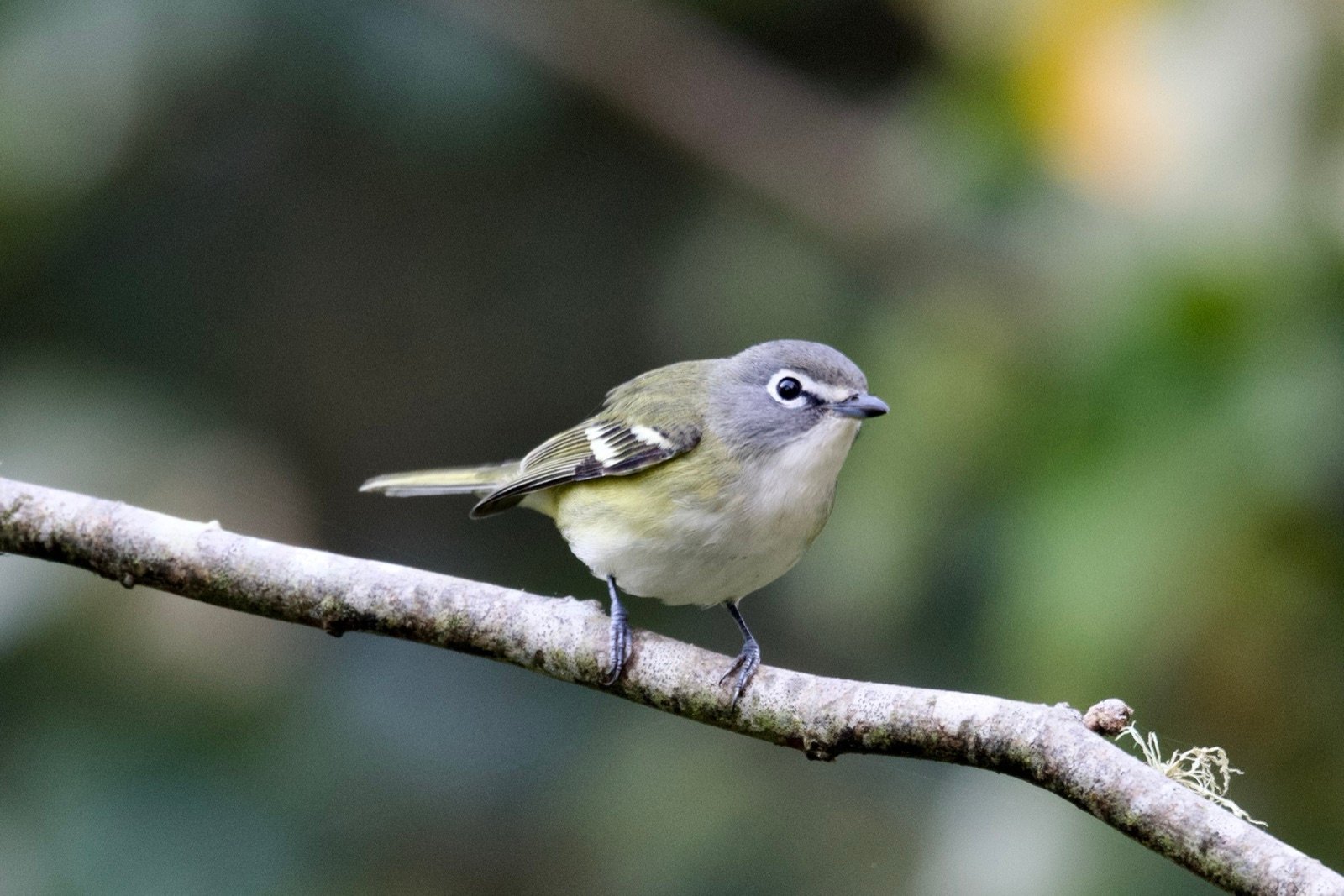
Look first at the head, which is blue-grey. The wings carry two bold, yellow-tinged wing bars, and the back is olive green. Males and females look alike, so you do not need to sort the sexes in the field.
The eye-ring and spectacles are a key mark. Plumbeous Vireo is plainer and greyer, while Cassin's Vireo falls between Plumbeous and Blue-headed. Some in-between birds cannot be named in the field, so do not worry if one stays unresolved.
What it sounds like
Behaviour and diet
It eats mainly insects but also takes berries and fruit. Fruit eating happens mostly during migration and winter in the tropics, where fruit is plentiful or insects are scarce.
Wintering birds are often seen with mixed flocks of warblers, tanagers and other vireos, yet the species is described as solitary and rarely flocks with its own kind. On migration it also travels with other small birds, such as sparrows. In fall migration it lingers later than most vireos.
Where it lives
Across its winter range it uses mixed pine and hardwood woods, plus coastal and floodplain swamps and low shrubby thickets. In Costa Rica it prefers forest edge and semi-open habitats.
From Mexico south to Costa Rica, wintering birds use forests from sea level up to about 2,700 m, so one can turn up from the lowlands to the highlands. Costa Rica marks the southern end of that winter range.
When to see it
A Guatemalan campus survey reports the bird there from late September to late May, which is the nearest dated winter window and only a rough guide for Costa Rica.
Similar birds
Cassin's Vireo looks much like this bird, but it has paler yellow patches, a smaller and thinner bill and a brownish-grey crown. Blue-headed, Cassin's and Plumbeous Vireos were once treated as one species, the Solitary Vireo.
By song, it is slower and sweeter than the Red-eyed Vireo's and less burry than the Yellow-throated Vireo's. It is also less repetitive than the Philadelphia Vireo's.
Names and lore in Costa Rica
Costa Ricans call it Vireo Solitario. In general Spanish it is also vireo cabeciazul, in Mexico vireo anteojillo, and in Nicaragua vireo de anteojos.
Status and conservation
The AOCR list marks it as M, a migrant, and the IUCN lists it as Least Concern, with numbers that have risen since the 1970s.
Photography tips
Pishing works well for drawing it into view when it is with mixed flocks. Follow the scolding chatter to the flock and be patient, as it forages slowly along branches.
How we know this 13 sources, each read on the date shown
- Wikipedia read 2026-11-04
https://en.wikipedia.org/wiki/Blue-headed_vireo - Wikipedia (Spanish) read 2026-11-04
https://es.wikipedia.org/wiki/Vireo_solitarius - All About Birds (Cornell Lab) read 2026-11-04
https://www.allaboutbirds.org/guide/Blue-headed_Vireo/sounds - All About Birds (Cornell Lab) read 2026-11-04
https://www.allaboutbirds.org/guide/Blue-headed_Vireo/overview - NatureServe Explorer read 2026-11-04
https://explorer.natureserve.org/Taxon/ELEMENT_GLOBAL.2.104986/Vireo_solitarius - Birdfact read 2026-11-04
https://www.birdfact.com/birds/blue-headed-vireo - Avibase read 2026-11-04
https://avibase.bsc-eoc.org/species.jsp?avibaseid=048F1F046E31AC96 - Animal Diversity Web read 2026-11-04
https://animaldiversity.org/accounts/Vireo_solitarius/ - Audubon Field Guide read 2026-11-04
https://www.audubon.org/field-guide/bird/blue-headed-vireo - Valery Schollaert read 2026-11-04
https://valeryschollaert.wordpress.com/vireo-a-tete-bleue-vireo-solitarius/ - Birds Wiki (Fandom) read 2026-11-04
https://birds.fandom.com/wiki/Blue-headed_Vireo - BirdPhotos.com read 2026-11-05
https://www.birdphotos.com/gallery2/main.php?g2_itemId=85196&g2_imageViewsIndex=2 - Arboretum UFM (Guatemala) read 2026-11-05
https://arboretum.ufm.edu/animales/vireo-solitarius/