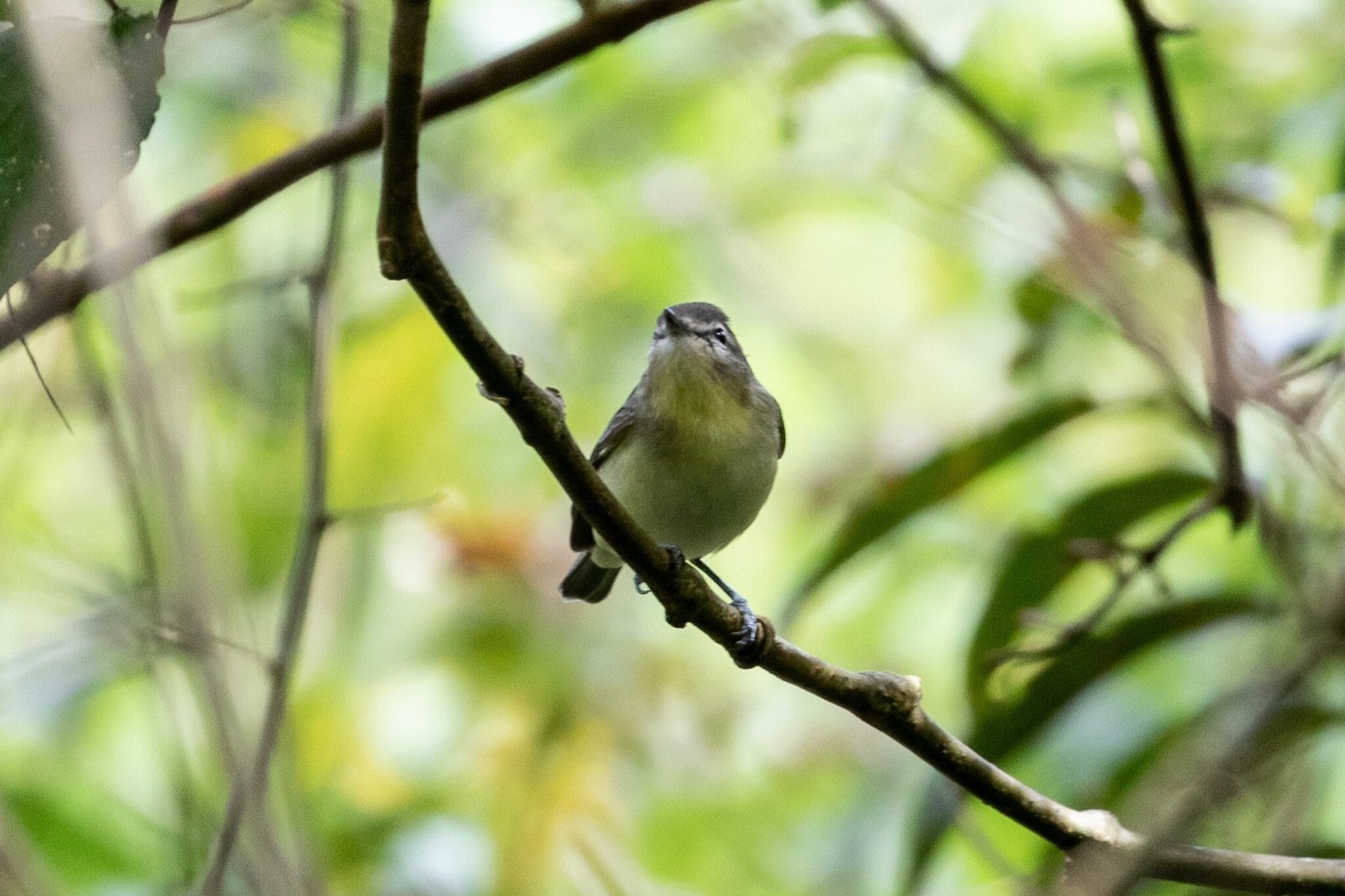
Family Vireonidae
Philadelphia Vireo
Vireo philadelphicus
In Spanish: Vireo Amarillento
- Migrant
Slight, dainty winter vireo that works high branches from late October to April.
In Costa Rica the Philadelphia Vireo is the most common wintering vireo. It is a Nearctic migrant that arrives at the end of October and leaves without fuss at the end of April, rarely in early May.
It is slight and almost dainty, and it moves methodically through the upper parts of trees. That unhurried style is a handy clue, because it is slower and less aggressive than the Red-eyed Vireo, the bird it is most often confused with.
On a trip we build in the winter months, the best approach is patience: scan the mixed flocks of small birds and look for a vireo picking slowly along a high branch.
How to find it
Check mixed flocks first, since migrants and wintering birds often join them. Look for a vireo working slowly along branches high in the trees. Flocks often give themselves away with thin contact calls and small movements in the leaves, so stand still and quiet and let them pass overhead. Listen too for a vireo that sings slowly and sounds a bit odd, as that slow song can help separate it from the Red-eyed Vireo. Shaded coffee farms, forest edges, gardens and mangrove edges are all worth a slow walk.
How to recognise it
This is a small, compact vireo of about 4.5 to 5 inches, with blue-grey legs. It is slight and almost dainty, and it works along branches slowly rather than darting about.
The Red-eyed Vireo is the main look-alike, so behaviour matters as much as plumage. The Philadelphia is the slower and less aggressive of the two. Because the birds sit high in the trees, watch for a vireo that moves methodically and pauses to check the leaves.
Costa Rica has three migrant vireos you can expect: the Red-eyed, the Yellow-throated and the Philadelphia. Knowing that short list makes a good starting point for sorting what you see.
What it sounds like
Behaviour and diet
The Philadelphia Vireo is often seen high in the trees, working along branches for insects. It picks small insects off the foliage, mostly beetles. Its diet is mostly insects and spiders, with some fruit in fall and winter.
In winter it is solitary or in small scattered groups. These often join mixed flocks of small birds, or groups of Tennessee Warblers. In Costa Rica it may join mixed flocks of woodland birds more generally.
Where it lives
In Costa Rica it occurs from the lowlands up to about 1650 m, and during migration it rarely reaches as high as 2100 m. It is fairly common on the Pacific slope and less numerous on the Caribbean side.
Wintering birds use open forest and forest edges, mangroves, cacao and shaded coffee farms, and gardens. Such farms are found up to about 5,250 feet. Migrants travel south through the fall until they reach the mountains of Costa Rica and Panama, where they have few Red-eyed Vireos to compete with.
When to see it
Birding from late October to early March should turn up Philadelphia Vireos, which share the season with Summer Tanagers, orioles and many winter warblers. Birds arrive at the end of October and depart at the end of April, rarely at the start of May.
Similar birds
The Red-eyed Vireo is the main look-alike. It is a common passage migrant in Costa Rica, seen on its way south from September to November and again from late March to May. The Yellow-green Vireo is another look-alike: it shows bright yellow on the flanks and lacks the Red-eyed Vireo's dark eye line.
Names and lore in Costa Rica
Costa Rica uses the Spanish name vireo amarillento. Elsewhere in the region other names are used: vireo de Filadelfia in Cuba, Mexico and Honduras, vireo canadiense in Nicaragua, and verderón de Philadelphia in Colombia.
Status and conservation
The AOCR lists it as a migrant (M), and in Costa Rica it is the most common wintering vireo, with an IUCN status of Least Concern.
Photography tips
Because it feeds high in the trees, a patient wait beside a mixed flock gives the best chance of a clear view. Stand still and quiet, and watch for small movements in the leaves.
How we know this 18 sources, each read on the date shown
- Birding Craft read 2026-11-04
https://birdingcraft.com/wordpress/2021/11/09/which-migrant-species-are-encountered-most-often-while-birding-in-costa-rica/ - Birding Craft read 2026-11-04
https://birdingcraft.com/wordpress/tag/costa-rica-birding/page/4/ - EcoRegistros read 2026-11-04
https://www.ecoregistros.org/site/imagen.php?id=19985 - Cloudbridge Nature Reserve read 2026-11-04
https://www.cloudbridge.org/wp-content/uploads/2020/04/Bird-Species-List-Costa-Rica-13-April-2020.pdf - Birds for Beer read 2026-11-04
https://birdsforbeer.com/2016/10/08/first-yellow-throated-vireo-of-the-season/ - Bird Watcher's Digest read 2026-11-04
https://www.birdwatchersdigest.com/bwdsite/bestofbwd2017/philadelphia-vireo-profile-deception.php - Smithsonian National Zoo read 2026-11-04
https://nationalzoo.si.edu/sites/default/files/documents/philadelphia_vireo_simple.pdf - Hotel Rivel blog read 2026-11-04
https://hotelrivel.online/a-little-bit-of-brotherly-love-the-philadelphia-vireo-visits-costa-rica/ - Birds for Beer read 2026-11-04
https://birdsforbeer.com/2019/05/31/vireos-yellow-green-and-red-eyed/ - Wikipedia (es) read 2026-11-04
https://es.wikipedia.org/wiki/Vireo_philadelphicus - All About Birds, Cornell Lab read 2026-11-04
https://www.allaboutbirds.org/guide/Philadelphia_Vireo/id - All About Birds, Cornell Lab read 2026-11-04
https://www.allaboutbirds.org/guide/Philadelphia_Vireo/overview - Costa Rica Focus read 2026-11-04
https://www.costaricafocus.com/slowing-down-makes-you-a-better-birder-in-costa-rica/ - All About Birds, Cornell Lab read 2026-11-04
https://www.allaboutbirds.org/guide/Philadelphia_Vireo/lifehistory - Flickr (Historia Natural text) read 2026-11-04
https://www.flickr.com/photos/jobando/28356976059 - Birding Craft read 2026-11-04
https://birdingcraft.com/wordpress/tag/mangrove-birding/ - Field Guides trip list 2017 read 2026-11-04
https://fieldguides.com/triplists/cos17.html - Audubon Field Guide read 2026-11-04
https://www.audubon.org/field-guide/bird/philadelphia-vireo