Family Cardinalidae
Blue Seedeater
Amaurospiza concolor
In Spanish: Semillero Azulado
- Resident
A shy, nearly black bamboo specialist of the high mountains.
The Blue Seedeater (Semillero Azulado) is a small, shy bird of the Costa Rican highlands, and it is never an easy one. Here it is an uncommon to rare resident, very local, and its fortunes follow the bamboo.
The species was first described from a Costa Rican specimen, with the type locality later narrowed to Miravalles. Birds turn up where bamboo is seeding and are often absent from patches that are not.
On a trip we build, the plan therefore starts with the bamboo rather than the calendar: bright light, quiet edges and streamsides, and patience for a brief view.
How to find it
Watch seeding bamboo patches, and look at clearings and forest edges with bamboo stands. Learn the song and listen at forest edges and streamsides above 2,000 m on the way up Irazú. Guides listen for calls from bamboo clumps. One male near Poás answered pishing and called from a patch of old bamboo. Bamboo that is not seeding often brings no response: searches at Tapantí and Bosque del Niño found no seedeaters, because the bird follows seeding bamboo. Expect a rare, local bird that is hard to see.
How to recognise it
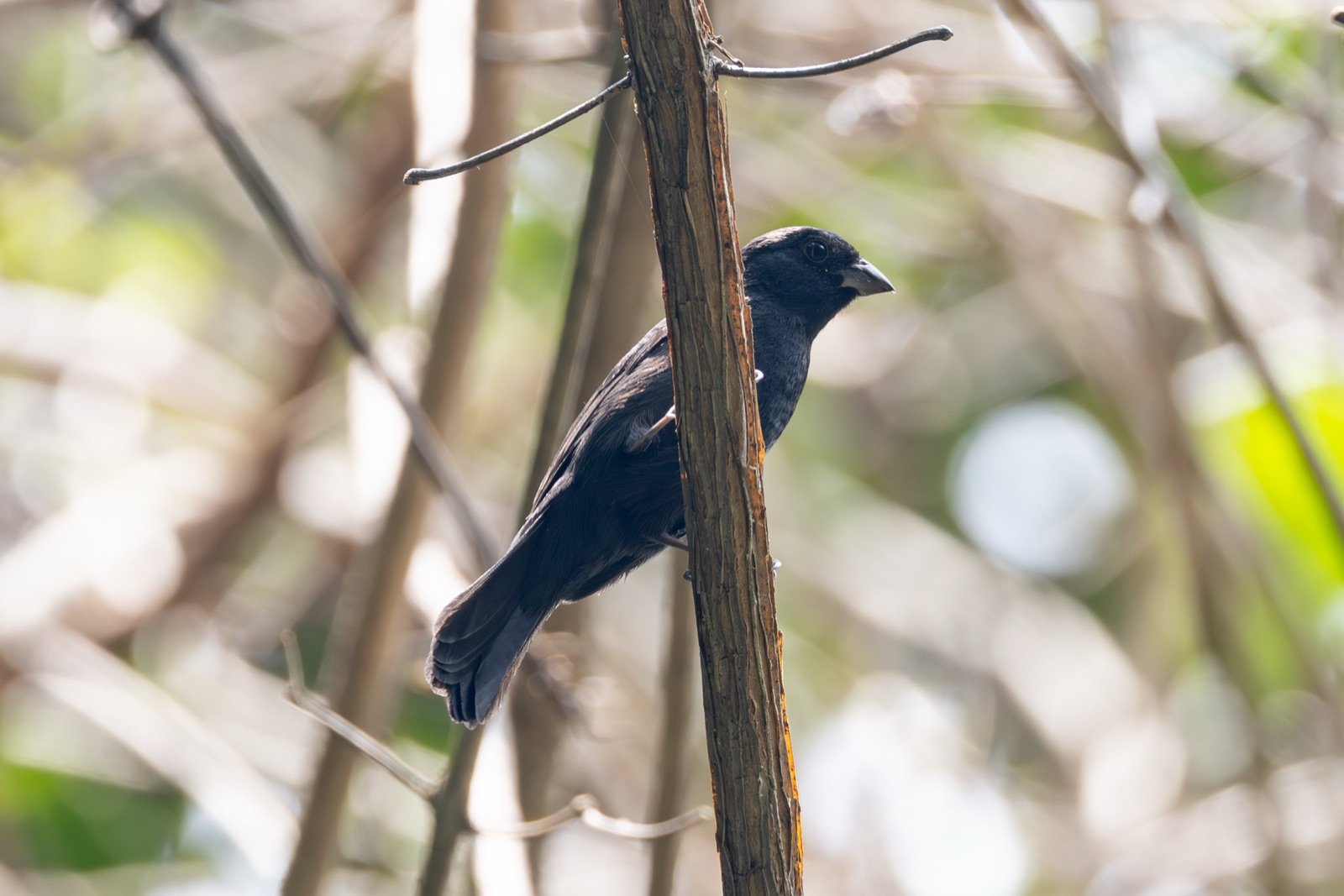
The male is all dark, almost black, with a blue sheen that shows mainly in good light. In shade or poor light he can look plain dark, and a male photographed in good light by a field guide author looked dark blue.
The female is warm cinnamon brown and plain, with no streaks. She is brighter and more rufous than the females of other seedeaters. She is a plain tawny brown, like the lowland Thick-billed Seed-Finch.
This is a small bird, about 11.5 cm long and about 13 g. The bill is thick and cone shaped, not rounded like the bill of a Sporophila seedeater.
What it sounds like
Behaviour and diet
It is usually alone, in pairs or in family groups, and it sometimes accompanies flocks of Black-cheeked Warbler or Yellow-thighed Finch.
Across its range it is a bamboo specialist that feeds on bamboo seed. Bamboo seeds heavily and irregularly, so this resident may wander nomadically, following bamboo flowering.
The nest is a cup of coarse grass lined with finer fibres. It sits about 3 m up in the fork of a tall shrub. A Costa Rican study found the breeding season runs from May to September.
Where it lives
In Costa Rica it lives only at about 1,700 to 2,200 m, while in northern Central America it ranges more widely, from 600 to 2,500 m. It uses ravines, clearings and edges of primary and secondary forest where bamboo grows thickly.
Its presence is tied to heavy bamboo growth at middle and high elevations, and it needs large natural areas of native bamboo to move around. It has been reported in all the mountain ranges, mostly on the Pacific slope, and also on the Caribbean side of the Tilarán and Central Volcanic ranges. It is most regular on the Pacific side of the Central Volcanic range, at 1,700 to 2,000 m. Elsewhere it is found between 1,000 and 2,200 m.
When to see it
It is seen mostly when bamboo is seeding. Seeding is irregular and a patch may hold birds only for a short time, so timing depends on the bamboo, not the calendar.
Similar birds
A male in shade can look plain dark, so wait for good light. Other bamboo-seed birds share its habitat and are also rare, such as Slaty Finch and Slate-colored Seedeater, so the bamboo alone does not confirm the species. Barred Parakeet and Peg-billed Finch may also turn up at seeding bamboo, so do not assume a bamboo bird is the seedeater.
Names and lore in Costa Rica
The Costa Rican Spanish name is Semillero Azulado. Other Spanish names for the species are Semillero Azul and Espiguero Azul, and Espiguero Azul is used in Panama.
Status and conservation
In Costa Rica it is an uncommon to rare resident, very local in the highlands, and the AOCR list codes it R.
Photography tips
Plan to watch for it in bright light, when the male's blue sheen shows and he looks dark blue rather than plain dark. Seeding bamboo patches along roads and streamsides are the places to wait.
How we know this 18 sources, each read on the date shown
- Aves de Costa Rica read 2026-11-04
https://www.avesdecostarica.com/Amaurospiza-concolor.html - Wikipedia read 2026-11-04
https://en.wikipedia.org/wiki/Blue_seedeater - Dialnet (study by José Pablo Castillo) read 2026-11-04
https://dialnet.unirioja.es/servlet/articulo?codigo=7561755 - SACC proposal 969 (LSU) read 2026-11-04
https://www.museum.lsu.edu/~Remsen/SACCprop969.htm - Birds of the World read 2026-11-04
https://birdsoftheworld.org/bow/species/blusee1/cur/introduction?lang=es - Wikipedia (Spanish) read 2026-11-04
https://es.wikipedia.org/wiki/Amaurospiza_concolor - Birding Craft read 2026-11-04
https://birdingcraft.com/wordpress/2018/05/22/elusive-birds-of-costa-rica-the-mountains/ - Birding Craft read 2026-11-04
https://birdingcraft.com/wordpress/tag/bamboo-birds/ - Birding Craft read 2026-11-04
https://birdingcraft.com/wordpress/tag/poas-birding/ - Birding Craft read 2026-11-04
https://birdingcraft.com/wordpress/category/middle-elevations/page/2/ - Birding Craft read 2026-11-04
https://birdingcraft.com/wordpress/2011/09/05/seeding-bamboo-on-the-road-to-volcan-barva/ - Birds for Beer read 2026-11-04
https://birdsforbeer.com/2020/12/01/blue-seedeater-another-new-bird-close-to-home/ - BirdForum Opus read 2026-11-04
https://www.birdforum.net/opus/Blue_Seedeater - iNaturalist Mexico read 2026-11-04
https://mexico.inaturalist.org/taxa/9890-Amaurospiza-concolor - Cloudbridge Nature Reserve species list read 2026-11-04
https://www.cloudbridge.org/wp-content/uploads/2020/04/Bird-Species-List-Costa-Rica-13-April-2020.pdf - Animals Wiki (Fandom) read 2026-11-04
https://animals.fandom.com/wiki/Blue_Seedeater - HandWiki read 2026-11-04
https://handwiki.org/wiki/Biology:Cabanis's_seedeater - Birda read 2026-11-04
https://app.birda.org/species-guide/36068/Cabanis's_Seedeater