Family Icteridae
Bobolink
Dolichonyx oryzivorus
In Spanish: Tordo Arrocero
- Migrant
A rare fall migrant, best checked in rice fields and open grass.
The Bobolink (Tordo Arrocero) is a bird you hope for rather than plan around. In Costa Rica it is a rare fall migrant, passing through from mid-September to October, and it is basically absent in spring.
It carries one of the longest songbird migrations, about 20,000 km a year. It breeds in southern Canada and the northern United States and winters in southern South America, and Costa Rica lies on the route between them.
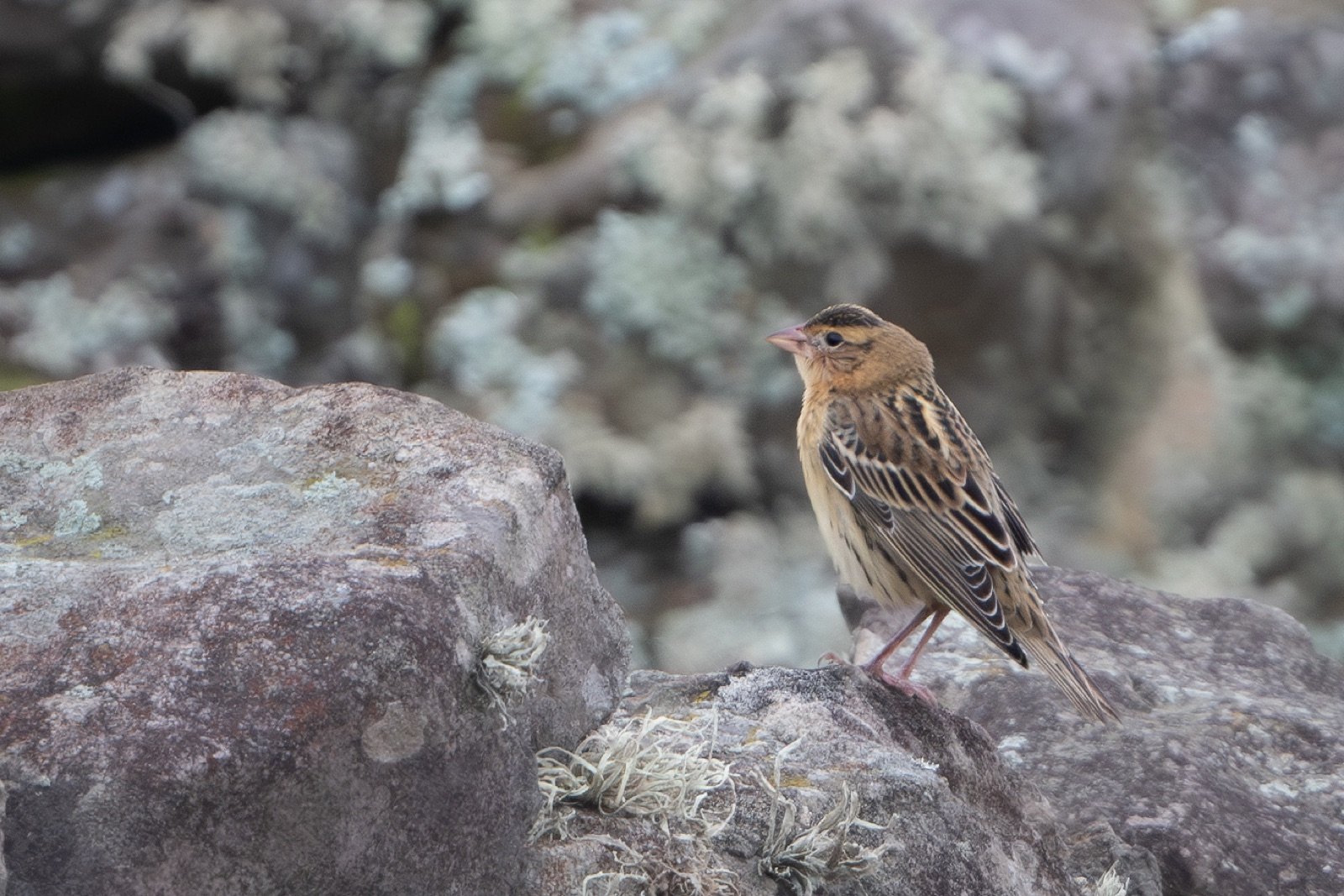
What you will meet here is not the black and cream male of the field guide cover. Birds in Costa Rica wear non-breeding plumage, so a careful look at the head stripes and the breast is the key.
How to find it
Check rice fields and open grassy areas in the southwest, such as around Coto. Scan flocks of cowbirds and grackles, since the Coto bird was with them. Outside the breeding season Bobolinks in general favour rice fields, so those are the places to look. Listen for the sharp 'pink' call note. Treat any candidate with care, and note the head stripes and the breast before you decide.
How to recognise it
Birds seen in Costa Rica are in non-breeding plumage.
Males show bold buffy stripes on the head and a faint reddish nape. They also have heavy black spotting on the breast and black streaks on the flanks.
Females are similar to the winter male but have a clean, unmarked breast.
Across its range, females and non-breeding birds are light brown with dark streaks and head stripes. Breeding males, which you will not see here, are mostly black with a creamy nape and white back and rump.
The build helps too: it is slimmer than other open-country blackbirds and has a more cone-shaped bill.
What it sounds like
Recording: Thomas Koffel, CC BY 4.0, source, read 4 Nov 2026.
Behaviour and diet
The Bobolink feeds mostly on grass and herb seeds, including rice. It is found alone or in flocks, and sometimes mixes with Red-breasted Meadowlarks or Red-winged Blackbirds.
In the one Coto sighting that was reported, the bird was with cowbirds and grackles.
Away from the breeding grounds it eats mainly seeds, while on the breeding grounds it takes insects such as grasshoppers, crickets and beetles.
Where it lives
In Costa Rica the Bobolink uses grassy clearings, crops, scrub and rice fields.
Most reports are along the Caribbean coast. Single birds sometimes move inland to mid elevations, for example near Cartago.
Small flocks turn up now and then near rice fields on the Pacific side, mostly in the southwest around Laurel and Coto.
Spring birds have not been reported on the mainland, though one strayed to Isla del Coco National Park in April and July.
When to see it
Look from mid-September to October, when it passes through as a rare fall migrant. It is basically absent in spring.
Similar birds
A female Red-winged Blackbird has a streaked breast and no crown stripes. Female and winter Bobolinks also look like some female meadowlark-type blackbirds, so a pale buffy streaked bird in rice fields needs care. A Coto 47 bird first reported as a Bobolink was later judged by the AOCR rare bird committee to be a female Red-breasted Blackbird.
Names and lore in Costa Rica
Tordo Arrocero is the Costa Rican list name. Across the Americas, Spanish names for the species include charlatán, tordo charlatán, chambergo, triste-pía, canadiense and chupador. The Latin name oryzivorus means rice eater, and an old English name is rice bird, from its habit of feeding on cultivated grain in winter and on migration.
Status and conservation
The official Costa Rican list marks the Bobolink as migratory (M), and the species is rare in the country.
How we know this 13 sources, each read on the date shown
- Aves de Costa Rica read 2026-11-04
https://avesdecostarica.com/Dolichonyx-oryzivorus.html - Flickr (Costa Rican natural history text, Tordo arrocero) read 2026-11-04
https://www.flickr.com/photos/jobando/29819473034 - Manuel Antonio Birding blog read 2026-11-04
https://manuelantoniobirding.wordpress.com/2014/10/26/yellow-headed-blackbird-and-bobolink-in-costa-rica/ - Wikipedia read 2026-11-04
https://en.wikipedia.org/wiki/Bobolink - Lista Oficial de las Aves de Costa Rica (AOCR) read 2026-11-04
https://listaoficialavesdecostarica.wordpress.com/lista-oficial/lista-oficial-online/ - Cornell Lab, All About Birds read 2026-11-04
https://www.allaboutbirds.org/guide/Bobolink/overview - All About Birds (Cornell Lab) read 2026-11-04
https://www.allaboutbirds.org/guide/Bobolink/sounds - American Bird Conservancy read 2026-11-04
https://abcbirds.org/birds/bobolink/ - Birds of the World (Cornell) read 2026-11-04
https://birdsoftheworld.org/bow/species/boboli/cur/sounds - Holden Forests & Gardens read 2026-11-04
http://www.holdenfg.org/nature-profiles/bobolink/ - Wikipedia (es) read 2026-11-04
https://es.wikipedia.org/wiki/Dolichonyx_oryzivorus - ArgentiNat (from Wikipedia) read 2026-11-04
https://www.argentinat.org/taxa/10487-Dolichonyx-oryzivorus - Hotel Rivel blog read 2026-11-04
https://hotelrivel.online/a-rare-visitor-the-bobolink-in-costa-ricas-mountain-embrace/