Family Icteridae
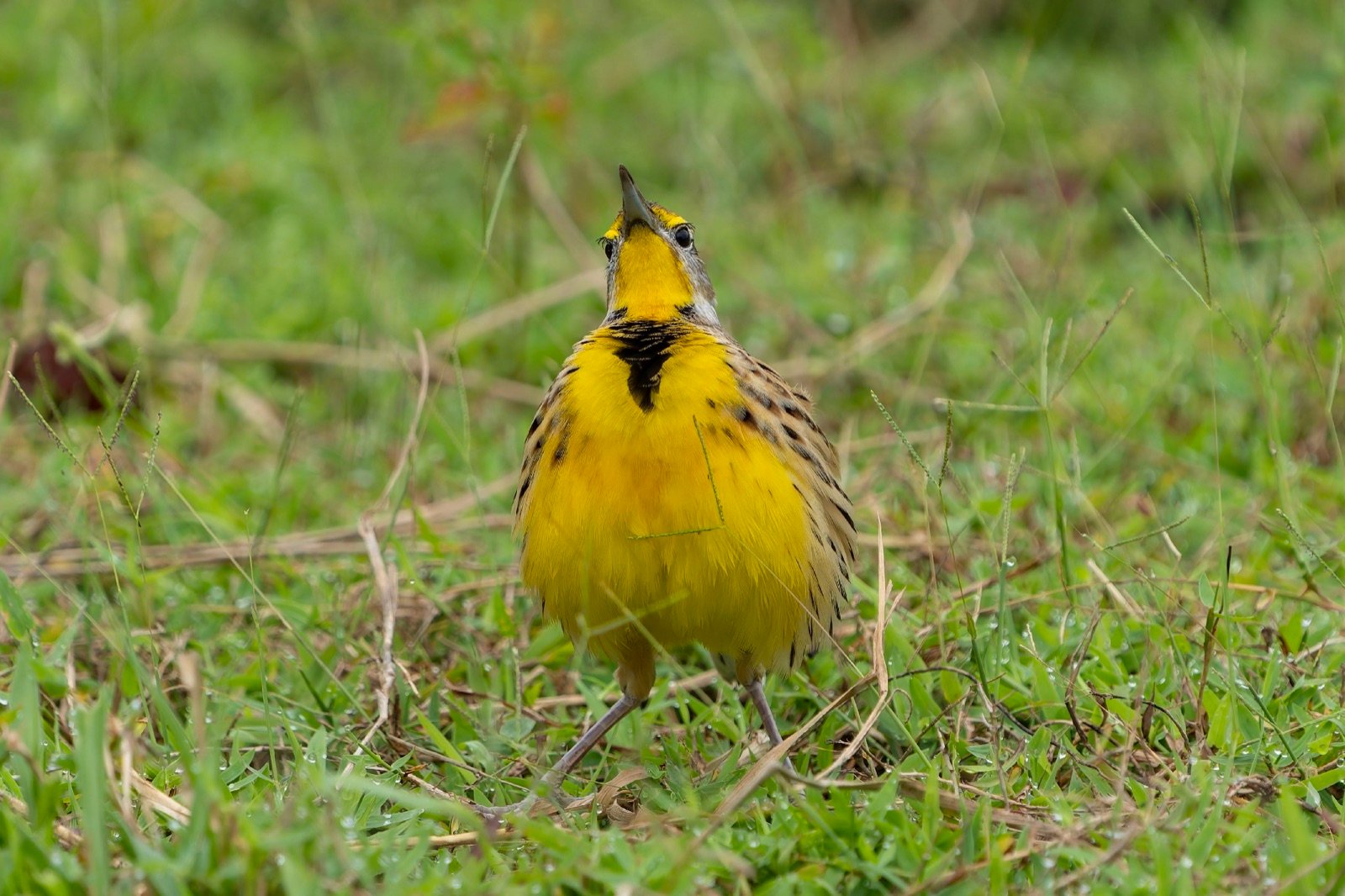
Eastern Meadowlark
Sturnella magna
In Spanish: Zacatero Común (Zacatera, Carmelo)
- Resident
Yellow-breasted farmland bird with a black chest V, singing from fence posts.
The Eastern Meadowlark, Zacatero Común in Spanish, is a common resident across the whole country wherever farming and cattle ranching are well established. It ranges from the lowlands up to about 2500 m, so open farmland almost anywhere in Costa Rica is worth a look.
It is a bird of open country rather than forest, which makes it a friendly first target for a beginning birder. Males often sing from fence posts, wires and poles, so a drive through pasture country is a good way to meet it.
Its story here is one of expansion. It has spread across much of the Caribbean side over roughly 30 years and the southern Pacific slope over roughly 20 years, and it keeps moving into new ground as forests are cleared.
How to find it
Look for it perched on fence posts, wires, poles or treetops in open grassy farmland, where males often sing from these exposed perches. Listen for the whistled song first, then scan the nearest posts. Pastures, crop fields and marshy edges are all worth checking. Despite its bright yellow underparts, a meadowlark can be surprisingly hard to see when it is hidden in tall grass, so be patient. On a trip we build, guests can meet it at places such as Cascadas del Toro, Eco Senderos and Bosques Rio Toro.
How to recognise it
This is a stocky bird about 20 cm long, with a long pointed bill, long legs and a short tail edged in white.
The field marks, in plain terms:
Underparts: bright yellow, crossed by a thick black V on the upper chest.
Head: pale, with thick dark stripes in adults.
Flanks: whitish with dark streaks.
Tail: the three outer feathers are white.
The white outer tail feathers are the detail to watch for. When the bird is startled it flicks its tail open and flashes them, and in flight it alternates quick wingbeats with short glides, tail spread.
What it sounds like
Recording: Guy Babineau, CC BY 4.0, source, read 4 Nov 2026.
Behaviour and diet
It walks on the ground and picks up insects, larvae and other small invertebrates, and adds seeds and fruit. It lives in pairs or family groups for most of the year.
The nest is a domed grass structure with a wide side entrance, usually set in a ground hollow hidden in dense grass. A nest with 3 chicks was seen in May, and fledglings were seen between early April and September.
Where it lives
It uses grass or herb-covered pastures and savannas, crop fields, marshes and gardens. Across Costa Rica it is found wherever farming and cattle ranching are well established, from the lowlands up to about 2500 m.
It has been photographed in dry forest farmland in Guanacaste, in the northern Pacific lowlands, and is also reported in the Central Valley area, with photos from San Mateo and Siquiares in Alajuela province. It is absent from the Pacific lowlands of the interior north.
Similar birds
The Western Meadowlark looks very much like it, and the two are nearly identical in the field. The Eastern usually has a white cheek stripe instead of yellow and shows more white in the tail. Its simple, melancholy whistled song is often the easiest way to separate the two, since the Western sings a complex, flute-like song. Costa Rica also lists the Red-breasted Meadowlark (Leistes militaris) beside the Eastern.
Names and lore in Costa Rica
Costa Ricans call it zacatero común, and the AOCR list adds the alternate names zacatera and carmelo. The name zacatero común is also used in Nicaragua, while other countries use different names, such as chirlobirlo in Colombia, sabanero in Cuba and pastorero oriental in Panama.
Status and conservation
The AOCR list marks it as a resident (R), and it is not threatened in Costa Rica.
Photography tips
Perched males are the best subjects, so scan fence posts, wires, poles and treetops in open grassy farmland. A singing male on an exposed perch often stays put long enough for a photo. Watch for the white outer tail feathers flashing when it flies.
How we know this 14 sources, each read on the date shown
- Aves de Costa Rica read 2026-11-04
https://www.avesdecostarica.com/Sturnella-magna.html - Ecos del Bosque read 2026-11-04
https://ecosdelbosque.com/fauna/sturnella-magna - YouTube (guide Minor Hidalgo) read 2026-11-04
https://www.youtube.com/watch?v=M3h0hdv9Q-w - Alamy photo listing read 2026-11-04
https://www.alamy.com/stock-photo-eastern-meadowlark-sturnella-magna-singing-on-wire-fence-costa-rica-170801978.html - Flickr (Gmo_CR) read 2026-11-04
https://www.flickr.com/photos/gmo_cr/30246518392 - BirdForum Opus read 2026-11-04
https://www.birdforum.net/opus/Eastern_Meadowlark - Wikipedia (es) read 2026-11-04
https://es.wikipedia.org/wiki/Sturnella_magna - Wikipedia read 2026-11-04
https://en.wikipedia.org/wiki/Eastern_meadowlark - Boreal Songbird Initiative read 2026-11-04
https://www.borealbirds.org/bird/eastern-meadowlark - South Carolina DNR read 2026-11-04
https://www.dnr.sc.gov/wildlife/species/songbirds/easternMeadowlark.html - South Dakota Birds read 2026-11-04
https://sdakotabirds.com/species/eastern_meadowlark_info.htm - Cornell Birds of the World read 2026-11-04
https://birdsoftheworld.org/bow/species/easmea/cur/distribution - Macaulay Library read 2026-11-04
https://macaulaylibrary.org/asset/612900595 - Wikipedia, List of birds of Costa Rica read 2026-11-04
https://en.wikipedia.org/wiki/List_of_birds_of_Costa_Rica