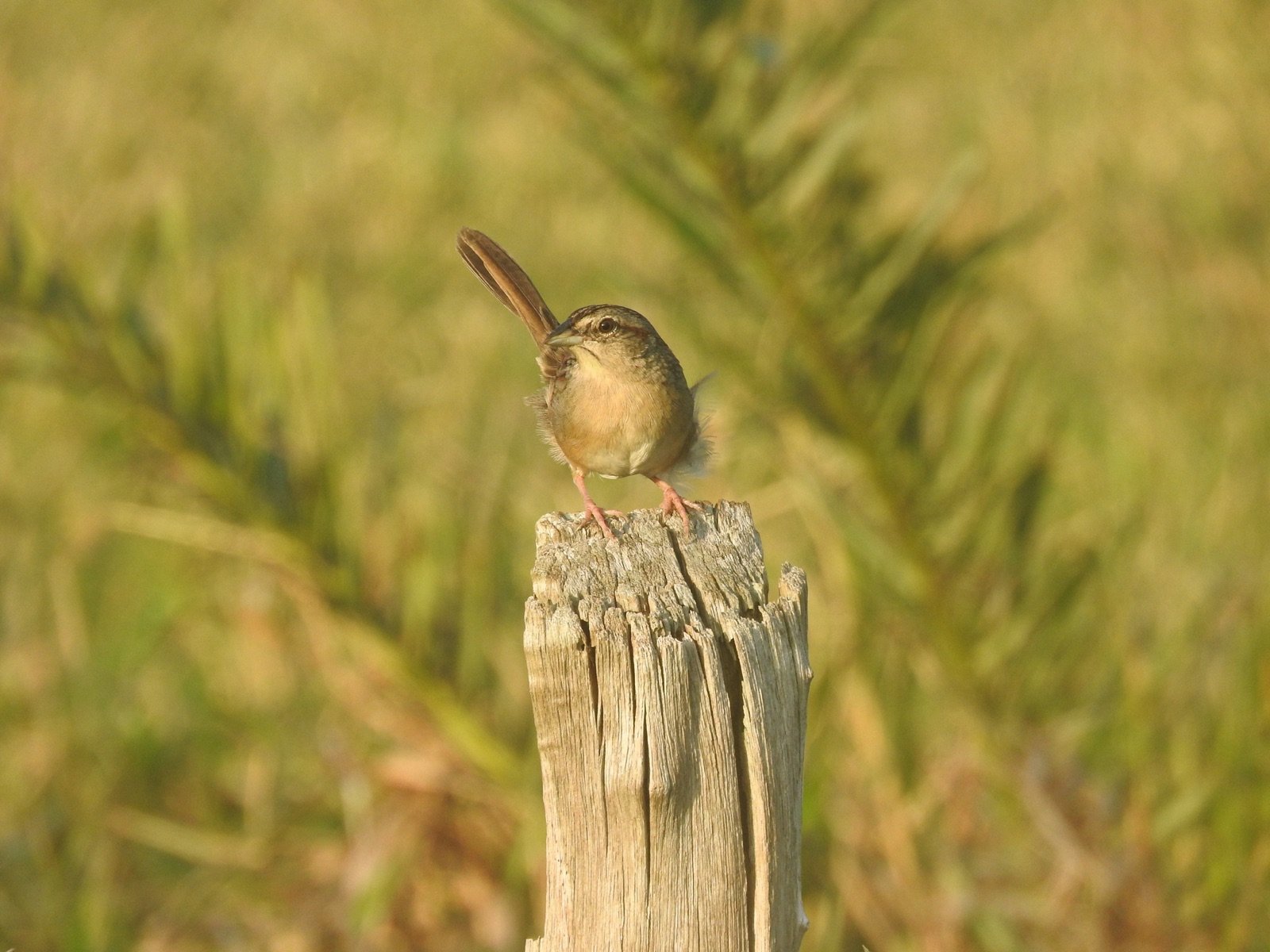
Family Passerellidae
Botteri's Sparrow
Peucaea botterii
In Spanish: Sabanero Pechianteado
- Resident
A secretive grassland sparrow at its southern limit in northwest Guanacaste.
Botteri's Sparrow (Sabanero Pechianteado) is a small, plain sparrow that is far easier to hear than to see. In Costa Rica it lives on the Pacific slope in the northwest, in the Cordillera de Guanacaste, and the country is the southern limit of its range, near the Miravalles volcano.
The Costa Rican birds are the subspecies vulcanica, separate from other populations, and the official Costa Rica list marks the species as a resident.
On a trip we build through northern Costa Rica, the Miravalles area in northern Guanacaste can be combined with Rincon de la Vieja and Tenorio volcanoes. That makes this a bird to plan around with your ears as much as your eyes.
How to find it
Walk quietly through grassland and listen for the thin tsip call note and the bouncing-ball song. Once you hear a male, scan low perches such as grass stems, shrubs and fence posts. Singing males are most visible in summer and may keep singing into the heat of the day. At Rincon de la Vieja it has been seen in a grassy area high on a trail, where Rock Wren and Rusty Sparrow were reported in the same spot. One Costa Rica guide calls the sparrows there hard work and says Botteri's is much easier to see at other sites, so that spot mainly suits local birders.
How to recognise it
This is a small, plain sparrow, and its field marks are subtle. These details describe the species across its whole range, not only Costa Rican birds.
Pale grey body, with brown and blackish streaks on the back.
A chestnut line through the eye and a thin black moustache.
A grey, unstreaked breast, with small yellow patches on the shoulders.
About 15 to 17 cm long, weighing roughly 17 to 26 g.
Because the plumage is so understated, learning the song first will help you far more than studying the feathers.
What it sounds like
Behaviour and diet
Botteri's Sparrow is secretive. It spends much of its time hidden in tall grass and low shrubs, feeding on or near the ground, and it hides in grass clumps while looking for food stealthily. It is often detected by song rather than sight.
During the breeding season males often sing from grass stems, shrubs or fence posts, so a quiet scan of low perches can pay off.
Where it lives
Across its range this sparrow lives in dense grassland and scrub, usually at low elevations. In Costa Rica it is recorded between about 500 and 1,100 m elevation.
Its home here is the Pacific slope of the northwest, in the Cordillera de Guanacaste, where the population is separate from others. The country marks the southern limit of its range, near the Miravalles volcano in Guanacaste.
When to see it
A Costa Rica bird guide says July may be the best month to visit Rincon de la Vieja, because there is less wind and Botteri's and Rusty Sparrows are easier to find.
Similar birds
Botteri's is very hard to tell from Cassin's Sparrow by sight, but the songs differ. Cassin's does not occur in Costa Rica, so this matters mainly farther north. Compared with Cassin's, Botteri's has a clearly streaked back and a bigger bill with a thick base. Its song starts with slow pips and speeds up into a dry rattle.
Names and lore in Costa Rica
Besides the official name Sabanero Pechianteado, Spanish sources also call it chingolo de Botteri and gorrión de Botteri. Other Spanish names listed include zacatonero de Botteri, sabanero dorsilistado, Chingolo Zacaterillo and Pinzón de Botteri. Costa Rican lists use Sabanero Pechianteado.
Status and conservation
The official Costa Rica list marks it as a resident (R), and the IUCN rates the species Least Concern.
Photography tips
Listen first, then scan. Males often sing from grass stems, shrubs or fence posts in the breeding season, so a low perch is your best chance of an open view. Walk quietly, since the thin tsip call note is hard to pinpoint.
How we know this 16 sources, each read on the date shown
- Wikipedia read 2026-11-04
https://en.wikipedia.org/wiki/Botteri's_sparrow - Wikipedia (Spanish) read 2026-11-04
https://es.wikipedia.org/wiki/Peucaea_botterii - SDakotaBirds read 2026-11-04
https://www.sdakotabirds.com/species/botteris_sparrow_info.htm - New Mexico Natural Heritage read 2026-11-04
https://nhnm.unm.edu/bcd/species/328721 - Laura Erickson's For the Birds read 2026-11-04
https://www.lauraerickson.com/bird/botteris-sparrow/ - NatureServe Explorer read 2026-11-04
https://explorer.natureserve.org/Taxon/ELEMENT_GLOBAL.2.104934/Peucaea_botterii - Lista Oficial de las Aves de Costa Rica read 2026-11-04
https://listaoficialavesdecostarica.wordpress.com/lista-oficial/lista-oficial-online/ - Birding Craft (Costa Rica bird finding guide) read 2026-11-04
https://birdingcraft.com/wordpress/category/costa-rica-bird-finding-guide/ - Birding Craft read 2026-11-04
https://birdingcraft.com/wordpress/2015/11/25/birding-costa-rica-at-rincon-de-la-vieja-what-to-expect-in-2016/ - Cornell Birds of the World read 2026-11-04
https://birdsoftheworld.org/bow/species/botspa/cur/introduction - All About Birds (Cornell Lab) read 2026-11-04
https://www.allaboutbirds.org/guide/Botteris_Sparrow/overview - Texas Breeding Bird Atlas read 2026-11-04
https://txtbba.tamu.edu/species-accounts/botteris-sparrow/ - Costa Rica Focus read 2026-11-04
https://www.costaricafocus.com/ - Dibird read 2026-11-04
https://dibird.com/species/botteri-s-sparrow/ - Birding Craft read 2026-11-04
https://birdingcraft.com/wordpress/2017/06/21/halfway-point-during-a-year-of-birding-in-costa-rica-616-down-84-more-to-go/ - SINAC (La Gaceta 2017) read 2026-11-04
https://www.sinac.go.cr/ES/visasilves/Enlaces%20Inters/05.%20Lista%20especies%20en%20peligro%20de%20extinci%C3%B3n%20y%20poblaciones%20reducidas.pdf