Family Laridae
Bridled Tern
Onychoprion anaethetus
In Spanish: Charrán Embridado
- Resident
A dark-backed tern of rocky islands and warm coastal seas
The Bridled Tern (Charrán Embridado, Onychoprion anaethetus) is a medium-sized tern, about 36 cm long, that breeds on rocky islands off the north Pacific coast of Costa Rica. The Pacific birds belong to the subspecies nelsoni, a rare form with fewer than 350 breeding pairs estimated across Costa Rica and Mexico.
You do not walk up to this bird. You find it by scanning, from a boat over warm coastal water or from the shore at places such as Puntarenas and Tortuguero, where a careful look through distant terns is often what turns it up.
How to find it
Look for it around floating seaweed patches (Sargassum) and other drifting debris at sea, where it forages for fish, squid and other small prey. Boat trips over warm coastal waters give the best chance. From land, seawatching works too. Scan flocks of distant terns carefully with a scope, because it can be missed among them. Look for a darker gray back and a hint of a head pattern.
How to recognise it
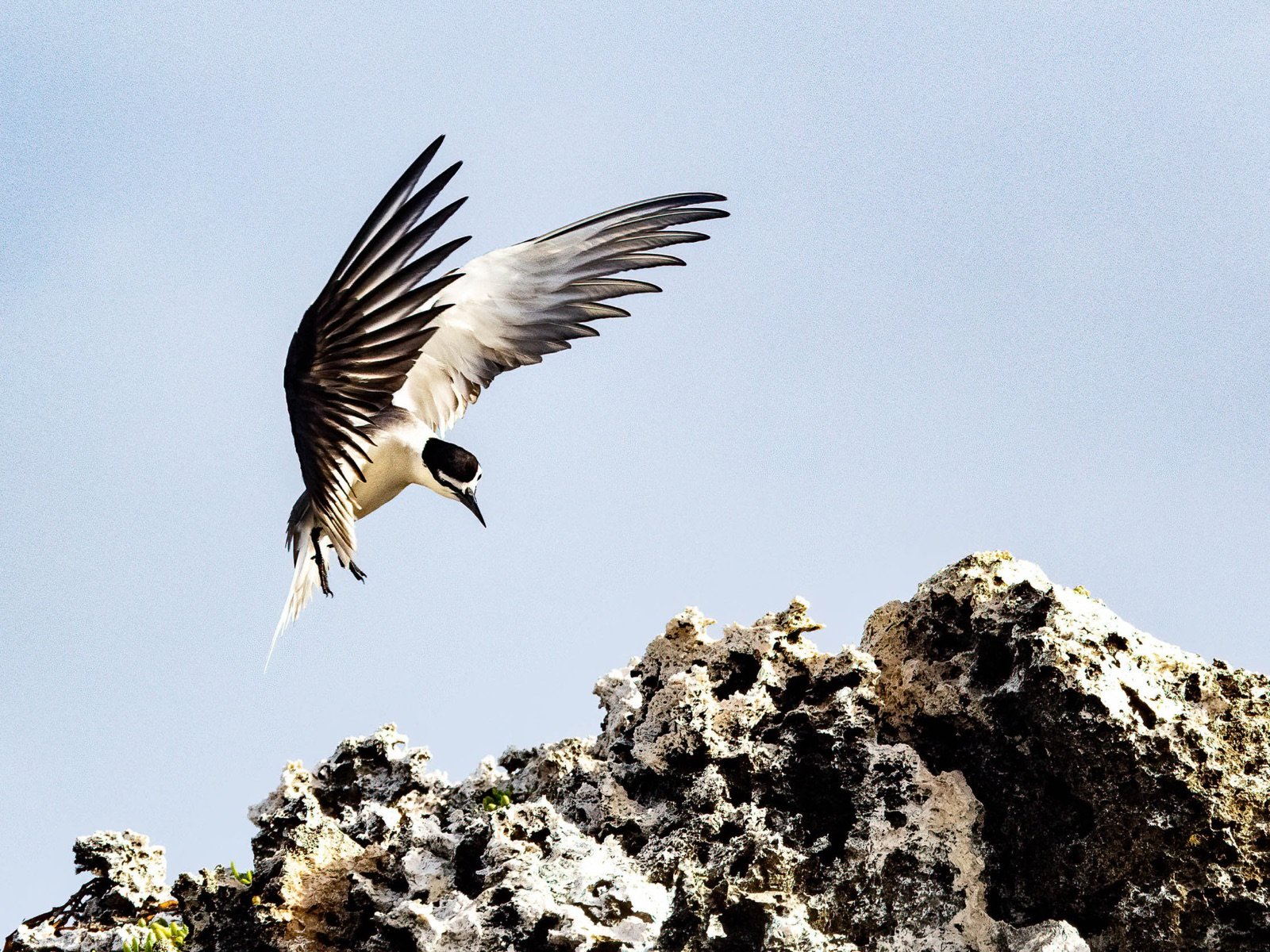
Start with size and shape: a medium-sized tern, about 36 cm long, with a dark back and a deeply forked tail. Breeding adults show a black crown and a black line from the bill to the eye. The bill and legs are black.
A pale nape collar and a thin white forehead patch that extends into a short eyebrow stripe help separate it from the Sooty Tern. Outside the breeding season the crown is mostly white with black streaks at the back. Young birds look like non-breeding adults but are paler above, with a scaly look. The Pacific form nelsoni has a darker back than other forms.
What it sounds like
Behaviour and diet
Birds are usually alone or in small, loose groups. At sea it rarely feeds in big flocks and stays close to floating debris, especially floating sargassum seaweed. It nests in sheltered crevices.
It feeds mostly by flying low, hovering and dipping to pick items off the water surface, and it seldom plunge-dives. It may gather where predatory fish drive small fish to the surface.
Where it lives
In Costa Rica it nests or rests on rocky islands just off the coast. It breeds on islands off the north Pacific coast, and one Costa Rican paper reports nesting among bunchgrass above sea cliffs, with cardón cacti nearby. Possible or known nesting areas include Santa Catalina Island in the southern Gulf of Papagayo and the islands around the Santa Elena Peninsula. The subspecies nelsoni breeds on islets including some in Guanacaste, in the northwest. Off the Caribbean coast it is an occasional visitor, and the nearest nesting colonies are off Belize and Venezuela.
When to see it
It is a breeding resident on the north Pacific islands, mostly from March to April and up to September. At other times it is rare or only occasional there, though a study off the Pacific coast found scattered birds in every season, usually fairly close to shore. Off the Caribbean coast it appears mostly between August and September.
Similar birds
The Sooty Tern is the usual comparison. The Bridled is slimmer and a little paler on the back, with a whitish collar across the hindneck, and in flight it shows more white in the outer tail and under the wingtip. It tends to nest in more scattered colonies and is more likely to be seen close to land.
Status and conservation
The AOCR list marks it as a rare resident and a migrant (RR,M), while globally it is rated Least Concern.
Photography tips
Use a scope on distant tern flocks and look for the darker gray back and a hint of a head pattern. Drifting seaweed patches are where it is most likely to settle or forage.
How we know this 12 sources, each read on the date shown
- Aves de Costa Rica read 2026-11-04
https://avesdecostarica.com/Onychoprion-anaethetus.html - Cornell Birds of the World read 2026-11-04
https://birdsoftheworld.org/bow/species/briter1/cur/movement?lang=es - SEO/BirdLife read 2026-11-04
https://seo.org/ave/charran-embridado/ - DiBird read 2026-11-04
https://dibird.com/species/bridled-tern/ - All About Birds, Cornell Lab of Ornithology read 2026-11-04
https://www.allaboutbirds.org/guide/Bridled_Tern/overview - New Information on Costa Rican Waterbirds (ResearchGate) read 2026-11-04
https://www.researchgate.net/publication/269579522_New_Information_on_Costa_Rican_Waterbirds - Observation frequency and seasonality of marine birds off the Pacific coast of Costa Rica (ResearchGate) read 2026-11-04
https://www.researchgate.net/publication/297895427_Observation_frequency_and_seasonality_of_marine_birds_off_the_Pacific_coast_of_Costa_Rica - Área de Conservación Tortuguero (SINAC) read 2026-11-04
https://www.acto.go.cr/conociendo-las-aves-marinas-del-caribe-noreste-de-costa-rica-dos-anos-de-observaciones-en-el-mar/ - Birding Craft read 2026-11-04
https://birdingcraft.com/wordpress/2023/03/27/costa-rica-birding-news-march-and-april-2023/ - Birding Craft read 2026-11-04
http://birdingcraft.com/wordpress/tag/puntarenas-seawatching/ - Birding Craft read 2026-11-04
https://birdingcraft.com/wordpress/tag/pelagic-birding-in-costa-rica/ - Audubon Field Guide read 2026-11-04
https://www.audubon.org/field-guide/bird/bridled-tern