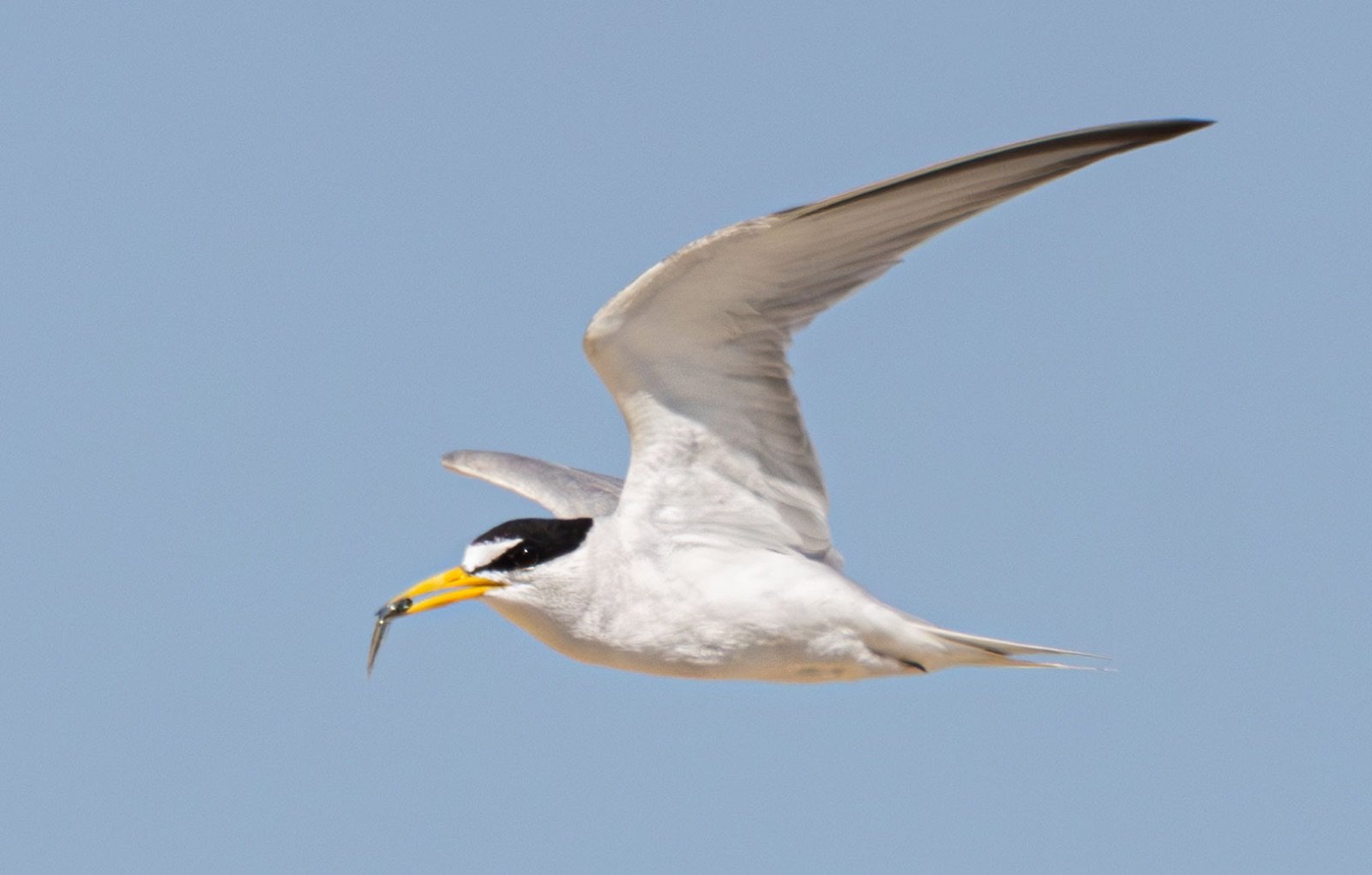
Family Laridae
Least Tern
Sternula antillarum
In Spanish: Charrán Chico
- Migrant
A tiny, quick-diving migrant tern of the Pacific coast in late summer.
The Least Tern (Charrán Chico) is a very small tern, about 22 to 24 cm long, and in Costa Rica it is a passing visitor. The official national list marks it as M, a migrant, so it does not breed here.
It usually passes through in late August and September, mostly along the Pacific coast. The Pacific subspecies browni, which breeds from central California to Mexico and winters mostly in Central America, is the form most likely to reach us.
On a trip we build around the Gulf of Nicoya, a morning of seawatching at Puntarenas is the way to look for small groups flying past and feeding near a distant sand bar.
How to find it
Seawatch from Puntarenas, a port city on a peninsula in the Gulf of Nicoya. Small groups can fly past and feed near a distant sand bar. The lighthouse area is a seawatching spot where Least Terns have been seen passing by. Watch for tiny terns making quick, repeated dives. Go early, since one large gathering had left by 9 a.m. Bring a spotting scope, because the flock there was far away. If you reach a beach or shoreline, look for birds standing or walking, where the dark wing tips show best.
How to recognise it
Think tiny, pale and quick.
Size: about 22 to 24 cm long, a very small tern.
Body: pale gray above and white below.
Head: white, with a black cap and a black line through the eye.
Wings: pale gray with conspicuous black outer wing tips.
Legs: yellowish.
Bill in summer: yellow with a small black tip.
Bill in winter: all blackish, with a larger white forehead and a smaller, less sharply defined cap. This is the plumage to expect in Costa Rica, and birds watched from Puntarenas in September were in clean white winter plumage with only a little black.
What it sounds like
Behaviour and diet
Least Terns fly low over water with fast, jerky wingbeats. The posture looks hunched, and the bill points slightly downward.
In Costa Rica they are easy to pick out by their quick, repeated dives. Small groups zip by and feed over a sand bar.
They eat mostly small fish from fresh or salt water, and sometimes small crustaceans and insects.
Gatherings can be brief. One big September group at Puntarenas was there in the morning and had all left by 9 a.m.
Where it lives
Away from Costa Rica, the species breeds on open sandy beaches and river sandbars. It winters widely along the sea coasts of Central and South America.
In Costa Rica it is a bird of the coast, mostly the Pacific side. Older records come from Pacific beaches, including Playa Naranjo in Santa Rosa and the area near Puntarenas, where it was described as a sporadic visitor and possibly a rare winter resident in some years.
When to see it
Least Terns usually pass through Costa Rica in late August and September, mostly along the Pacific coast. A September report from Puntarenas lists them among that month's expected migrants and saw them flying toward the inner Gulf of Nicoya.
Similar birds
The Yellow-billed Tern is a close relative that is paler gray above and has a longer black bill tip, but it is a rare vagrant in Costa Rica. The Least Tern also has a shorter black bill tip than the Peruvian Tern, whose underparts are light gray rather than white. Compared with the Old World Little Tern, it has a gray rump and tail, not white.
Names and lore in Costa Rica
Costa Rica's Spanish name is Charrán chico. Other Spanish names for the species include charrán mínimo, charrán menudo, gaviotín enano and gallito marino. Other countries use different names, such as Gaviotica in Cuba and Gaviotín Menor in Ecuador.
Status and conservation
The official Costa Rica bird list marks the Least Tern as M, a migrant, so it is not a breeding resident.
Photography tips
Distance is the challenge. The 250-bird flock on the Puntarenas sand bar was far away, and a birder needed a spotting scope at 40x to confirm every bird was a Least Tern. Arrive early, as the birds there had all left by 9 a.m.
How we know this 16 sources, each read on the date shown
- Lista Oficial de las Aves de Costa Rica (AOCR) read 2026-11-04
https://listaoficialavesdecostarica.wordpress.com/lista-oficial/lista-oficial-online/ - Birds Colombia (from Spanish Wikipedia) read 2026-11-04
https://birdscolombia.com/2018/08/02/gaviotin-enano-least-tern-sternula-antillarum/ - Wikipedia read 2026-11-04
https://en.wikipedia.org/wiki/Least_tern - Cornell Birds of the World read 2026-11-04
https://birdsoftheworld.org/bow/species/leater1/cur/introduction?lang=es - iNaturalist guide (GTM Research Reserve) read 2026-11-04
https://www.inaturalist.org/guide_taxa/278431 - Wikipedia (Spanish) read 2026-11-04
https://es.wikipedia.org/wiki/Sternula_antillarum - Costa Rica Living and Birding read 2026-11-04
https://birdingcraft.com/wordpress/2023/10/03/october-the-most-exciting-month-for-birding-in-costa-rica/ - Costa Rica Living and Birding read 2026-11-04
https://birdingcraft.com/wordpress/tag/seawatching-in-costa-rica/ - Audubon Field Guide read 2026-11-04
https://www.audubon.org/field-guide/bird/least-tern - Birds of the World (Cornell) read 2026-11-04
https://birdsoftheworld.org/bow/species/leater1/1.0/introduction?lang=es&printable= - New Information on Costa Rican Waterbirds read 2026-11-04
https://www.researchgate.net/publication/269579522_New_Information_on_Costa_Rican_Waterbirds - Avibase read 2026-11-04
https://avibase.bsc-eoc.org/species.jsp?avibaseid=BE78E765F1DA8123 - Avibase read 2026-11-04
https://avibase.bsc-eoc.org/checklist.jsp?region=CR - Biodiversity Atlas of LA read 2026-11-04
https://biodiversityla.org/species/threatened/california-least-tern/ - Costa Rica Living and Birding read 2026-11-04
http://birdingcraft.com/wordpress/ - EarthLife read 2026-11-04
https://earthlife.net/least-terns/