 Brown Violetear
Family Trochilidae
Brown Violetear
Colibri delphinae
In Spanish: Colibrí Orejivioláceo Pardo
- Resident
A dull brown hummingbird with a violet ear patch, local in the foothills.
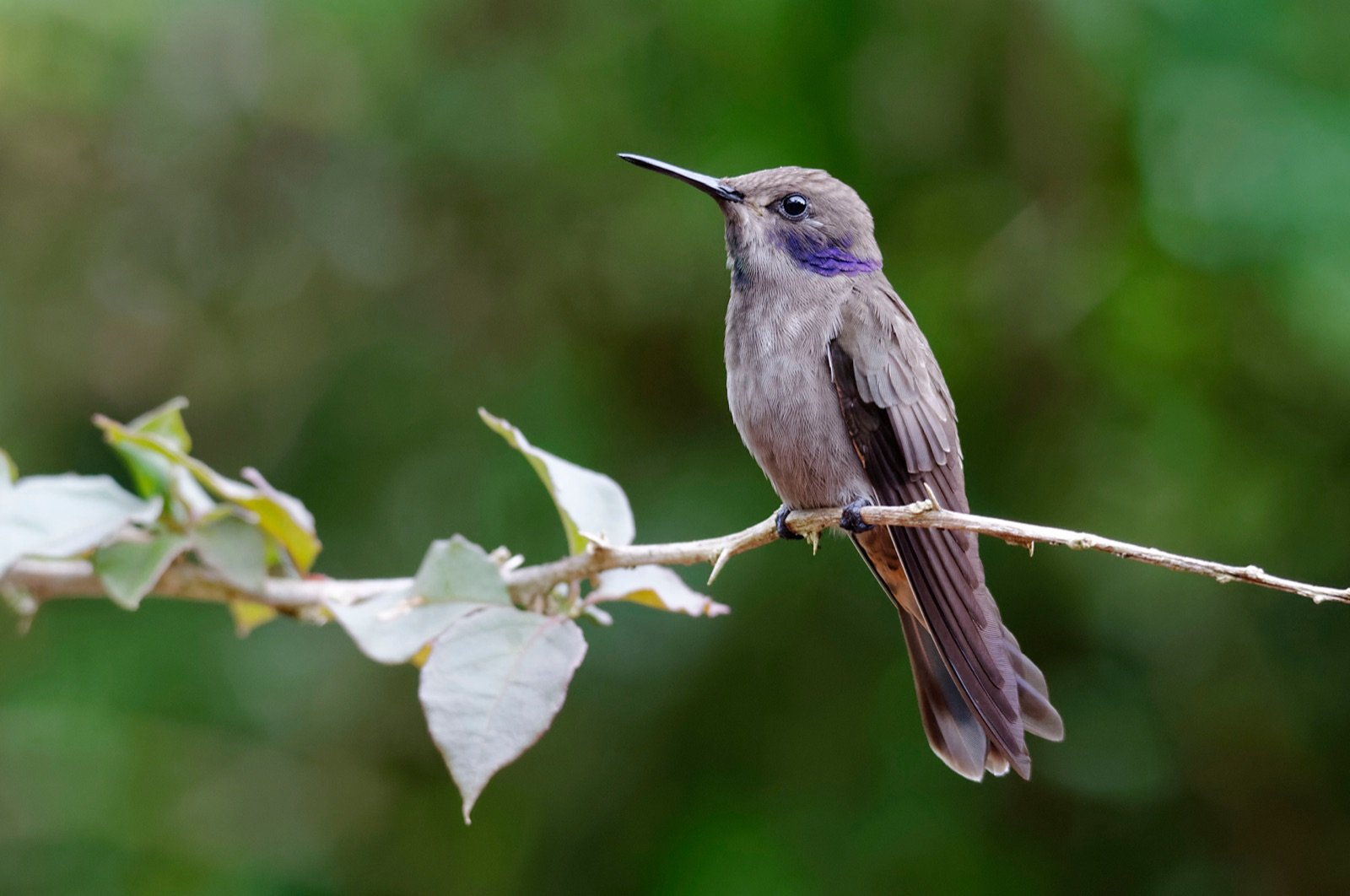
Most violetears are green, so a brown one stops you. The Brown Violetear is a fairly large, dull hummingbird, mostly grayish brown, with a violet ear patch and a pale cheek stripe.
In Costa Rica it is an uncommon, local resident of all the main mountain ranges and the higher parts of the Osa Peninsula. On a trip we build, the places to meet it are forest edges, flowering trees and foothill feeders, where it is bold and easy to watch.
How to find it
Look at forest edges and clearings, where it drops to shrub height to feed. Flowering trees and hummingbird feeders in the foothills are good places to watch. In the breeding season, listen along edges for the scattered singing groups of males, which is a good way to locate them. A viewing balcony such as the one at Soda Cinchona lets you watch hummingbirds from very close, because they ignore the people at the tables. A private garden in Sarapiquí with feeders and a covered dining area has also produced it on a birding trip.
How to recognise it
Look for a fairly large, dull hummingbird. It is mostly grayish brown with a green gloss on the back.
The face carries a violet ear patch and a pale cheek stripe, like the one on a hermit hummingbird. The bill is short and dark, and the tail is broad. The throat has a shiny green patch with blue along its lower edge. The tail is bronze green with a pale tip over a dark band. Across its range it also shows a rufous rump and grayer underparts, and the feet are dark.
Females look like males but have a smaller throat patch. Range-wide it is about 11.5 cm long and weighs about 6.5 g. Young birds have wide cinnamon edges on the upperpart feathers and show little or no violet on the face.
What it sounds like
Recording: John G. Phillips, CC BY 4.0, source, read 4 Nov 2026.
Behaviour and diet
It feeds mostly on small, short flowers of trees and epiphytes, and it often catches flying insects in clearings for protein. It is rarely territorial, yet it is very aggressive around other hummingbirds. It dominates smaller hummingbirds at flowers and can keep others away from feeders. Rather than defending one patch, it uses feeding routes that link flowering plants. When not breeding, it may move considerable distances into adjacent lowlands.
Where it lives
In Costa Rica it mostly uses the forest canopy and tall second growth, and it comes down to shrub level at forest edges and clearings. On the Caribbean side it lives at roughly 400 to 1100 m, and on the Pacific side it reaches about 1600 m. It occurs in all the main mountain ranges and in the higher parts of the Osa Peninsula. Range-wide it prefers humid evergreen forest, especially semi-open second growth, edges, shrubby patches and shade coffee plantations.
When to see it
A Costa Rican source says it breeds from November to April or May, and males sing in scattered groups in the lower canopy along forest edges at that time.
Similar birds
Other violetears in Costa Rica are mostly green, including the Lesser Violetear and the rare Mexican Violetear. The Brown Violetear stands out for its dull brown plumage and its short, straight bill.
Names and lore in Costa Rica
Costa Ricans use the AOCR name Colibrí Orejivioláceo Pardo, and one Costa Rican bird site also lists the plain nicknames 'colibrí' and 'gorrión'. Colombia says 'chillón pardo', Honduras 'orejimorada café' and Ecuador 'orejivioleta parda'.
Status and conservation
The AOCR list marks it as a resident (R), and it is an uncommon, local bird in Costa Rica.
Photography tips
Flowering trees and foothill feeders are the best bet, since it drops to shrub height at forest edges and clearings to feed. Balcony feeders let you shoot from close range.
How we know this 16 sources, each read on the date shown
- Aves de Costa Rica read 2026-11-04
https://avesdecostarica.com/Colibri-delphinae.html - Flickr (Costa Rican bird guide text) read 2026-11-04
https://www.flickr.com/photos/jobando/29464307972 - Ecos del Bosque read 2026-11-04
https://ecosdelbosque.com/fauna/colibri-delphinae - Tripadvisor read 2026-11-04
https://www.tripadvisor.com/LocationPhotoDirectLink-g12024619-d9981285-i175571509-Quinta_Galeon_Lodge-El_Jardin_Province_of_San_Jose.html - Animalia read 2026-11-04
https://animalia.bio/brown-violetear - Cornell Birds of the World read 2026-11-04
https://birdsoftheworld.org/bow/species/brvear1/cur/introduction - Costa Rica Birding Trips read 2026-11-04
https://costaricabirdingtrips.com/trochilidae/brown-violetear-colibri-delphinae - Avibase read 2026-11-04
https://avibase.bsc-eoc.org/checklist.jsp?region=CR - Wikipedia read 2026-11-04
https://en.wikipedia.org/wiki/Violetear - Lista Oficial de las Aves de Costa Rica (AOCR) read 2026-11-04
https://listaoficialavesdecostarica.wordpress.com/lista-oficial/lista-oficial-online/ - Anthony Lujan read 2026-11-04
https://www.anthony-lujan.com/hummingbirds/brown-violetear - El Ecoturista read 2026-11-04
https://elecoturista.com/internacional/costa-rica-un-destino-ornitologico-top-y-ii-centro-y-norte/ - Flickr (Costa Rican bird guide text) read 2026-11-04
https://www.flickr.com/photos/jobando/28817683792 - Wikipedia (es) read 2026-11-04
https://es.wikipedia.org/wiki/Colibri_delphinae - Birda read 2026-11-04
https://app.birda.org/species-guide/2789/Brown_Violetear - Cloudbridge Nature Reserve read 2026-11-04
https://www.cloudbridge.org/wp-content/uploads/2020/04/Especies-de-Aves-Costa-Rica-13-April-2020.pdf