Family Trochilidae
Lesser Violetear
Colibri cyanotus
In Spanish: Colibrí Orejivioláceo Verde
- Resident
Green hummingbird with violet ear patches, common in the highlands.
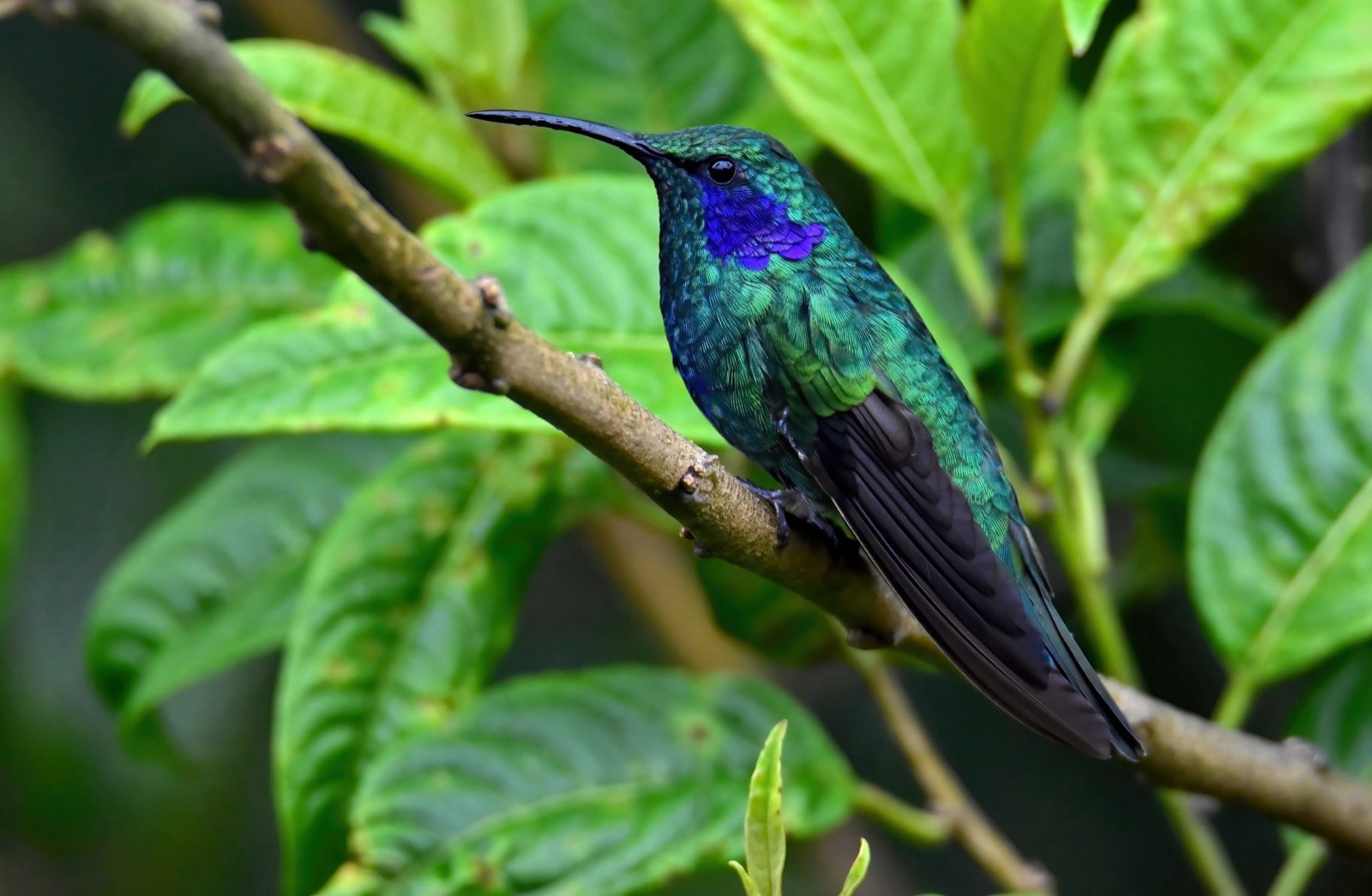
The Lesser Violetear is a mostly shining green hummingbird with a glittering violet patch on each side of the neck that looks like an ear. In Costa Rica it lives in the highlands, in montane forest, forest edge and gardens with flowering shrubs.
On trips we build, guests meet it in the highland garden and feeder areas of San Gerardo de Dota. It comes readily to nectar feeders and shows no fear of people.
How to find it
For much of the year males sing nonstop from high perches that overlook open areas with flowers, so scan exposed high twigs. Several males often share one area. Nectar feeders and flowering shrubs are reliable places to watch, since it shows no fear of people. Look to pastures, living fences and forest edges as well as the forest itself.
How to recognise it
This is a medium-sized hummingbird that looks mostly shining green. The feature that gives it its name is a glittering violet patch on each side of the neck, which looks like an ear. The bill is black and nearly straight. The tail is metallic blue-green with bronzy central feathers, and a bold black band sits near the tip. Most Lesser Violetears have a plain green breast. Some Costa Rican birds may show a little blue on the underparts. When a male is excited the violet patches stand out from the head like small ears.
What it sounds like
Behaviour and diet
It usually feeds alone but gathers at flowering trees, feeding from mid-level to the canopy, and it defends feeding spots. At feeders or flowering shrubs it spends much of its time chasing other hummingbirds, though more aggressive species such as the Fiery-throated Hummingbird and the mountain-gems often push males away. Males display their violet ear patches, and one was photographed at Los Quetzales National Park showing them to a Green-crowned Brilliant.
Where it lives
The Costa Rican form lives in the highlands. It is common in montane forest, forest edge and high-elevation gardens with flowering shrubs. Across its whole range it is commonly found at about 1,200 to 2,300 m, and occasionally lower, to around 900 m. In Costa Rica it is a common to abundant resident in the highlands south of the Cordillera de Guanacaste. It prefers open ground with scattered shrubs and trees, including pastures, living fences, regrowth and forest edges.
When to see it
In Costa Rica it breeds from October to March. Outside the breeding season it spreads down the mountains to about 1,000 m.
Similar birds
No similar species shares its range in Costa Rica and Panama. The Brown Violetear is larger and overlaps widely, but the Lesser replaces it at higher altitudes, so higher up the Lesser is the one to expect.
Names and lore in Costa Rica
The Costa Rican Spanish name is Colibrí Orejivioláceo Verde, sometimes shortened to Orejivioláceo verde. Other countries use different names for the same bird, such as orejivioláceo menor in Panama and colibrí chico in Argentina.
Status and conservation
The AOCR official list gives it as a resident species in Costa Rica, and it is rated Least Concern.
Photography tips
Scan exposed high twigs above flowery open areas, where males sing from perches. Feeders put it close, since it is bold around people. At feeders and shrubs it keeps chasing other hummingbirds, so expect quick movement.
How we know this 20 sources, each read on the date shown
- Wikipedia read 2026-11-04
https://en.wikipedia.org/wiki/Lesser_violetear - Cornell Birds of the World read 2026-11-04
https://birdsoftheworld.org/bow/species/lesvio1/cur/introduction - Birda species guide read 2026-11-04
https://app.birda.org/species-guide/2793/Lesser_Violetear - Anthony Lujan read 2026-11-04
https://www.anthony-lujan.com/hummingbirds/lesser-violetear - Wikipedia (Spanish) read 2026-11-04
https://es.wikipedia.org/wiki/Colibri_cyanotus - Flickr (Mario E. Campos S.) read 2026-11-04
https://www.flickr.com/photos/103263246@N06/10984138316 - Martin Perez blog read 2026-11-04
https://www.martin-perez.es/2024/04/los-colibries-simbolos-de-belleza-y.html - Flickr (Eduardo Mena) read 2026-11-04
https://www.flickr.com/photos/eduardomena/13961423309/in/photostream/ - Cornell Birds of the World read 2026-11-04
https://birdsoftheworld.org/bow/species/lesvio1/cur/breeding - Lista Oficial de las Aves de Costa Rica read 2026-11-04
https://listaoficialavesdecostarica.wordpress.com/lista-oficial/lista-oficial-online/ - Aves de Colombia (BirdsColombia) read 2026-11-04
https://birdscolombia.com/2017/06/29/colibri-verdemar-colibri-cyanotus/ - Flickr (Costa Rican natural history text, Paraiso del Quetzal) read 2026-11-04
https://www.flickr.com/photos/jobando/26300567735 - Travel To Eat read 2026-11-04
https://traveltoeat.com/exquisite-hummingbirds-in-costa-rica/ - Reef to Rockies (WBU Costa Rica 2025 trip report) read 2026-11-04
https://reefstorockies.com/wbu-costa-rica-2025/ - Frame to Frame read 2026-11-04
https://frametoframe.ca/dazzled-by-hummingbirds-monteverde-costa-rica/ - PSNP blog (lightshedder) read 2026-11-04
https://psnp.info/p4td_/?cat=356&paged=2 - Ecos del Bosque read 2026-11-04
https://ecosdelbosque.com/familias/trochilidae - Infobae (New York Times) read 2026-11-04
https://www.infobae.com/america/the-new-york-times/2025/11/04/guia-para-viajar-a-costa-rica-sin-gastar-mucho/ - Cornell Birds of the World read 2026-11-04
https://birdsoftheworld.org/bow/species/lesvio1/cur/identification - Wikipedia read 2026-11-04
https://en.wikipedia.org/wiki/Brown_Violetear