Family Strigidae
Burrowing Owl
Athene cunicularia
In Spanish: Lechuza Llanera
- A
A very rare wanderer; one confirmed record in 120 years.
The Burrowing Owl (Lechuza Llanera) is a small owl that stands on the ground in daylight, and in Costa Rica it is a very rare visitor. On 28 November 2020 one was seen at La Ceiba, Orotina, Alajuela, the first confirmed Costa Rican record in 120 years.
Before that, the last confirmed record was a specimen collected in December 1900 on the southwestern slope of Irazú volcano.
It is not a realistic target on a Costa Rica trip, and it is much easier to see in other countries. We include it so you know what it is and why it makes news when it turns up.
How to find it
Do not plan a trip around this owl. The farmland at Orotina is not a place visitors can count on for it.
The 2020 bird was seen at about 1:30 pm on the ground beside a dirt road between a rice field and grassland. The field had many bare patches that looked like the open grassland this owl normally uses.
Finding one in the huge pastures and farmland of Guanacaste has been compared to looking for a needle in a haystack. If you do scan open ground, range-wide guides suggest looking for the upright posture at burrow entrances and listening for the coo at dawn and dusk.
How to recognise it
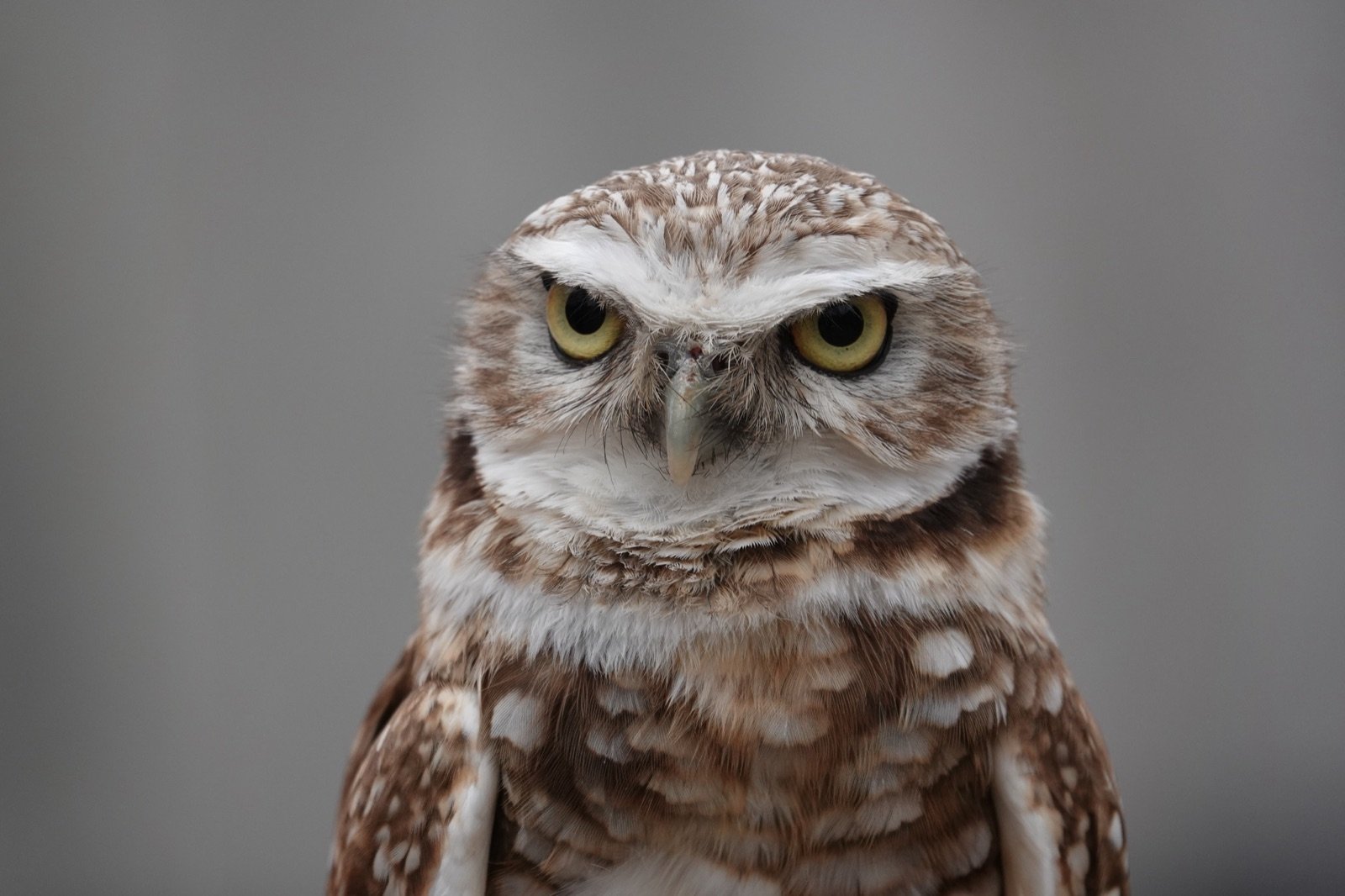
This is a small owl with long, mostly bare grayish legs.
Look for these marks:
no ear tufts;
a flat face;
bright eyes (yellow, as the 2020 observers noted);
strong white eyebrows;
a white chin patch.
Adults have brown heads and wings with white spots. The chest and belly are white with brown spots or bars. The body is slightly larger than an American robin.
The 2020 observers identified their bird by the yellow eyes, plumage markings and typical posture on the ground, and treated these as enough to separate it from other Costa Rican owls.
What it sounds like
Recording: Zac Peterson, CC BY 4.0, source, read 4 Nov 2026.
Behaviour and diet
Unlike most owls, this one is often active in daytime, though it avoids midday heat and hunts mostly at dawn and dusk. It often stands on mounds or fence posts and bobs its head when agitated.
It eats large insects such as grasshoppers and beetles, which it chases on foot or catches in the air. It also takes small vertebrates. These habits are described for the species across its range.
The 2020 Orotina owl was cautious. It crouched chest-down among soil mounds and vegetation, legs ready to push into flight, then flew short distances and hid in grass.
Where it lives
Across its range it lives in open, dry country with short vegetation, such as grassland, farmland and desert. It nests and roosts in burrows dug by other animals.
In Costa Rica the only recent record came from farmland in Orotina, Alajuela, where rice and grass are harvested. A Costa Rican source says the bird prefers savannas, pastures and other open areas, which points to lowland open country.
Two unconfirmed reports exist from Guanacaste: one in 1980 in the northern part of the province, and one in 2005 near Rincón de la Vieja National Park.
When to see it
Both the 2020 record (28 November) and the older specimen (December 1900) fall in the northern winter, and the authors suggest the 2020 bird was a migrant. One tour company suspects a few Burrowing Owls reach Costa Rica in November.
Similar birds
In the Costa Rican context the authors of the 2020 record call it unmistakable. The yellow eyes, white eyebrows, ground-dwelling habit and daytime activity set it apart from other owls.
Names and lore in Costa Rica
A Costa Rican bird site lists the common names as lechuza terrestre and lechuza llanera, and the second matches the AOCR Spanish name.
Status and conservation
The AOCR lists it as status A, and it is a very rare visitor, treated as a wandering, migratory bird with very few reports across Central America.
Photography tips
The 2020 owl was wary. It twice crouched among soil mounds and vegetation and then flew off when people came within 10 to 20 m, so expect to need a long lens. A Tropical Kingbird attacked it, and it flew low for 30 m and dived into roadside grass and Stachytarpheta plants.
How we know this 12 sources, each read on the date shown
- Huitzil (via Redalyc) read 2026-11-04
https://www.redalyc.org/journal/756/75674981009/html/ - Lifer Tours read 2026-11-04
https://www.lifertours.com/single-post/the-owls-of-costa-rica-and-how-we-see-them - Wikipedia read 2026-11-04
https://en.wikipedia.org/wiki/Burrowing_owl - The Owl Pages read 2026-11-04
https://www.owlpages.com/owls/species.php?s=2250 - Huitzil (Redalyc) read 2026-11-04
https://www.redalyc.org/journal/756/75674981009/movil/ - Aves de Costa Rica read 2026-11-04
https://avesdecostarica.com/Athene-canicularia.html - Huitzil (Alfaro-Rojas et al. 2022) read 2026-11-04
https://www.redalyc.org/journal/756/75674981009/ - La Nación read 2026-11-04
https://www.nacion.com/archivo/4-especies-de-buhos-cambian-de-casa-y-habitos-en-el-pais/PL6OYJRVXZDU7H6R7KW6ZZSK2M/story/ - Huitzil (Alfaro-Rojas et al. 2022) read 2026-11-04
https://mexorn.org/index.php/huitzil/article/view/586 - NatureServe via ArgentiNat read 2026-11-04
https://www.argentinat.org/taxa/19975-Athene-cunicularia - Birdfact read 2026-11-04
https://www.birdfact.com/birds/burrowing-owl - U.S. Fish and Wildlife Service read 2026-11-04
https://www.fws.gov/species/burrowing-owl-athene-cunicularia