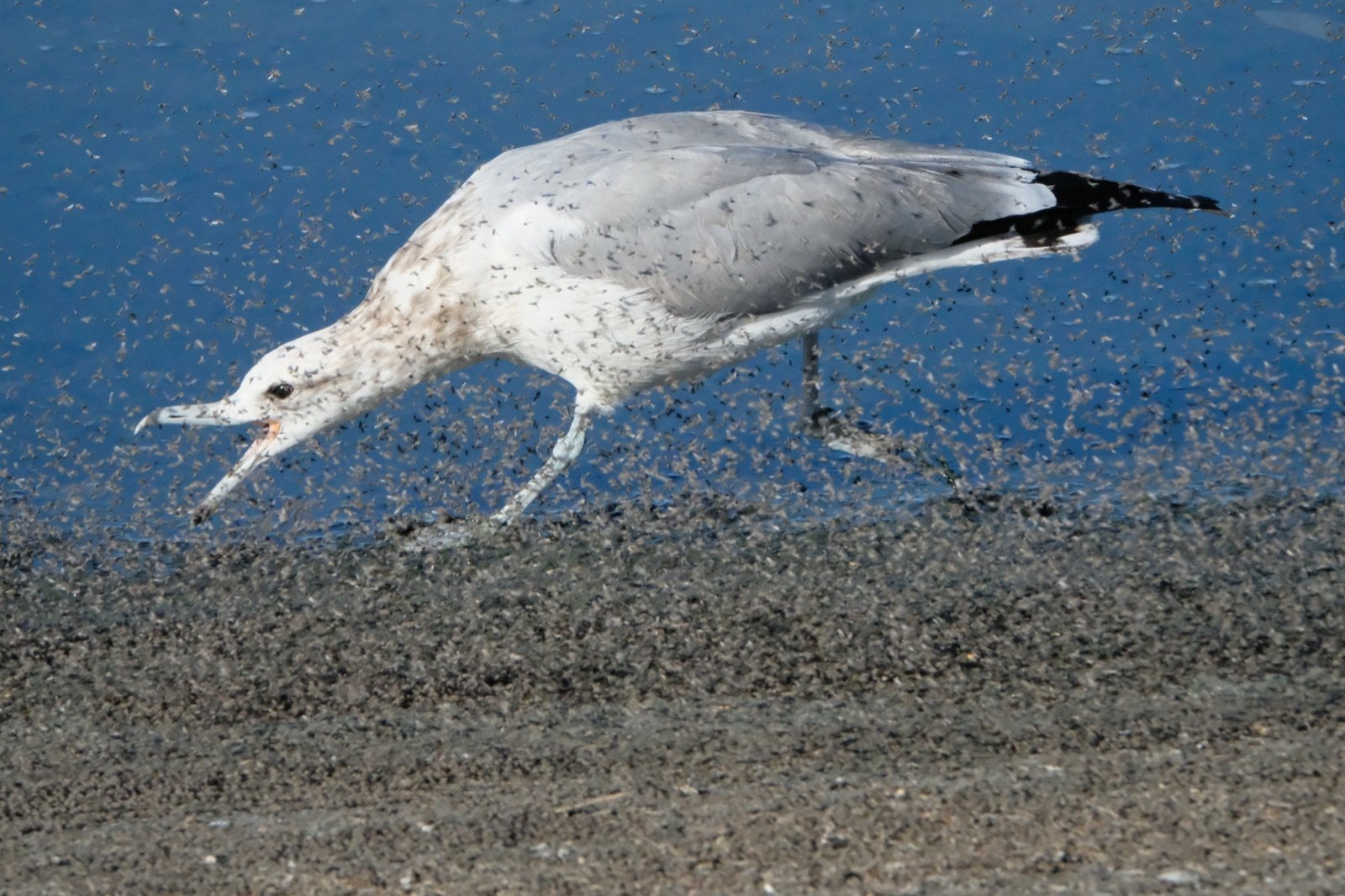
Family Laridae
California Gull
Larus californicus
In Spanish: Gaviota Californiana
- A
An accidental gull from North America, first logged at Tárcoles in 2013.
The California Gull is not a bird to plan a trip around. The official Costa Rican list gives it status A, accidental, which means a rare vagrant rather than a resident or a regional endemic.
The first Costa Rican record came from the Pacific coast in March 2013. It was a first-winter bird, a young gull in its first winter, seen on the beach at Tárcoles, Puntarenas. It was added to the official list in late 2013 with photos as evidence.
For a beginning birder, this page is a good way to learn what a vagrant is, and why one gull on a Pacific beach matters to people who keep a country list. Costa Rica's regular gulls are only the Laughing Gull and the migrant Franklin's Gull, so this one sits among the rarest gulls to hope for.
How to find it
Treat any sighting as a lucky bonus, not a goal. Gull flocks along the Pacific coast are the sensible place to look, since the Costa Rican record came from a Pacific beach. Long coastlines, shrimp ponds and other gull spots get little birding coverage, so careful checks could turn up rarities. Check the birds one at a time rather than as a flock. Note the back colour first, since the darker grey is a useful clue. Then look for a red spot and a black mark on the bill, not a neat black ring. Pay special attention to young gulls.
How to recognise it
Adults are medium-sized gulls with a rounded head. Look for these marks:
- A grey back, a little darker than a Ring-billed or Herring Gull.
- A white body, yellow bill and yellow legs, though one source describes the legs as greenish.
- A black ring and a red spot near the bill tip.
- Dark eyes.
- In flight, black wingtips with large white spots.
Young birds look very different. They are dark brown at first, with a thinner bill that is sharply pink at the base. This matters here, because every first country record in Central America involved a young bird. Costa Rica's was a first-winter gull, and Panama's first was a second-winter bird.
What it sounds like
Behaviour and diet
These are habits of the species in general, not observations from Costa Rica. It eats insects, fish, and the eggs and young of other birds, especially ducklings. It feeds in flight, or picks food up while swimming, walking or wading. It also scavenges at garbage dumps, marinas and docks. On coasts it feeds on dead fish and garbage, so a gull working the tideline or a dock is behaving as the species normally does.
Where it lives
The species breeds on inland lakes and marshes in western North America. It nests in colonies, sometimes very large and mixed with Ring-billed Gulls, in a shallow scrape on the ground near a lake or marsh, often on an island. Most birds then move to the Pacific coast for the winter.
It normally winters along the Pacific coast from Canada to Nayarit, Mexico. It sometimes wanders beyond that range, with records as far south as Ecuador. In Costa Rica the first record came from the Pacific coast, on the beach at Tárcoles in Puntarenas.
When to see it
The first Costa Rican California Gull was recorded in March 2013, which is the only dated Costa Rican record we have.
Similar birds
This is a hard gull for beginners to pick out. It is bigger than a Ring-billed Gull and smaller than a Herring Gull, though sizes can overlap. Next to an adult Herring Gull it has a darker grey back, dark eyes and black and red marks on the bill tip. In a mixed flock its call is lower and rougher than a Ring-billed Gull's, and its bill shows a red spot and a black mark, not a neat black ring.
Names and lore in Costa Rica
The Spanish name on the official Costa Rican list is Gaviota Californiana. Some sources also write it as Gaviota de California.
Status and conservation
The official Costa Rican list, in its 2025-2026 edition, gives it status A, accidental: a rare vagrant, not a resident or endemic.
Photography tips
The record at Tárcoles was accepted with photos as evidence, so clear images of the back colour, bill marks and leg colour are what count. Photograph young birds too, as they are the likeliest to turn up.
How we know this 14 sources, each read on the date shown
- Lista Oficial de las Aves de Costa Rica (AOCR) read 2026-11-04
https://listaoficialavesdecostarica.wordpress.com/lista-oficial/lista-oficial-online/ - Wikipedia read 2026-11-04
https://en.wikipedia.org/wiki/List_of_birds_of_Costa_Rica - ResearchGate (first Central American records paper) read 2026-11-04
https://www.researchgate.net/figure/First-country-records-for-California-Gull-Larus-californicus-in-Central-America-and_fig1_353046195 - Wikipedia read 2026-11-04
https://en.wikipedia.org/wiki/California_gull - Audubon Field Guide read 2026-11-04
https://www.audubon.org/field-guide/bird/california-gull - Earthpedia read 2026-11-04
https://earthpedia.earth.com/animal-encyclopedia/undefined/laridae/larus-californicus/ - Cornell Lab, All About Birds read 2026-11-04
https://www.allaboutbirds.org/guide/California_Gull/sounds - National Geographic read 2026-11-04
https://www.nationalgeographic.com/animals/birds/facts/california-gull - Warble read 2026-11-04
https://www.birdwarble.com/birds/california-gull/ - La Nación read 2026-11-04
https://www.nacion.com/ciencia/aplicaciones-cientificas/gaviotas-pato-y-ciguena-se-unen-al-club-oficial-de-aves-de-costa-rica/3GQALQQLMVHNFIHJR4ZYDIG2CU/story/ - Birding Craft (Costa Rica Birding News) read 2026-11-05
https://birdingcraft.com/wordpress/2023/03/27/costa-rica-birding-news-march-and-april-2023/ - 10,000 Birds read 2026-11-05
https://www.10000birds.com/gullmania-in-costa-rica.htm - Bird Watching Costa Rica read 2026-11-05
https://www.birdwatchingcostarica.com/familia/laridae/ - Ecoregistros read 2026-11-05
https://www.ecoregistros.org/sheet/Larus-californicus