Family Laridae
Black Skimmer
Rynchops niger
In Spanish: Rayador Negro
- Migrant
A black-backed migrant that feeds by slicing the water with its bill.
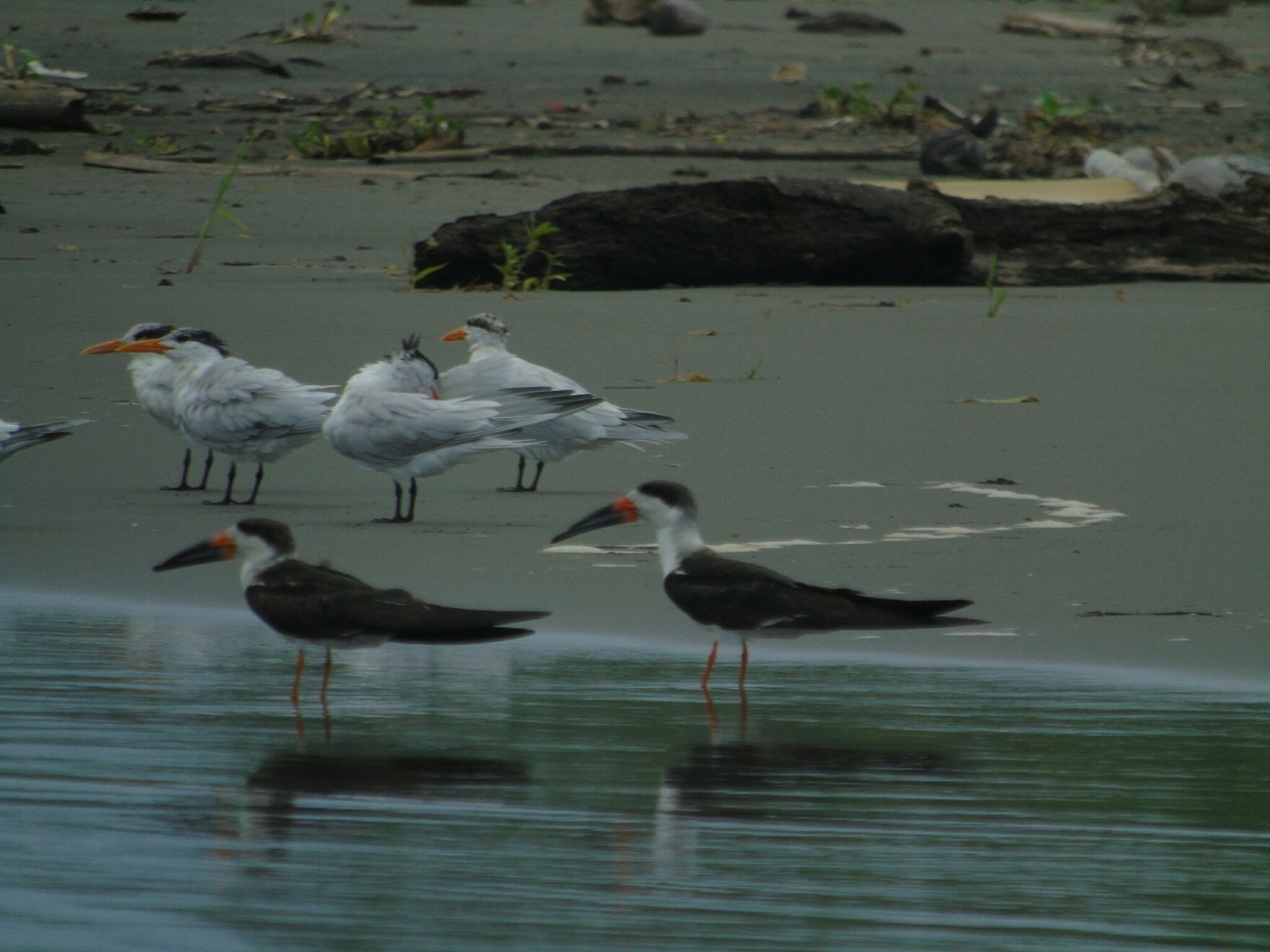
Without its odd bill, the Black Skimmer would look like a big, long-winged tern with a black back. With it, nothing else on the coast compares. The bill is blackish with a scarlet base, and the lower half is much longer than the upper.
In Costa Rica it is a migrant, locally common during passage and wintering around the Gulf of Nicoya. Much smaller numbers turn up occasionally in the Tempisque basin, Bahía Salinas and Golfo Dulce.
On a trip we build around Carara, a boat outing on the Tárcoles river, west of Carara National Park, can turn up skimmers. A tour report there counted over 100 at one spot.
How to find it
Costa Rica gets both northern-winter and austral-winter skimmers, so check flocks in either half of the year. Look for resting birds on mud or sand banks, where they sit among gulls and terns. A boat trip on the Río Tárcoles mangroves is a good place to try, and a Carara-area itinerary notes that skimmers patrol the shallows there. The same boat trip also brings crocodiles and Boat-billed Herons. Late in the day is worth trying, since they feed mostly then.
How to recognise it
Start with the bill. It is blackish with a scarlet base, and the lower half is much longer than the upper half. The legs are red-orange. The eyes have vertical, cat-like pupils, which is unusual for a bird.
The rest of the bird is a big, long-winged tern shape with a black back.
Winter adults have a white forehead, face and hindneck, with a dark cap. Juveniles look scaly or mottled above because the feathers have pale buff edges.
Northern birds have white underwings and outer tail feathers. In southern birds these are dusky gray, which helps tell the two groups apart.
What it sounds like
Recording: Guy Babineau, CC BY 4.0, source, read 4 Nov 2026.
Behaviour and diet
Skimmers are social. By day they rest on mud or sand banks, usually with flocks of gulls and terns.
They feed at any hour, but mostly late in the day and at night when fish rise to the surface. A skimmer flies low with its bill open, and the long lower half cuts the water. When it touches a fish, the bill snaps shut. Because it feeds by touch, it can even hunt at night.
Flocks in flight may turn together in unison, with their long wings beating in step.
Where it lives
In Costa Rica it uses calm water: rivers, estuaries, lagoons, salt ponds, tidal flats, salt works and coastal lagoons. The wintering centre is the Gulf of Nicoya.
Smaller numbers turn up occasionally in the Tempisque basin, Bahía Salinas, a lake in the country and Golfo Dulce.
Across Central America the species is almost entirely coastal. It prefers open sand, gravel or shell bars, and it nests in colonies near terns.
When to see it
Birds that breed in North America pass through from mid September to late October and again from early April to late May, and they winter around the Gulf of Nicoya. A few South American breeders spend May to October around the Gulf of Nicoya and Golfo Dulce.
Similar birds
Field guides list Caspian, Royal and Common Terns as look-alikes. The skimmer is set apart by its black back, red-based bill with a longer lower half, and its low, bill-in-water feeding flight. Royal Tern often shares the same roosts, but it has a long orange bill and gray wings, and its call is a loud, rolling note, unlike the skimmer's bark.
Names and lore in Costa Rica
Rayador Negro is the Costa Rican Spanish name. Other Spanish names used across the range include Pico de Tijera, Picotijera Americano, Rayador de Agua and Rayadora.
Status and conservation
The official Costa Rican bird list gives this species the status M, meaning a migrant, under the name Rayador Negro.
Photography tips
At the Chomes shrimp pools, birds gather in the shallower inner pools once the water drops. Skimmers arrived from the beach in the morning, so go when the water is low.
How we know this 15 sources, each read on the date shown
- Flickr (Historia Natural, INBio-style species account) read 2026-11-04
https://www.flickr.com/photos/jobando/25481581071 - Texas Saltwater Fishing Magazine read 2026-11-04
https://www.texassaltwaterfishingmagazine.com/fishing/black-skimmer - ArgentiNat (from Wikipedia) read 2026-11-04
https://www.argentinat.org/taxa/4496-Rynchops-niger - Lista Oficial de las Aves de Costa Rica (AOCR) read 2026-11-04
https://listaoficialavesdecostarica.wordpress.com/lista-oficial/lista-oficial-online/ - Birds of the World (Cornell) read 2026-11-04
https://birdsoftheworld.org/bow/species/blkski/1.0/habitat - Field Guides Costa Rica 2018 trip report read 2026-11-04
https://fieldguides.com/triplists/cos18.html - Eagle-Eye Tours read 2026-11-04
https://www.eagle-eye.com/tour/costa-rica-birding-tour/ - All About Birds, Cornell Lab read 2026-11-04
https://www.allaboutbirds.org/guide/Black_Skimmer/sounds - Audubon Field Guide read 2026-11-04
https://www.audubon.org/field-guide/bird/black-skimmer - Birds of Prince Edward Island read 2026-11-04
https://www.birdsofpei.info/p/black-skimmer.html - Bird Island Research Directory read 2026-11-04
https://birdislandresearch.org/seabirds - Avibase read 2026-11-04
https://avibase.bsc-eoc.org/species.jsp?avibaseid=88AB027C4DF06D93 - Birds of the World read 2026-11-04
https://birdsoftheworld.org/bow/species/blkski/cur/introduction?lang=es - Birdingcraft read 2026-11-04
https://birdingcraft.com/wordpress/2015/11/05/tips-for-birding-in-costa-rica-at-chomes-and-puerto-morales/ - BirdWatching Costa Rica read 2026-11-04
https://www.costaricabirdingtrips.com/journeys/birdwatching-chomes-cocorocas-puntarenas-costa-rica