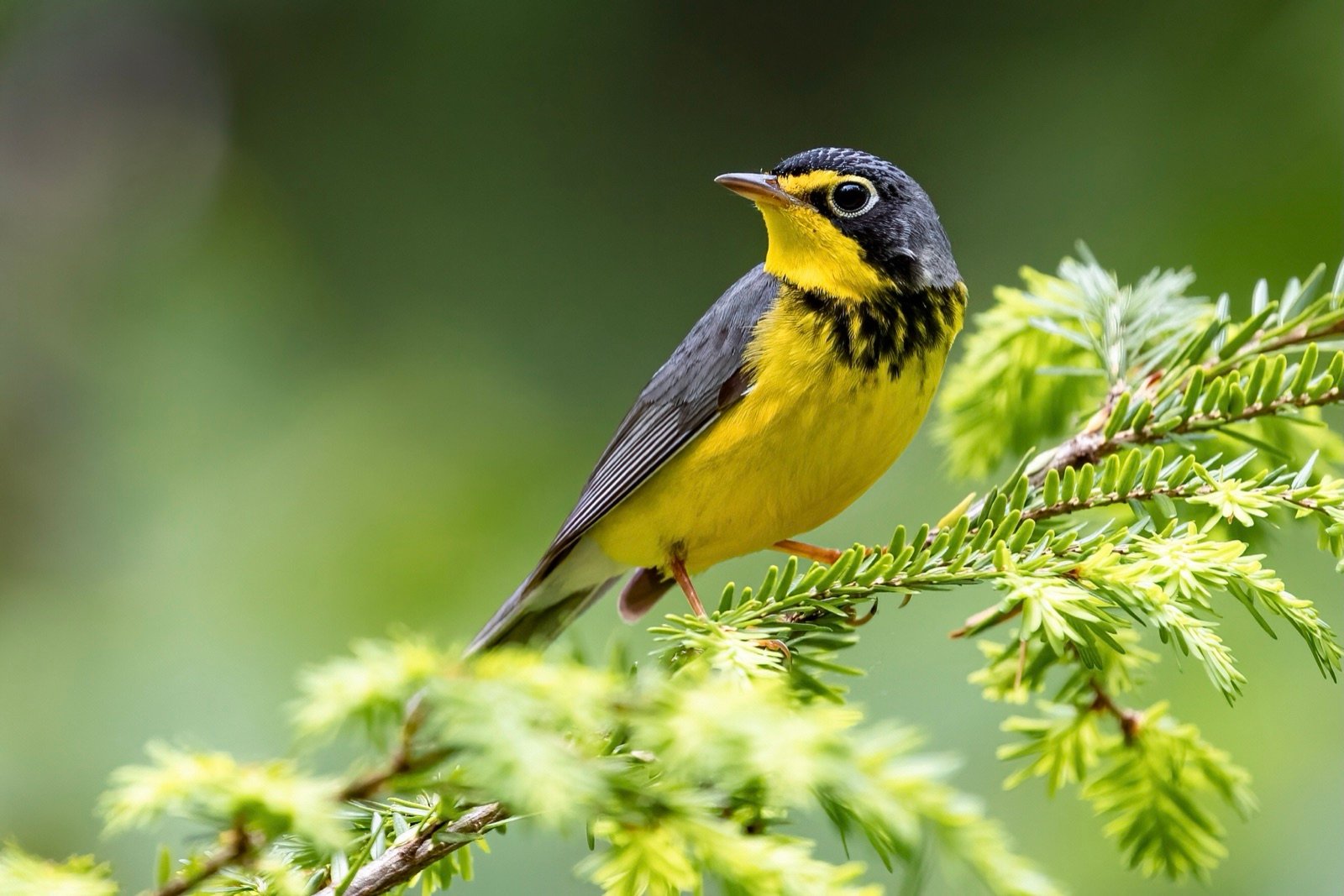
Family Parulidae
Canada Warbler
Cardellina canadensis
In Spanish: Reinita Pechirrayada
- Migrant
A necklaced gray and yellow warbler that only passes through Costa Rica.
The Canada Warbler (Reinita Pechirrayada) is a migrant only in Costa Rica. It breeds in northern North America and passes through on its way to wintering grounds in South America.
It usually travels and feeds alone, and a Costa Rica naturalist calls it skittish, so a sighting tends to be brief and feels earned. On a trip we build, the places to look are shaded, brushy forest on the slopes around Turrialba and in the central highlands, where it has been recorded.
The bird to know is a small gray warbler with a yellow belly and a necklace of dark streaks. Look low, watch for a cocked tail, and be ready for a short view.
How to find it
Look in the shrubby understory of damp, brushy woodland, where migrants use shaded thickets and second growth. Its habit of flitting low with a cocked tail helps you pick it out. Check mixed flocks in the understory too, since in the tropics it forages with other birds, usually 3 to 30 feet up in denser foliage. In the Río Tiribí Protected Zone a guide has watched it forage at all levels of the forest. Be ready for short views: one naturalist's bird appeared briefly at the top of a low tree before vanishing. Listen for the flat chip note.
How to recognise it
This is a small warbler, 12 to 13 cm long.
The male has:
- a gray head and back, plain and unmarked
- a yellow throat and belly
- a white eye ring
- a necklace of dark streaks across the chest
Females look like males but are duller. The face contrast is weak, there are no forehead marks, and the necklace is fainter and grayer.
The plain gray upperparts are the detail that matters most when you compare it with other necklaced yellow warblers.
What it sounds like
Recording: Mary Krieger, CC BY 4.0, source, read 4 Nov 2026.
Behaviour and diet
On migration it usually travels and feeds alone, and rarely with a second bird. It is found in woodland or among scattered trees.
It moves quickly, hopping and fluttering between branches in the understory, often holding its tail cocked up. It eats mainly insects, taken from vegetation, from the ground, or in flight. It is very active when feeding and catches more insects in the air than most warblers: it flushes insects from leaves, then darts out to snatch them in flight.
Where it lives
On southbound migration through Central America it appears on both coasts and in the central highlands, reaching about 2,000 m (6,500 feet) or higher in Skutch's account.
In Costa Rica it has been recorded on the slopes of Turrialba Volcano, at Aquiares, in Santa Cruz near Turrialba, in the Río Tiribí Protected Zone and at Cloudbridge Nature Reserve.
On its winter range, outside Costa Rica, it lives in dense understory of cloud forest and submontane rainforest, in young to mid-age secondary growth and along forest edges, mostly at 1000 to 2100 m. It also uses coffee plantations and hedgerows.
When to see it
An older account by Skutch gave Costa Rican fall passage dates ending around October 20, and a male was photographed at Aquiares during September migration. Wintering warblers in general can be seen from late October to early March.
Similar birds
Canada Warbler can be confused with Magnolia Warbler, since both have a black necklace on yellow underparts. Canada has plain gray upperparts, while Magnolia shows white on the wings and head. A Costa Rica writer calls Canada the more common of the two.
Names and lore in Costa Rica
The official Costa Rican Spanish name is Reinita Pechirrayada. In other countries it is also called reinita canadiense, reinita collareja in Panama and chipe de collar in Mexico.
Status and conservation
The AOCR list classes it as M, a migrant, and globally the IUCN lists it as Least Concern.
Photography tips
Expect short views. One bird appeared briefly at the top of a low tree before vanishing, so keep your camera ready and scan low branches and shaded thickets, where its cocked tail and quick flitting help you find it.
How we know this 17 sources, each read on the date shown
- Birdzilla (Bent Life History, quoting Skutch) read 2026-11-04
https://www.birdzilla.com/birds/canada-warbler/ - Birds for Beer (John Beer) read 2026-11-04
https://birdsforbeer.com/2017/05/25/magnolia-warbler-very-late-migration-date/ - Jose Pablo Castillo blog read 2026-11-04
https://josepablocastillo.wordpress.com/page/2/ - Cloudbridge Nature Reserve bird list read 2026-11-04
https://www.cloudbridge.org/wp-content/uploads/2020/04/Bird-Species-List-Costa-Rica-13-April-2020.pdf - Wikipedia (Spanish) read 2026-11-04
https://es.wikipedia.org/wiki/Cardellina_canadensis - iNaturalist Mexico (IUCN, SARA) read 2026-11-04
https://mexico.inaturalist.org/taxa/145275 - Aves y Ventanas Costa Rica read 2026-11-04
https://avesyventanascostarica.wordpress.com/algunas-aves-que-han-golpeado-contra-ventanas-en-costa-rica/ - Birding Craft read 2026-11-04
http://birdingcraft.com/wordpress/2025/09/01/reminders-of-bird-migration-in-costa-rica/ - All About Birds (Cornell Lab) read 2026-11-04
https://www.allaboutbirds.org/guide/Canada_Warbler/sounds - Birds of the World (Cornell Lab) read 2026-11-04
https://birdsoftheworld.org/bow/species/canwar/cur/sounds - Tennessee Wildlife Resources Agency read 2026-11-04
https://www.tn.gov/twra/wildlife/birds/forest-birds/canada-warbler.html - Cornell Lab Land Trust read 2026-11-04
https://www.birds.cornell.edu/landtrust/canada-warbler-cawa/ - Audubon Field Guide read 2026-11-04
https://www.audubon.org/field-guide/bird/canada-warbler - Boreal Songbird Initiative read 2026-11-04
https://www.borealbirds.org/bird/canada-warbler - La Carolina Lodge bird list read 2026-11-04
https://lacarolinalodge.com/wp-content/uploads/2019/10/Lista-de-Aves-LCL.pdf - Tayutic Mountain Reserve read 2026-11-04
https://tayuticmountainreserve.com/2025/01/17/the-northward-migration-of-birds-in-costa-rica-a-natural-phenomenon/ - Aves y Ventanas Costa Rica read 2026-11-04
https://avesyventanascostarica.wordpress.com/tag/crash/