Family Icteridae
Chestnut-headed Oropendola
Psarocolius wagleri
In Spanish: Oropéndola Cabecicastaña (Oropéndola, Oropel, Guacalillo)
- Resident
Chestnut head, yellow tail and a colony of hanging nests in one tall tree
Look up at a tall, isolated tree and you may see its crown hung with 12 to 50 long nests. Birds go in and out all day, so a colony of Chestnut-headed Oropendolas is conspicuous and easy to spot.
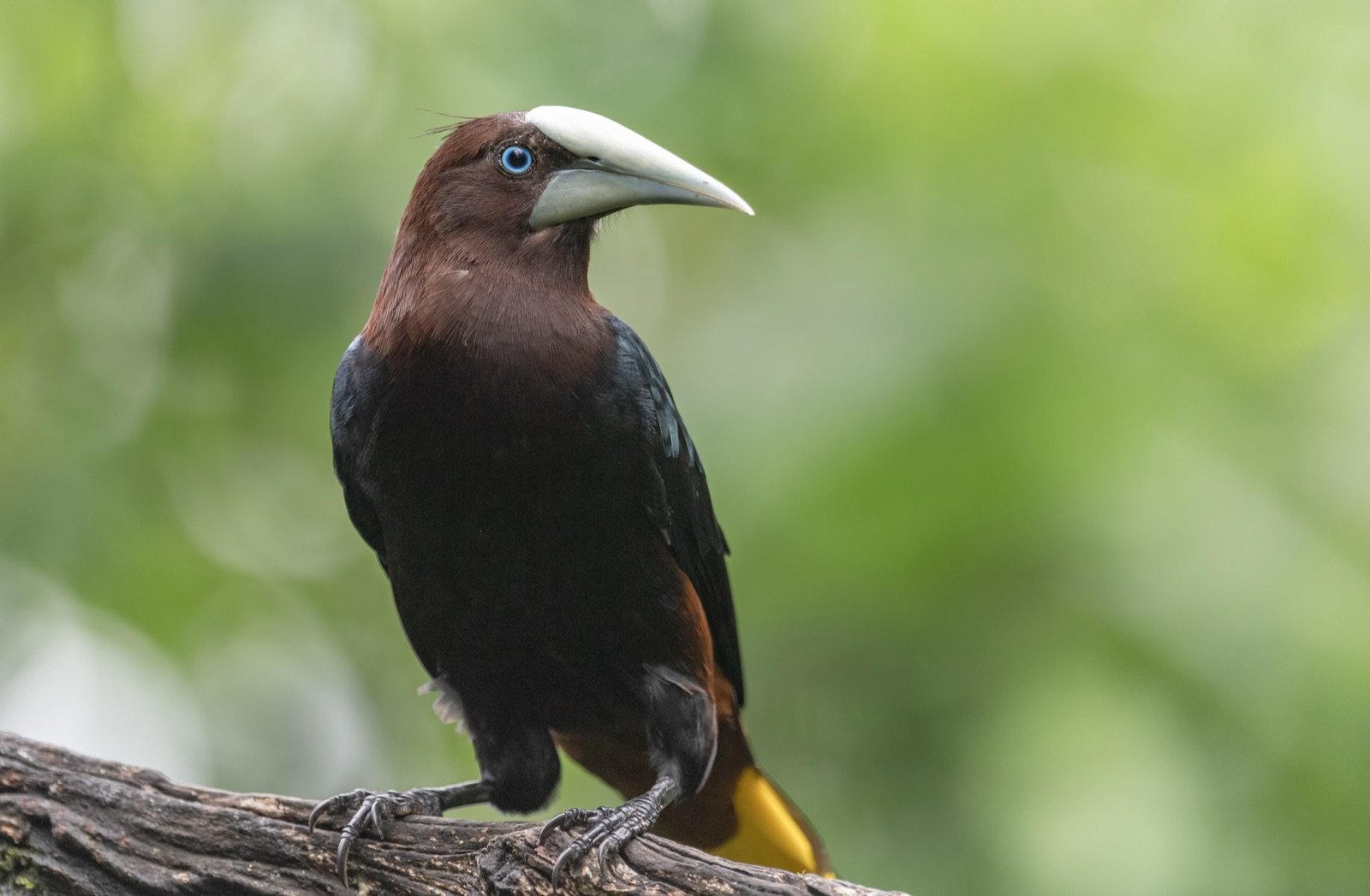
The bird is large and dark, with a yellow tail, pale eyes and a long pale bill. In Costa Rica it is a resident on the Caribbean side, from the lowlands up to about 1200 m, and it is most numerous in the foothills.
For a beginning birder the colony tells you where to stop and watch. Of the three oropendolas in the country, the Montezuma is the one most often seen, so learning to separate the two is part of the fun.
How to find it
Scan for a tall, isolated tree with a cluster of long hanging nests, since the colonies are easy to spot. Clearings and forest edges are the places to check, because that is where it nests. Birds go in and out all day, so a few minutes of watching is rewarding. Short elevational and seasonal movements are known, likely following fruiting trees, so a quiet spot may be busy on another visit. A banana feeder in a village near Turrialba has also drawn one, during a very rainy week.
How to recognise it
This is a large, dark bird with a conspicuous yellow tail, pale eyes and a long pale bill. The bill has a swollen cap on the forehead.
Up close, the eye is pale blue. The ivory-coloured bill seems to reach the top of the head, which makes it look very large.
Adults have a chestnut head, neck and rump, with a black back and wings. The male is 35 cm long, with a black belly. The female is smaller at 28 cm, with a dark chestnut belly and duller plumage.
Against the Montezuma, this species is smaller and mainly black with a chestnut head, and it lacks coloured facial patches.
What it sounds like
Recording: Dylan Camacho Guzman, CC BY 4.0, source, read 4 Nov 2026.
Behaviour and diet
It moves in noisy, loose flocks that fly at treetop level, and females usually outnumber males in the colonies. Colonies sit in one or a few isolated trees and are noisy, which can make the bird seem more common than it really is.
Range-wide, it hunts small lizards, tree frogs and large invertebrates in the canopy, and it also eats fruit and nectar.
Where it lives
It prefers wooded areas and nests at forest edges, in clearings and in isolated trees. In Costa Rica it is a resident on the Caribbean side, from the lowlands up to about 1200 m, and most numerous in the foothills. During the breeding season it locally climbs as high as 1700 m.
In the south Pacific it is local around Coto Brus and the Golfo Dulce region, and it is occasional in the lower General Valley.
When to see it
Range-wide, the species breeds between January and June, and colonies are most active and noisy then. In March 2023 at Manzanillo, Talamanca, adults were busy at nests and chicks were nearly grown.
Similar birds
Costa Rica has three oropendolas. The Montezuma is the one most often seen, and the Crested is found only in the far south. The Montezuma is mainly chestnut with a blackish head, the reverse of this species. At Manzanillo, Montezuma Oropendolas bred nearby but in a separate colony.
Names and lore in Costa Rica
Costa Ricans know it as Oropéndola, Oropel or Guacalillo. Around San Antonio, near Turrialba, locals call oropendolas oropeles, although oropel is really the name of a snake.
Status and conservation
The AOCR lists it as a resident (R), and the IUCN rates the species Least Concern.
Photography tips
Colonies are easy to find, but photos are hard. Adults slip into the nest too fast, so shoot when they leave. They keep feeding chicks even with photographers directly below.
How we know this 12 sources, each read on the date shown
- Aves de Costa Rica read 2026-11-04
https://avesdecostarica.com/Psarocolius-wagleri.html - Holistic Birding read 2026-11-04
https://holisticbirding.wordpress.com/chestnut-headed-oropendola-psarocolius-wagleri/ - Birds for Beer read 2026-11-04
https://birdsforbeer.com/2014/12/12/chestnut-headed-oropendola/ - EcoRegistros read 2026-11-04
https://www.ecoregistros.org/site_en/imagen.php?id=574155 - Anywhere.com read 2026-11-04
https://www.anywhere.com/flora-fauna/bird/chestnut-headed-oropendola - Birds Colombia (quoting Wikipedia) read 2026-11-04
https://birdscolombia.com/2022/06/17/oropendola-cabecicastana-chestnut-headed-oropendola-psarocolius-wagleri/ - Wikipedia read 2026-11-04
https://en.wikipedia.org/wiki/Chestnut-headed_oropendola - Birds of Colombia read 2026-11-04
https://www.birdsofcolombia.org/costarica/Psarocolius.html - iNaturalist Panamá (Wikipedia text) read 2026-11-04
https://panama.inaturalist.org/taxa/10125-Psarocolius-wagleri - The Kid Should See This read 2026-11-04
https://thekidshouldseethis.com/post/chestnut-headed-oropendola-costa-rica-bird-feeder-cam - Anywhere.com read 2026-11-04
https://www.anywhere.com/costa-rica/attractions/la-selva-reserve#scorpion - Wikipedia read 2026-11-04
https://en.wikipedia.org/wiki/Montezuma_oropendola