Family Apodidae
Chimney Swift
Chaetura pelagica
In Spanish: Vencejo de Paso
- Migrant
A sooty, cigar-shaped migrant swift, mostly seen over the Caribbean slope.
The Chimney Swift (Vencejo de Paso) is only a migrant in Costa Rica. It breeds in eastern North America and passes quickly through Central America on its way to South America.
That makes it a bird of the right moment and the open sky. A Costa Rica birder says the most reliable way to see it is during migration, and that he does not see it very often in the country at other times.
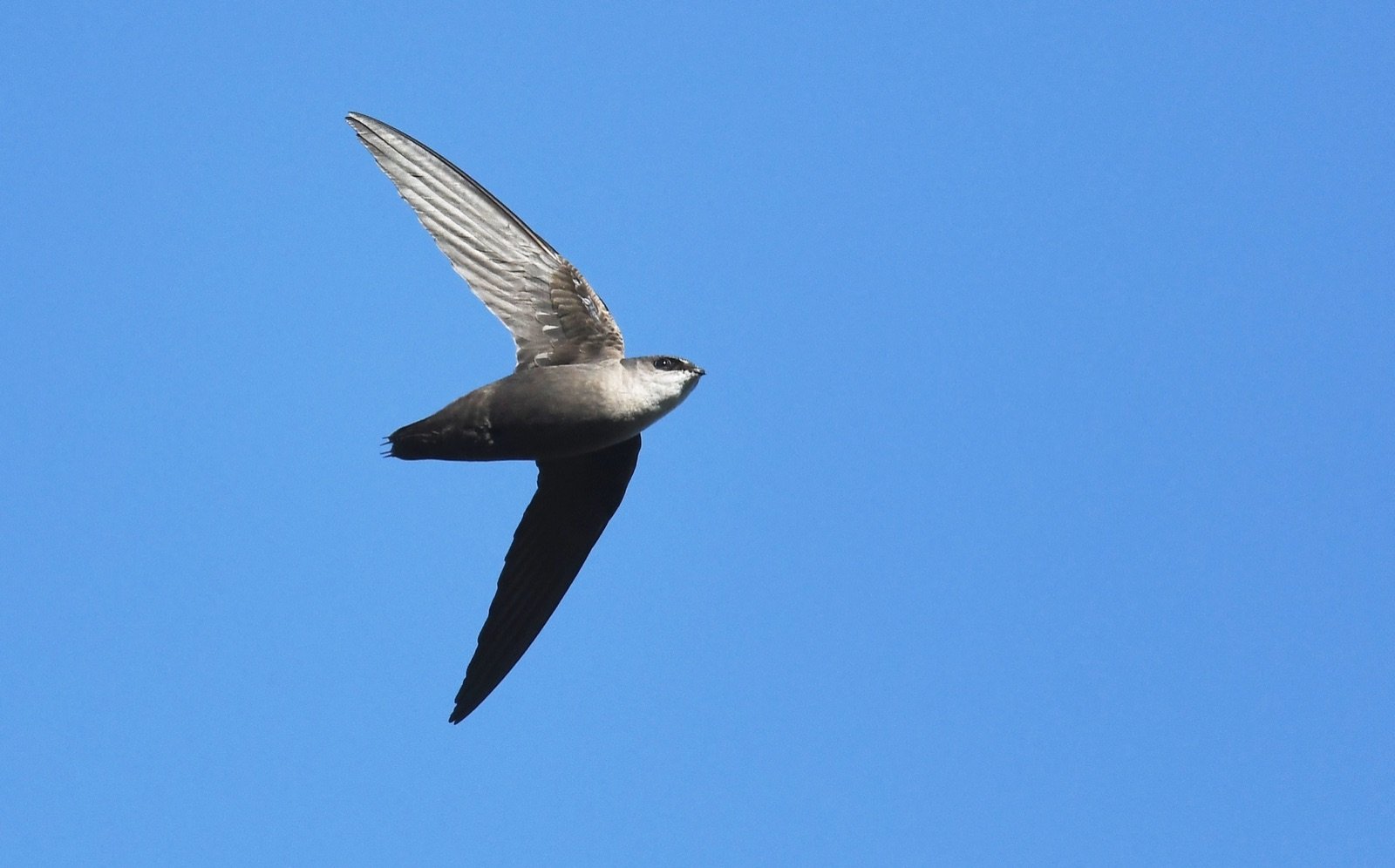
For a beginning birder it is a fine lesson in reading silhouettes. It cannot perch, so you will not find it on a branch. What you learn instead is a shape: a tiny body, long curved wings and stiff, shallow wingbeats.
How to find it
Plan around migration, since that is the most reliable way to see this swift in Costa Rica. Start in the Caribbean lowlands, especially near the coast, and scan the sky rather than the trees. Look for a dark, cigar-shaped bird with long, narrow, curved wings and quick, stiff, shallow wingbeats. Stormy weather can bring thousands down into feeding flocks over open country. Migrants usually fly high, so expect distant views, and expect big flocks to be easier to pick out than single birds.
How to recognise it
Look for a small, sooty gray swift with very long, slender wings and very short legs.
Silhouette is the best clue:
- a tiny, dark, cigar-shaped body
- curved wings
- stiff, shallow wingbeats
- a short tail that is hard to notice in flight
Its upperparts are the most evenly colored of the Chaetura swifts, with little contrast between back and rump.
Swallows are a useful comparison. They have broader, triangular wings and a tail that is easy to see, while the Chimney Swift has long, narrow, curved wings and a tail you will barely notice. It hunts insects over rooftops, fields and rivers.
What it sounds like
Behaviour and diet
This swift spends almost its whole life in the air and feeds on flying insects. It cannot perch. When it rests, it clings to vertical surfaces such as chimney walls, hollow trees or caves.
During passage through Costa Rica, stormy weather can pull thousands into feeding flocks over open country, where they sometimes mix with other swifts. Almost always, you will see it in flight.
Where it lives
In Costa Rica this is a bird of the sky above open country, hunting insects over fields, rivers and rooftops. It is mostly seen on the Caribbean slope, where it is sometimes common to abundant, especially near the coast. Numbers there are patchy, not steady. Migrating birds usually fly high, above about 50 m, so the weather and the timing of passage matter more than the habitat below.
When to see it
Northbound birds pass from mid-March to late April, and spring passage is also listed as running to mid-May. Southbound birds pass from early October to early November. A Costa Rica birding writer calls April a peak month, with large numbers of swallows and Chimney Swifts.
Similar birds
Vaux's Swift looks similar, but it has a paler throat and rump. It is a little smaller and paler, has a slightly different shape, and its calls are higher pitched. Unlike the Chimney Swift, Vaux's Swift stops its migration in Central America. The Costa Rican list also shows Gray-rumped Swift (resident) and Costa Rican Swift (endemic) as Chaetura swifts that could be confused with it.
Names and lore in Costa Rica
The Costa Rican bird list gives the Spanish name Vencejo de Paso. Other Spanish names used for the species are vencejo de chimenea, vencejo pasajero and vencejo espinoso.
Status and conservation
On the Costa Rican list (AOCR) it is a migrant (M), breeding in eastern North America and passing through on the way to South America.
Photography tips
Migrating Chimney Swifts usually fly high, above about 50 m, so expect distant views. Big flocks are easier to see than single birds, so aim for a good migration day and look for the shape of the flock against the sky.
How we know this 16 sources, each read on the date shown
- Birds of Costa Rica (birdsofcolombia.org) read 2026-11-04
https://www.birdsofcolombia.org/costarica/Chaetura.html - Wikipedia read 2026-11-04
https://en.wikipedia.org/wiki/Chimney_swift - Cornell Lab, All About Birds read 2026-11-04
https://www.allaboutbirds.org/guide/Chimney_Swift/overview - All About Birds (Cornell Lab) read 2026-11-04
https://www.allaboutbirds.org/guide/Chimney_Swift/sounds - National Geographic read 2026-11-04
https://www.nationalgeographic.com/animals/birds/facts/chimney-swift - Tennessee Wildlife Resources Agency read 2026-11-04
https://www.tn.gov/twra/wildlife/birds/chimney-swift.html - Missouri Department of Conservation read 2026-11-04
https://mdc.mo.gov/discover-nature/field-guide/chimney-swift - Wikiwand (Spanish Wikipedia) read 2026-11-04
https://www.wikiwand.com/es/articles/Chaetura_pelagica - NatureServe Explorer read 2026-11-04
https://explorer.natureserve.org/Taxon/ELEMENT_GLOBAL.2.106082/Chaetura_pelagica - Birds of the World (Cornell) read 2026-11-04
https://birdsoftheworld.org/bow/species/chiswi/cur/movement - Birding Craft read 2026-11-04
https://birdingcraft.com/wordpress/2023/03/27/costa-rica-birding-news-march-and-april-2023/ - 10,000 Birds read 2026-11-04
https://www.10000birds.com/millions-of-red-eyed-vireos-eastern-kingbirds-chimney-swifts-in-costa-rica-all-heading-north.htm - Birding Craft (comment) read 2026-11-04
https://birdingcraft.com/wordpress/2010/08/30/migrants-are-on-their-way-back-to-costa-rica/ - Old Bird (Evans, flight calls) read 2026-11-04
http://oldbird.org/pubs/fcmb/species/goatsuck/chsw/chsw.htm - Bird Watching Costa Rica read 2026-11-04
https://www.birdwatchingcostarica.com/ave/chimney-swift/ - AOCR Lista Oficial read 2026-11-04
https://listaoficialavesdecostarica.wordpress.com/lista-oficial/lista-oficial-online/