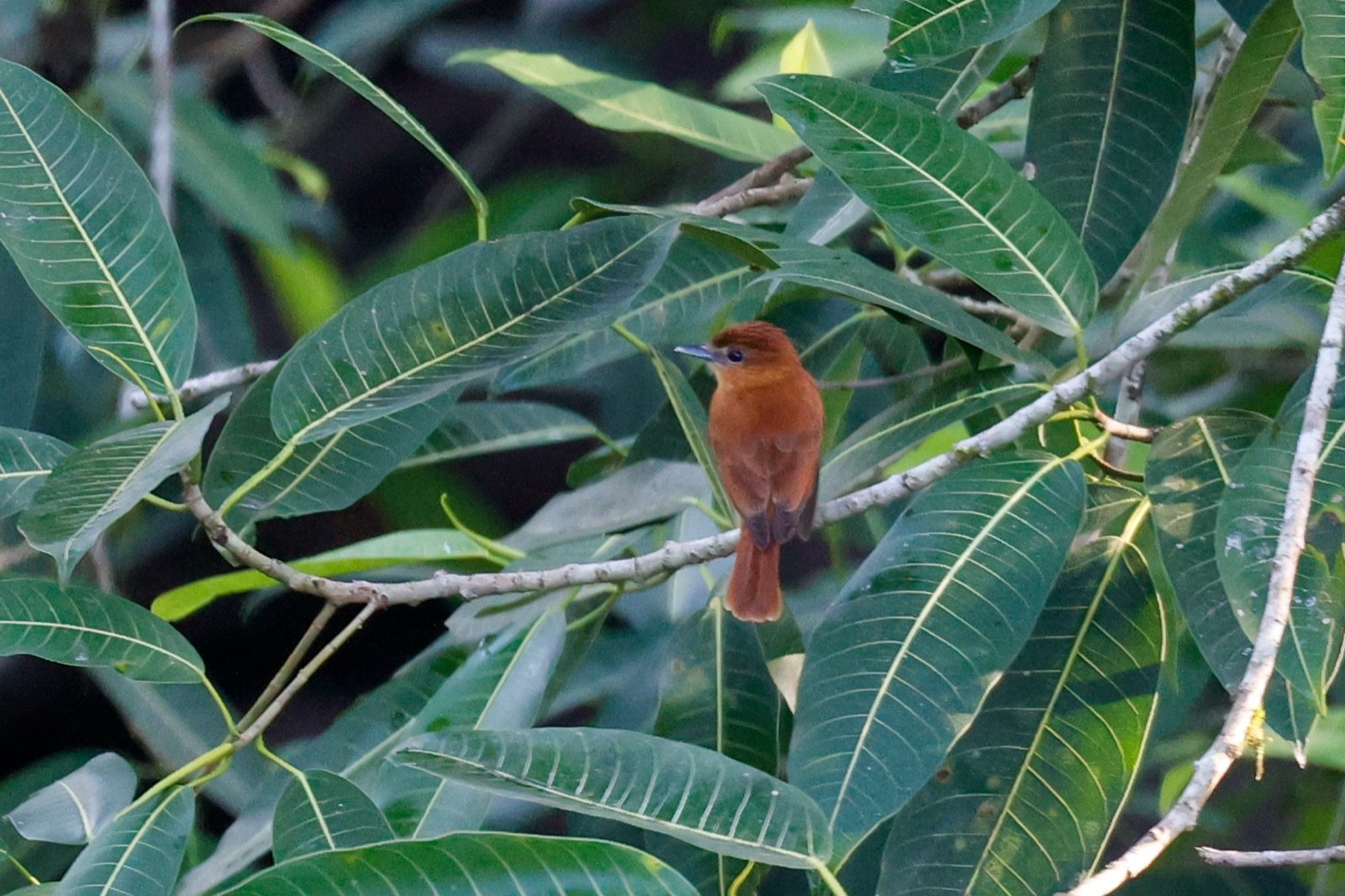
Family Tityridae
Cinnamon Becard
Pachyramphus cinnamomeus
In Spanish: Cabezón Canelo
- Resident
A small rufous becard where male and female look alike
The Cinnamon Becard (Cabezón Canelo) has a trick most becards lack: male and female look the same. Of Costa Rica's five becards, it is the only one where you do not have to sort the sexes, which makes it a friendly first becard to learn.
It is common on the Caribbean slope and very uncommon on the Pacific slope. A Costa Rica guide expects pairs at almost every forest edge in the Caribbean lowlands and foothills, so it is a realistic target for a beginner.
On trips we build, guests can meet it around Arenal and La Selva, where it turns up in the early morning and around clearings and entrance roads.
How to find it
Start on the Caribbean slope, where pairs should be at almost every forest edge in the lowlands and foothills. Look along rivers, in second growth and at forest edge. Check mixed flocks of edge birds, but expect it alone just as often. Early morning is a good time: at Arenal one group saw it daily, regular around the lights. Learn the plaintive call, since the sound tells you how widespread it is. Look up as well, because singing birds can sit in the tops of tall trees.
How to recognise it
This is a small becard, about 14 to 15 cm long. Look for these marks:
Rufous above, paler cinnamon below.
A grey bill and grey legs.
A deep rufous crown, dusky lores and tawny cheeks in adults of the nominate form.
Both sexes alike, unlike most becards.
Young birds are brighter above and paler overall, which is worth remembering if one looks a little off. The crown and face details describe the nominate form across the species' range, so Costa Rican birds may differ in small ways.
What it sounds like
Recording: Tommy Andriollo, CC BY 4.0, source, read 4 Nov 2026.
Behaviour and diet
The Cinnamon Becard sometimes joins mixed flocks of edge birds but is just as often alone, so do not count on a flock to lead you to it. It favours edges and openings, especially along rivers and streams, and sometimes rises into the forest canopy or goes out into nearby second growth. It picks prey from foliage in flight. A pair in Turrialba showed fluttering flight and took both berries and insects without landing.
The nest is a bulky ball of leaves, fibres and moss with a side entrance, often placed near an active wasp nest. It hangs 2.5 to 15 m up on the tip of a thin sloping branch and holds 3 to 4 eggs. Chicks stay in the nest at least 20 days.
Where it lives
Across its range it lives at the edges and inside of evergreen and second-growth forest. It also uses open woodland, riverside areas, clearings with tall trees and coastal mangroves.
In Costa Rica it reaches up to about 900 m elevation, and one natural history account gives about 750 m. The Costa Rican form occurs on the Caribbean slope, where it is a common resident of the lowlands. On the Pacific side it occurs from Puntarenas Province south into western Panama, uncommon to local in or near mangroves from north of the Gulf of Nicoya to the Panama border. A guide reports it as most common in gardens and at lowland rainforest edges.
When to see it
Breeding in Costa Rica runs from March to July, when nest building can make pairs easier to watch.
Similar birds
Among Costa Rica's five becards, this is the only one where male and female look the same. Only the female Rose-throated Becard looks similar, but she has a very dark crown, while the Cinnamon Becard has a deep rufous crown. In South America a similar bird, the Chestnut-backed Becard, has a grey collar and a whiter throat and belly. The Cinnamon is more evenly rich rufous above and a bit smaller.
Names and lore in Costa Rica
In Costa Rica the usual Spanish name is Cabezón Canelo. Other Spanish names are Anambé Canelo and, in Mexico, Mosquero-cabezón Canelo. The Latin species name means cinnamon-coloured.
Status and conservation
The AOCR list marks it as a resident (R), common on the Caribbean slope and very uncommon on the Pacific slope, and the IUCN rates it Least Concern.
Photography tips
Look along rivers, in second growth and at forest edge, where it sometimes joins mixed flocks but is just as often alone. Singing birds can give good scope views from the top of a tall tree: one was seen beside a Fasciated Antshrike in the top of a Sandbox Tree. Nest-building pairs in clearings have offered exceptional views.
How we know this 14 sources, each read on the date shown
- Wikipedia read 2026-11-04
https://en.wikipedia.org/wiki/Cinnamon_becard - Animalia.bio read 2026-11-04
https://animalia.bio/cinnamon-becard?taxonomy=3048 - BirdForum Opus read 2026-11-04
https://www.birdforum.net/opus/Cinnamon_Becard - Wikipedia (Spanish) read 2026-11-04
https://es.wikipedia.org/wiki/Pachyramphus_cinnamomeus - Dibird read 2026-11-04
https://dibird.com/species/cinnamon-becard/ - Birds for Beer (Paul Pickering) read 2026-11-04
https://birdsforbeer.com/2019/05/26/another-unusual-sighting-cinnamon-becard-at-1300-m-in-san-antonio-de-santa-cruz/ - Birding Craft read 2026-11-04
https://birdingcraft.com/wordpress/2012/06/04/where-to-see-becards-when-birding-in-costa-rica/ - Birding Craft read 2026-11-04
https://birdingcraft.com/wordpress/tag/cinnamon-becard/ - Field Guides trip list read 2026-11-04
https://fieldguides.com/triplists/cr215.html - Field Guides trip list read 2026-11-04
https://fieldguides.com/triplists/cos18.html - Eagle-Eye Tours read 2026-11-04
https://www.eagle-eye.com/blog/costa-rica-caribbean-mountains-to-coast-october-2021/ - Flickr (Historia Natural de Costa Rica text, Puerto Viejo de Sarapiquí) read 2026-11-05
https://www.flickr.com/photos/jobando/24995973284 - Animalia.bio read 2026-11-05
https://animalia.bio/cinnamon-becard - Birds Colombia read 2026-11-05
https://birdscolombia.com/2019/10/14/cabezon-canelo-cinnamon-becard-pachyramphus-cinnamomeus/