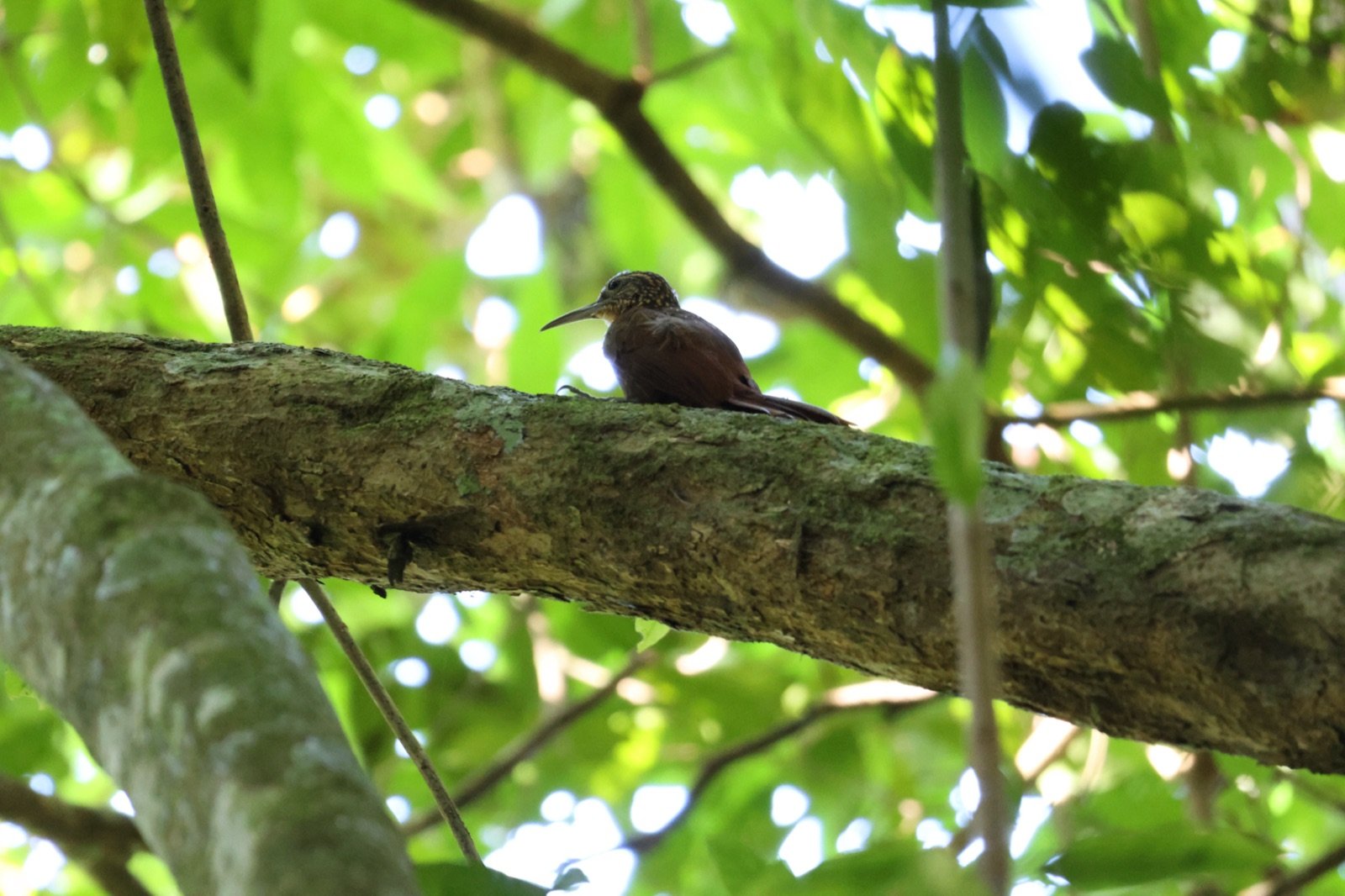
Family Furnariidae
Cocoa Woodcreeper
Xiphorhynchus susurrans
In Spanish: Trepador Gorgianteado
- Resident
A long-billed trunk climber of the humid lowlands, easier to hear than to watch.
The Cocoa Woodcreeper (Trepador Gorgianteado) is one of the more common woodcreepers of Costa Rica's humid lowlands, found on both the Caribbean and Pacific slopes. A guide lists it among 50 species worth learning by voice before a trip, and a sharp, piercing call is often how it first gives itself away.
On trips we build, guided walks on forest trails in Carara National Park on the Pacific side often turn it up. A 2026 group had great views there on a morning walk, alongside antshrikes and antbirds. It has also been recorded at La Selva on the Caribbean side, and around Caño Negro in the northern lowlands.
It is a bird that rewards a listening ear as much as a sharp eye.
How to find it
Learn the sharp, piercing call first, since the bird is often detected by voice. Walk forest trails in the humid lowlands, such as those at Carara and La Selva. Check army ant swarms, a good place to look for it. A canopy tower can also give views in a mixed group. A March 2024 tour called it one of its more commonly heard and seen woodcreepers, with great looks at La Selva and Carara. Do not be discouraged by a heard-only bird: at La Selva one tour heard it calling and never saw it, and the guide noted that this is normal for such a common species.
How to recognise it
Look for a long-billed, long-tailed woodcreeper with buffy streaking on the head, neck and breast. The bill is long, fairly heavy, pale and slightly curved downward.
Range wide, the upperparts, wings and tail are rufous, the underparts are olive-brown, and the breast has broad cinnamon streaks.
Adults measure about 21 to 25.5 cm and weigh about 43 to 58 g, so this is a big woodcreeper.
A Costa Rica guide gives a first rule for telling woodcreepers apart: focus on the head and bill.
What it sounds like
Behaviour and diet
Range wide, it climbs trunks, often in a spiral, and works along branches, often on the underside. With flocks it forages at mid-levels, while at army ant swarms it forages much closer to the ground.
It eats mostly arthropods, and sometimes small frogs and lizards.
In Costa Rica, a tour report says this big lowland woodcreeper typically attends army ant swarms. At Carara one was heard calling from the forest during a swarm visit. A Pacific lowlands tour also recorded it from a canopy tower, in a mixed group with parrots and woodpeckers, so it can be seen from a tower as well as on trails.
Where it lives
In Costa Rica it is fairly common in forested parts of the humid lowlands. Tour reports call it fairly common in the wet lowlands and foothills of both the Caribbean and Pacific slopes.
It prefers forest over open ground more than the Streak-headed Woodcreeper does, but it also turns up at forest edges.
Range wide, it mostly lives in humid evergreen forest and also uses mature secondary woodland. Its range runs from southeastern Honduras through Nicaragua and Costa Rica into western Panama.
Similar birds
Streak-headed Woodcreeper is more of an open-country and edge bird. Long-tailed Woodcreeper has more obvious pale spectacles and less streaking on the head than Cocoa and Streak-headed. Spotted Woodcreeper is a common bird of mixed flocks in foothill and cloud forest. Ivory-billed Woodcreeper has a strong, straight, pale bill and a paler head, and in Costa Rica is restricted to dry forest and riverside areas of the northwest Pacific. Some Central American field guides still use the name Buff-throated Woodcreeper, a species found only in South America.
Names and lore in Costa Rica
In Costa Rica the official Spanish name is Trepador Gorgianteado. Elsewhere it is called trepatroncos cacao in Colombia, trepatroncos chocolate in Panama and trepador chillón in Venezuela. The Latin species name susurrans means murmuring or whispering, and the genus name means sword-billed in Greek.
Status and conservation
It is a resident on the AOCR list (R), and BirdLife International lists the species as Least Concern.
Photography tips
A heard-only bird is common, so patience matters. Army ant swarms bring it closer to the ground, and a canopy tower can offer a view in a mixed group. A morning trail walk at Carara has given great views.
How we know this 22 sources, each read on the date shown
- Birding Craft read 2026-11-04
https://birdingcraft.com/wordpress/2011/11/07/tips-on-woodcreeper-identification-when-birding-costa-rica/ - Field Guides trip report read 2026-11-04
https://fieldguides.com/triplists/cos23b.html - Wikipedia read 2026-11-04
https://en.wikipedia.org/wiki/Cocoa_Woodcreeper - Birding Craft read 2026-11-04
https://birdingcraft.com/wordpress/2011/06/07/antswarms-at-carara-national-park-on/ - Naturalist Journeys species list read 2026-11-04
https://www.naturalistjourneys.com/pdf/trip-reports/1559-202512-central_america-costa_rica-christmas_tour-species_list.pdf - Birding Craft read 2026-11-04
https://birdingcraft.com/wordpress/2021/11/24/which-bird-vocalizations-to-study-for-birding-in-costa-rica/ - Planet of Birds read 2026-11-04
http://www.planetofbirds.com/passeriformes-furnariidae-cocoa-woodcreeper-xiphorhynchus-susurrans - BirdForum Opus read 2026-11-04
https://www.birdforum.net/opus/Cocoa_Woodcreeper - EcoRegistros read 2026-11-04
https://www.ecoregistros.org/sheet/Xiphorhynchus-susurrans - Field Guides Birding Tours, Costa Rica 2016 trip list read 2026-11-04
https://fieldguides.com/triplists/cos16.html - Field Guides Birding Tours, Costa Rica 2019 trip list read 2026-11-04
https://fieldguides.com/triplists/cos19.html - Eagle-Eye Tours, Costa Rica Sampler Trip Report 2026 read 2026-11-04
https://www.eagle-eye.com/blog/costa-rica-sampler-trip-report-feb-16-27-2026/ - Field Guides Birding Tours, Costa Rica 2024 trip list read 2026-11-04
https://fieldguides.com/triplists/cos24.html - Field Guides Birding Tours, Costa Rica: Birding the Edges Part II 2020 read 2026-11-04
https://fieldguides.com/triplists/cr220.html - Birdquest, Ultimate Costa Rica Tour Report 2025 read 2026-11-04
https://www.birdquest-tours.com/wp-content/uploads/2025/07/costa-rica-classic-2025-text.pdf?v=1766840199 - Wikipedia (Spanish) read 2026-11-04
https://es.wikipedia.org/wiki/Xiphorhynchus_susurrans - Wikipedia read 2026-11-04
https://en.wikipedia.org/wiki/Cocoa_woodcreeper - iNaturalist (Wikipedia text) read 2026-11-04
https://www.inaturalist.org/taxa/11063-Xiphorhynchus-susurrans - 10,000 Birds read 2026-11-04
https://www.10000birds.com/pats-costa-rica-bird-list-2021.htm - Exotic Birding read 2026-11-04
http://www.exoticbirding.com/costarica/osa-peninsula/checklist.html - Wikipedia read 2026-11-04
https://en.wikipedia.org/wiki/Xiphorhynchus_susurrans - UWI St. Augustine read 2026-11-04
https://sta.uwi.edu/fst/lifesciences/sites/default/files/lifesciences/documents/ogatt/Xiphorhynchus_susurrans%20-%20Cocoa%20Woodcreeper.pdf