Family Cuculidae
Cocos Cuckoo
Coccyzus ferrugineus
In Spanish: Cuclillo de la Isla del Coco
- Resident
- Regional endemic
A peach and brown cuckoo found only on Isla del Coco, far out in the Pacific.
The Cocos Cuckoo (Cuclillo de la Isla del Coco) lives on one island and nowhere else: Isla del Coco, about 532 km off Costa Rica in the Pacific. It is found nowhere on the mainland.
Isla del Coco is a national park with only a small ranger station. Three land birds are endemic there: this cuckoo, the Cocos Flycatcher and the Cocos Finch.
Of the three it is the least common, and it is one of the least often detected birds on the island. It rewards patient planning rather than quick ticking.
How to find it
Island-restricted endemics like this one generally need boat access or special permits, so planning starts well before any trip. Local guides and park reports are the best source for current sightings. Once there, expect a quiet bird that rarely calls and moves silently through the canopy. Scan forest rich in bromeliads, and check the vegetation around the bays and the forest edges, especially in the breeding season. If you find one, watch for a while, since it sometimes stays on a single perch for several minutes.
How to recognise it
For a cuckoo, this one is bright. Learn it in plain parallel marks:
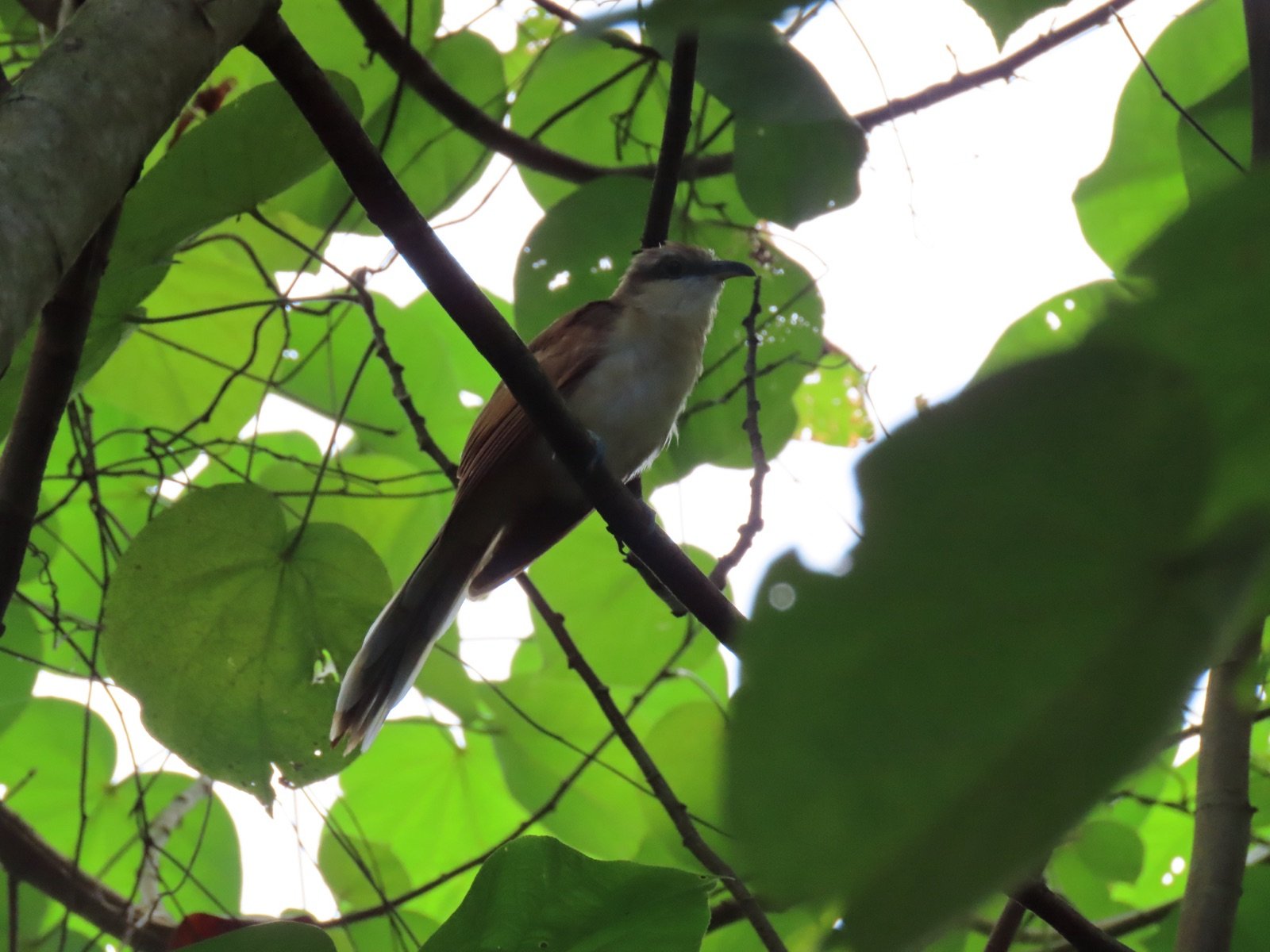
Below: peach. Above: brown.
Head: dark gray cap, black eye mask and a yellow eye ring.
Wings: a rufous panel.
Tail: long and black with white tips.
Bill: black on the upper half, bright yellow on the lower half with a black tip.
Size: adults are about 33 cm long.
It is the most colorful Coccyzus cuckoo in Costa Rica. It is also the only cuckoo on Isla del Coco, so there is no local confusion species: any cuckoo you see there is this one.
Behaviour and diet
This is a stealthy bird. It moves silently from branch to branch in the canopy and forages in forest rich in bromeliads, searching carefully for arthropods. Sometimes it stays on one perch for several minutes, which can give a patient observer a chance.
It takes large insects such as hawkmoth caterpillars and cicadas, and it also catches the island's anole lizards. It is a year-round resident that tends to sit at forest edges while breeding and deeper in the forest interior at other times.
Where it lives
It occurs across the whole of Isla del Coco, from sea level up to cloud forest at about 400 m, and it depends on mature forest dominated by endemic trees. Besides interior forest, it uses vegetation around the bays, especially in the breeding season.
It also frequents thickets, tangles and hanging vines along the main ravines, and it uses secondary growth and Hibiscus scrub.
When to see it
It is present on the island all year. Breeding starts as the rainy season gives way to the dry season, from January to mid April.
Similar birds
Its closest look-alike is the Mangrove Cuckoo, called Cuclillo de Antifaz in Spanish. That bird lives on the mainland, not on Isla del Coco. Some authors have treated the Cocos Cuckoo as just a subspecies of the Mangrove Cuckoo.
Names and lore in Costa Rica
The Spanish name on the Costa Rican list is Cuclillo de la Isla del Coco. Spanish sources also write it as cuclillo de isla del Coco or cuclillo de la isla Cocos.
Status and conservation
It is a resident endemic on the AOCR list (R-END), and the IUCN lists it as Vulnerable.
Photography tips
Patience is the whole method. Look for a bird sitting still on one perch in the canopy of bromeliad-rich forest, since it may stay there for several minutes before moving silently on.
How we know this 10 sources, each read on the date shown
- Birds of the World (Cornell) read 2026-11-04
https://birdsoftheworld.org/bow/species/coccuc1/cur/introduction - Expediciones Tropicales read 2026-11-04
https://www.expedicionestropicales.com/costa-rica-info/costa-rica-national-parks/coco-island-national-park/ - Ramírez-Alán, Ecología e historia natural del Cuclillo de la Isla del Coco (via ResearchGate) read 2026-11-04
https://www.researchgate.net/publication/240451783_Phylogeny_of_the_cuckoo_genus_Coccyzus_Aves_Cuculidae_A_test_of_monophyly - EcuRed read 2026-11-04
https://www.ecured.cu/Cuclillo_de_la_Isla_del_Coco - 33Science read 2026-11-04
https://33science.com/2026/01/07/endemic-species-of-costa-rica/ - Wikipedia (Spanish) read 2026-11-04
https://es.wikipedia.org/wiki/Coccyzus_ferrugineus - Wikipedia read 2026-11-04
https://en.wikipedia.org/wiki/Cocos_cuckoo - Endemic Species of Costa Rica read 2026-11-04
https://endemicspeciesofcostarica.weebly.com/cocos-island-cuckoo.html - Oiseaux-Birds read 2026-11-04
https://www.oiseaux-birds.com/card-cocos-cuckoo.html - ResearchGate (Herrera et al.) read 2026-11-04
https://www.researchgate.net/publication/348357574_Ecologia_e_historia_natural_del_Cuclillo_de_la_Isla_del_Coco_Coccyzus_ferrugineus_en_la_Isla_del_Coco_Costa_Rica_consideraciones_para_su_conservacion_Ecology_and_natural_history_of_Cocos_Cuckoo_Coccyz