Family Tyrannidae
Cocos Tyrannulet
Nesotriccus ridgwayi
In Spanish: Mosquerito de la Isla del Coco
- Resident
- Regional endemic
Cocos Island's only flycatcher, found nowhere else in the world.
The Cocos Tyrannulet (Mosquerito de la Isla del Coco) lives on one island and nowhere else in the world. That island is Cocos, a Costa Rican national park about 550 km out in the Pacific from the mainland.
It is the only flycatcher found in Isla del Coco National Park, and one of three bird species endemic to the island. The island holds about half of Costa Rica's endemic birds, so this small bird says a lot about how special that far Pacific outpost is.
A 2025 University of Costa Rica study counted 181 bird species on Cocos Island. Over 90 percent are visitors, and this tyrannulet is one of the few residents.
How to find it
Start along the forest edge, especially near the ranger station and the Avocado Lookout. It is described as abundant, so listening for a chattering series that speeds up and ends in a clatter is a good first step. Then scan the forest, the secondary growth and the tall Hibiscus thickets of the Annona swamp. Watch for a small bird that circles you and flickers near your head, since that is typical behaviour. Check the thin outer branches near treetops, where it places its nest.
How to recognise it
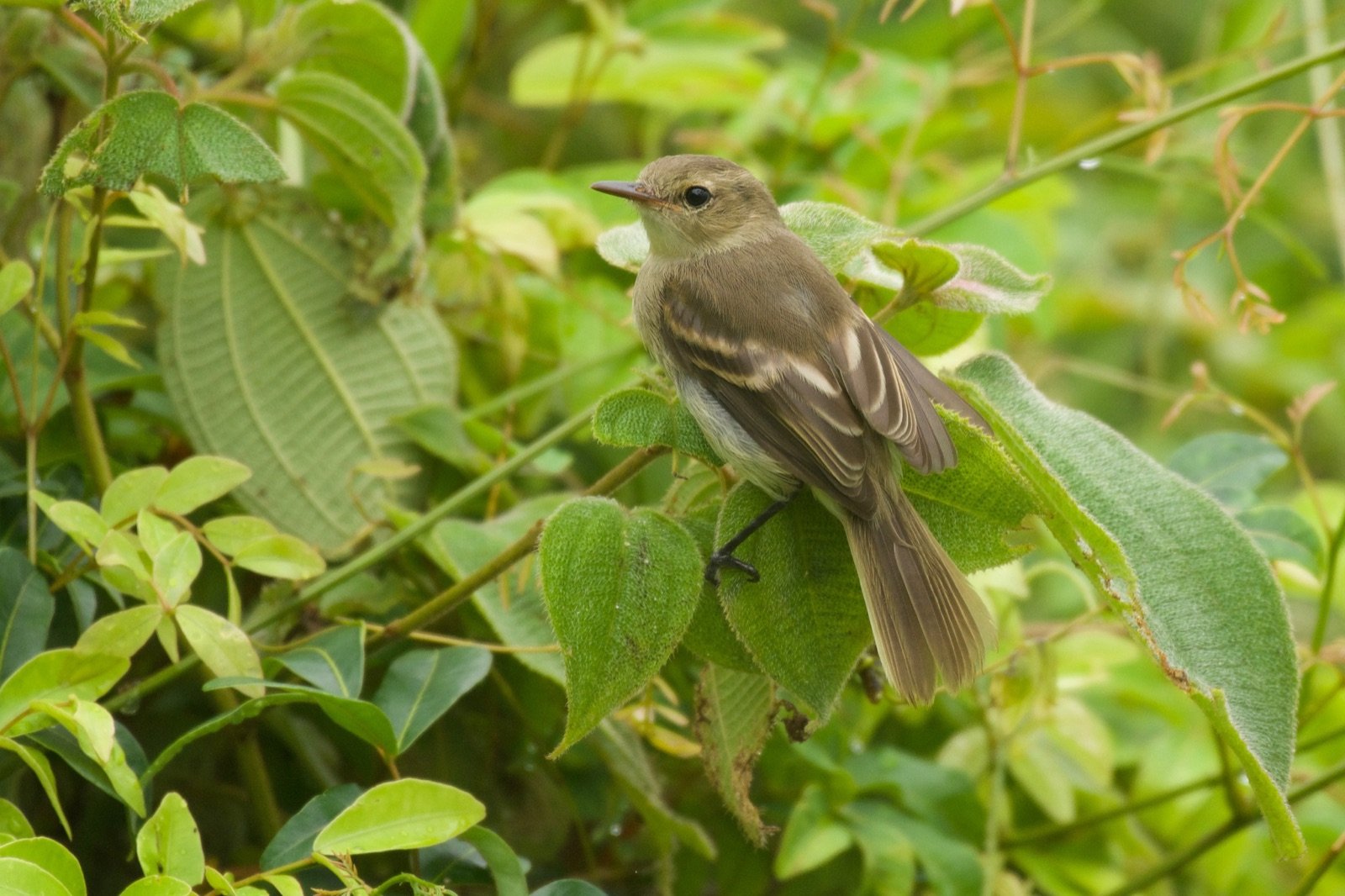
This is a small, vocal flycatcher, about 13 cm long and about 11 g, with a long bill and a fairly long tail.
Look for these marks:
- Upperparts grayish olive to dark brownish olive.
- Wings and tail darker, with buffy wing bars (a double wing-bar).
- A pale eyebrow stripe.
- Underparts pale grayish buff, buffy white or pale yellowish.
- Upper bill black.
- Lower bill pale horn colored with a dusky tip.
Color varies quite a lot between birds, so do not expect two individuals to look identical. The two-toned bill is a steadier clue than the body shade.
Behaviour and diet
It takes prey mostly by striking upward at foliage from a perch. It also gleans, briefly hovers, and makes short flights to catch insects in the air.
The nest is a small cup of plant fibers set on a thin branch among outer foliage, usually near the top of a tree. Elsewhere in its range the cup is lined with feathers and often covered outside with spider egg sacs, sitting about 10 to 25 m up, and the clutch is usually one egg. Breeding runs from January to April or May.
Its habit of circling people and flickering near their heads is the root of its best-known local nickname.
Where it lives
On Cocos Island it lives inside forest and in tall Hibiscus thickets in the Annona swamp, and it regularly visits areas of secondary growth. More broadly it uses the edges and interior of evergreen forest, secondary forest, and scrubby or swampy areas.
It occurs from sea level up to about 575 m. The island has no permanent settlements and its forest is mostly intact.
When to see it
It stays on the island all year and breeds there. A recent island guide article says it nests from January to April and records a photograph from September 2020, showing it is present then.
Similar birds
Genetic work found that the mainland Mouse-colored Tyrannulet is a species complex that includes the Cocos bird. That mainland species ranges from Costa Rica and Panama south to Brazil and northern Argentina. On the island itself the Cocos Tyrannulet is the only flycatcher in the national park, so there is little to confuse it with.
Names and lore in Costa Rica
Costa Ricans also call it mosquerito del Coco or piojito de las Islas Coco. Locally it is known as the 'Holy Spirit': its habit of circling people and flickering near their heads led pirates to link it with a mythical deity.
Status and conservation
The AOCR lists it as a resident endemic (R-END), one of three bird species endemic to Cocos Island, and it looks stable.
How we know this 13 sources, each read on the date shown
- Wikipedia read 2026-11-04
https://en.wikipedia.org/wiki/Cocos_flycatcher - Aves de Costa Rica read 2026-11-04
https://avesdecostarica.com/Nesotriccus-ridgwayi.html - Museo Nacional de Costa Rica read 2026-11-04
https://www.museocostarica.go.cr/nuestro-trabajo/investigaciones/historia-natural/isla-del-coco/aves/ - Wikipedia read 2026-11-04
https://en.wikipedia.org/wiki/Nesotriccus - Wikipedia (es) read 2026-11-04
https://es.wikipedia.org/wiki/Nesotriccus_ridgwayi - Visit Cocos Island read 2026-11-04
https://www.visitcocosisland.com/cocos-flycatcher/ - Oiseaux-Birds read 2026-11-04
https://www.oiseaux-birds.com/card-cocos-flycatcher.html - Wikispecies read 2026-11-04
https://species.wikimedia.org/wiki/Nesotriccus_ridgwayi - ResearchGate: Isla del Coco, discovering avian treasures read 2026-11-05
https://www.researchgate.net/publication/393791542_Isla_del_Coco_Costa_Rica_discovering_avian_treasures_in_a_remote_oceanic_sanctuary - ResearchGate (Cocos Island foraging study) read 2026-11-05
https://www.researchgate.net/publication/301737918_The_Mouse-colored_Tyrannulet_Phaeomyias_murina_is_a_species_complex_that_includes_the_Cocos_Flycatcher_Nesotriccus_ridgwayi_an_island_form_that_underwent_a_population_bottleneck - Endemic Species of Costa Rica (student site) read 2026-11-05
https://endemicspeciesofcostarica.weebly.com/cocos-island-flycatcher.html - Delfino.cr read 2026-11-05
https://delfino.cr/2025/12/nuevo-estudio-de-la-ucr-revela-que-la-isla-del-coco-alberga-181-especies-de-aves - Endemic Costa Rica student page read 2026-11-05
https://8thhallmarktrip.wixsite.com/endemiccostarica/cocos-island-flycatcher