 Collared Plover
Family Charadriidae
Collared Plover
Anarhynchus collaris
In Spanish: Chorlitejo Collarejo (Turillo)
- Resident
A small, cautious plover that runs, freezes and vanishes among the stones.
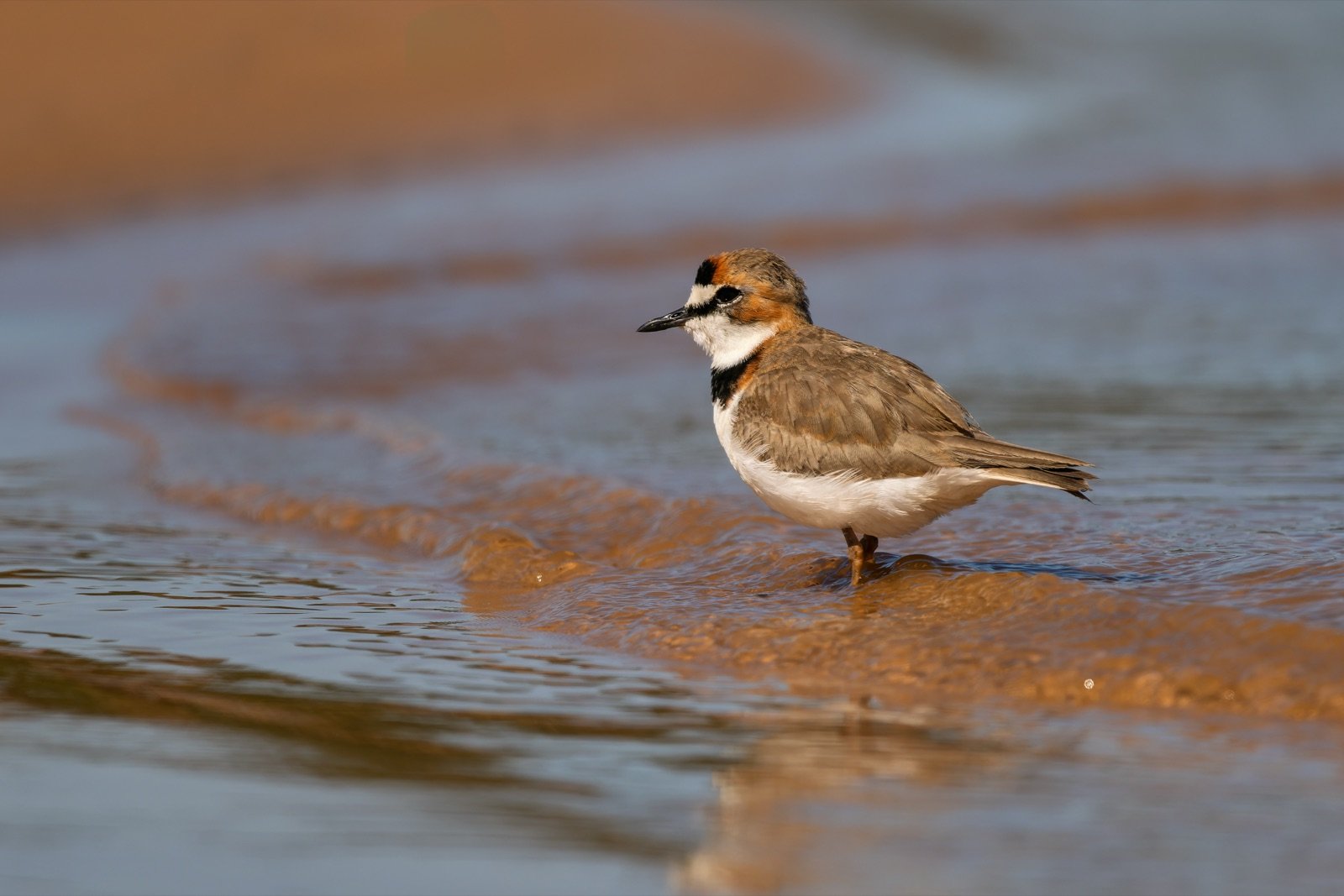
The Collared Plover is a small plover, about 18 cm long, with a black band across the breast and a chestnut crown. It runs a short way, stops suddenly, looks around and then pecks at its food.
In Costa Rica it is an uncommon and local resident, widespread in the lowlands along both coasts. On a trip we build, guests can meet it on the Río Tárcoles mangrove boat tour on the Pacific side, where one birding tour watched a pair patrol the river shoreline in March 2024.
It rewards patience. It is very cautious, and a careful scan of a gravel bar or a drift line is often what turns it up.
How to find it
Start with the Río Tárcoles boat trip. Guides there knew where to find one, pulled the boat onto a river sandbank, and the group soon had good views. A careful scan of a gravel bar turned up this cryptic plover beside a Double-striped Thick-knee on another tour. On beaches, scan among stones and drift objects, where it runs fast and then freezes. At close range the pink legs help separate it from the Semipalmated Plover on the Caribbean beach. Large crocodiles were lurking near the sandbank, which makes for a vivid setting.
How to recognise it
Adults have a black band across the breast, a brown back and a white belly. The crown and nape are chestnut, and the legs are yellow in general descriptions.
At close range on the Caribbean beach the legs show as pink, which helps separate it from the Semipalmated Plover. Look also for a thin black bill, a bright head pattern and a narrow black chest band.
Despite the name, it has no full white collar on the nape.
Young birds are plainer. They show little or no rufous and black on the head, the breast band is dusky and less clear, and the back looks scaled buff.
Behaviour and diet
It runs a short way, stops suddenly, looks around, then quickly pecks at insects, beach amphipods and other small invertebrates. It is usually alone or in pairs, and it sometimes joins loose groups of other plovers.
It flies low and in a straight line.
The nest is a bare scrape on sand or dry soil, lined with shells and debris and often beside a beach vine or grass clump. The female lays 2 pale buff eggs with dark brown spots. A pair was filmed mating and defending a territory on a sod farm in Guanacaste in January 2023.
Where it lives
It lives above the high tide line on beaches with scattered drift items. It also uses mud or gravel banks on lowland rivers and the muddy edges of drying lagoons.
In Costa Rica it is widespread in the lowlands along both coasts. It breeds mainly on beaches and on mud and gravel banks near river mouths.
When to see it
It is a resident, so it is present all year. Breeding runs from March to June, and birders have reported it in January, February and March on the Tárcoles river trips.
Similar birds
Wilson's Plover has a thick bill, a squarer forehead and a larger body, while the Collared Plover has a thin bill and is smaller. The Semipalmated Plover is larger with a thicker bill and has a pale collar that the Collared Plover lacks. The Snowy Plover is similar in size but paler above, has dark legs and never shows a complete breast band.
Names and lore in Costa Rica
Besides the AOCR name Chorlitejo Collarejo (Turillo), other Spanish names include Chorlito de collar, Chorlo de collar and Playero collarejo. The standardized Spanish name is Chorlitejo de Azara.
Status and conservation
The AOCR list marks it as a resident (R), and in Costa Rica it is an uncommon and local one.
Photography tips
Be ready to wait. One photographer saw this bird easily in Costa Rica in the late 1990s but had few photo chances for years after, and long, patient watching at Manzanillo brought close-ups. Because it runs fast and then freezes among stones or drift objects, scan carefully and let it settle. Its low, straight flight helps you follow it when it moves.
How we know this 13 sources, each read on the date shown
- Wikipedia read 2026-11-04
https://en.wikipedia.org/wiki/Collared_plover - Bird Watching Costa Rica read 2026-11-04
https://www.birdwatchingcostarica.com/ave/collared-plover/ - Flickr (Spanish natural history text, Ciudad Neily photo) read 2026-11-04
https://www.flickr.com/photos/jobando/28484333902 - Birds for Beer read 2026-11-04
https://birdsforbeer.com/2019/01/21/collared-plover-and-others/ - Holistic Birding read 2026-11-04
https://holisticbirding.wordpress.com/collared-plover-charadrius-collaris/ - YouTube read 2026-11-04
https://www.youtube.com/watch?v=Kkc_AGWk1x4 - Birda read 2026-11-04
https://app.birda.org/species-guide/6545/Collared_Plover - Field Guides Birding Tours, Costa Rica 2018 trip list read 2026-11-04
https://fieldguides.com/triplists/cos18.html - Eagle-Eye Tours, Costa Rica Sampler 2022 trip report read 2026-11-04
https://www.eagle-eye.com/blog/costa-rica-sampler-2022-trip-report/ - Field Guides Birding Tours, Costa Rica 2024 trip list read 2026-11-04
https://fieldguides.com/triplists/cos24.html - MC Curation, Collared Plover Gallery read 2026-11-04
https://mccuration.com/collared-plover-gallery/ - Villamontes (Bolivia) read 2026-11-04
https://villamontes.com.bo/cuevo/naturaleza/chorlito-de-collar - Birds Colombia read 2026-11-04
https://birdscolombia.com/2018/01/29/chorlitejo-collarejo-collared-plover-charadrius-collaris/