Family Anatidae
Comb Duck
Sarkidiornis sylvicola
In Spanish: Pato Crestudo
- A
A big black and white duck with a knobbed bill, accidental in Costa Rica.
The Comb Duck, Pato Crestudo in Spanish, is not a bird to expect on a normal trip to Costa Rica. The AOCR list gives it status A, its accidental code, and Avibase classes it here as rare or accidental.
Costa Rica sits just beyond the range where the species occurs locally in eastern Panama, so a sighting would be a vagrant surprise. That is exactly why it is worth knowing.
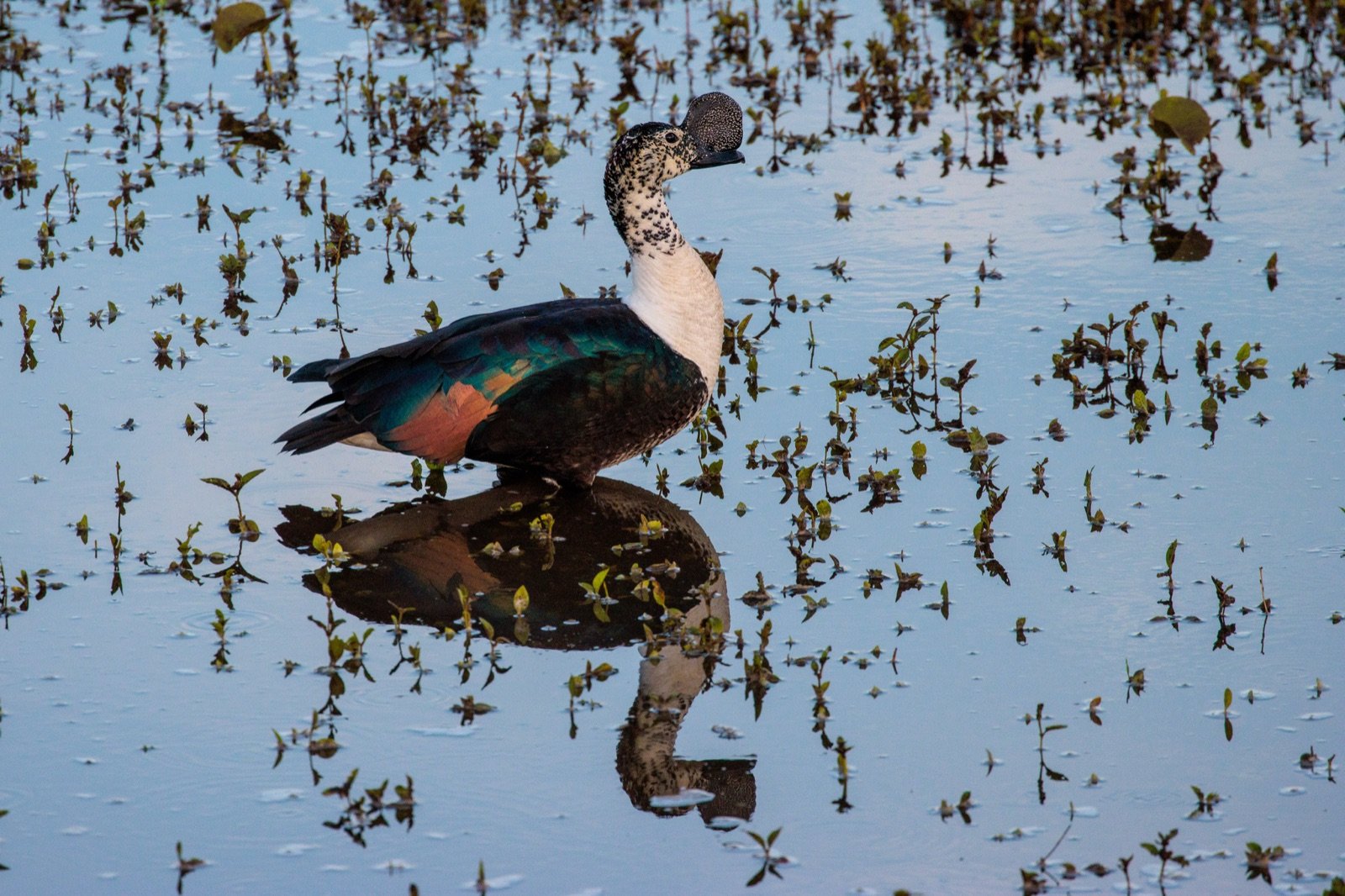
It is one of the largest ducks, 56 to 76 cm long, and the male carries a large black fleshy knob on the bill. If one turns up on a wetland you are scanning, you will want to recognise it.
How to find it
Because it is accidental here, there is no dependable place to look, so treat it as a bonus rather than a target. Scan slow fresh water, marshes and flooded fields, and check the trees beside them for perched birds. Watch ducks in flight over water, where the broad wings and bold black and white pattern stand out. Outside Costa Rica it sometimes forms flocks of 30 to 40 in the drier part of the year, and flocks are small in the wet season. Alone or in small groups is more usual.
How to recognise it
Adults show these marks:
A white head flecked with dark spots.
A pure white neck and underparts.
Glossy blue-black upperparts.
This is one of the largest ducks, 56 to 76 cm long, with a wingspan of 116 to 145 cm. The male is much larger than the female and has a large black fleshy knob on top of the bill. The female looks like the male but is smaller and has no knob, which separates the sexes.
Young birds are dull buff on the face, neck and underparts, with dull brown upperparts, crown and eyestripe. These details describe the species in general, not Costa Rican birds specifically.
Behaviour and diet
The Comb Duck swims slowly and splashes at the surface. Its diet is mostly plant matter, with some small fish and invertebrates (see below). It is often seen flying over water, showing broad wings and bold black and white plumage.
It is one of the few ducks that perches in trees, and it sometimes sleeps in them, so look up as well as across the water.
Outside Costa Rica it is most often seen alone or in small groups, and it is active by day.
Where it lives
Across its range it uses many freshwater habitats, from swamps and marshes to flooded grassland, pasture and irrigated fields. It lives in the tropics and subtropics, in slow fresh water in South American lowlands, and it occurs locally in eastern Panama.
One Colombian source says the species ranges from Panama and Colombia south to Uruguay, Argentina and Chile, and reaches about 1,200 m elevation. Costa Rica sits just beyond that range.
Similar birds
Young birds seen at a distance can be mistaken for Fulvous Whistling-Duck. They are rarely seen without adults nearby, which makes them easy to identify. The American Comb Duck is generally smaller than the Old World Knob-billed Duck, and its flanks are darker: black in males and medium grey in females.
Names and lore in Costa Rica
The AOCR list uses Pato Crestudo. Other Spanish names for the species include pato de monte and pato crestudo sudamericano. Further local names elsewhere in South America include pato ganso, ganso de espolón, pato arrocero and pato de moco, and putriao in Brazil.
Status and conservation
The AOCR list (updated June 2026) gives the Comb Duck status A, its accidental code, while other lists call it rare or accidental and mark its resident status as uncertain.
How we know this 21 sources, each read on the date shown
- Wikipedia read 2026-11-04
https://en.wikipedia.org/wiki/List_of_birds_of_Costa_Rica - Avibase read 2026-11-04
https://avibase.bsc-eoc.org/checklist.jsp?region=CR - Exotic Birding Costa Rica checklist read 2026-11-04
http://www.exoticbirding.com/costarica/checklist.html - Animalia (from Wikipedia) read 2026-11-04
https://animalia.bio/comb-duck - Birds of the World read 2026-11-04
https://birdsoftheworld.org/bow/species/comduc3/cur/introduction?lang=es - Wikipedia (Spanish) read 2026-11-04
https://es.wikipedia.org/wiki/Sarkidiornis_sylvicola - Aves de Peru read 2026-11-04
https://avesdeperu.org/anatidae/pato-crestudo-sarkidiornis-sylvicola/ - Oiseaux.net read 2026-11-04
https://www.oiseaux.net/birds/comb.duck.html - Crónica del Quindío read 2026-11-04
https://cronicadelquindio.com/actualidad/novedades/fauna/pato-crestudo/ - Birds of Colombia read 2026-11-04
https://birdsofcolombia.com/pages/american-comb-duck - Cornell Birds of the World read 2026-11-04
https://birdsoftheworld.org/bow/species/comduc3/cur/introduction - Sacramento Zoo read 2026-11-04
https://www.saczoo.org/comb-duck - Birds Colombia read 2026-11-04
https://birdscolombia.com/2017/12/18/pato-crestudo-comb-duck-sarkidiornis-melanotos/ - Lista Oficial de las Aves de Costa Rica (AOCR) read 2026-11-04
https://listaoficialavesdecostarica.wordpress.com/lista-oficial/lista-oficial-online/ - Aves de Chile read 2026-11-04
https://www.avesdechile.cl/590.htm - Birdwatching in Costa Rica bird list read 2026-11-05
https://birdwatchingincostarica.com/bird-lists/ - Avibase Costa Rica checklist read 2026-11-05
https://avibase.bsc-eoc.org/checklist.jsp?list=howardmoore®ion=CR - Duck Species read 2026-11-05
https://duckspecies.org/comb-duck/ - Planet of Birds read 2026-11-05
https://planetofbirds.com/anseriformes-anatidae-comb-duck-sarkidiornis-sylvicola/ - Wikipedia read 2026-11-05
https://en.wikipedia.org/wiki/Comb_Duck - Costa Rica Spirit read 2026-11-05
https://www.costarica-spirit.com/es/guias/observacion-aves-por-region/