Family Parulidae
Connecticut Warbler
Oporornis agilis
In Spanish: Reinita Ojianillada
- A
An accidental warbler with a bold eye ring and only three Costa Rican records
The Connecticut Warbler (Reinita Ojianillada) is not a bird to plan a trip around, and it is better to say so plainly. The official AOCR list gives it status A, which means accidental. It breeds in Canada and the northern US and winters in South America, so Costa Rica lies off its usual path.
Only 3 sightings are listed for the country, made between October and March, all in Pacific lowlands and valleys. Geolocator tracking shows the species flies over water for about two days from eastern North America to the Greater Antilles, then makes a second hop of 600 to 800 km over the Caribbean to South America. It largely bypasses Central America, which helps explain why records here are so thin.
For a beginning birder it is still a good bird to know. Its full eye ring and its habit of walking instead of hopping make it a lesson in careful looking, and learning it sharpens your eye for the Mourning Warbler.
How to find it
Look low, because it is found below eye level in dense weeds, thickets or small trees. Check damp, brushy edges and secondary growth, plus field edges and hedgerows. Watch the ground too, since it walks rather than hops. It often stands still in shadow, so patience matters more than speed. Song is unlikely to help, so scan for the pale eye ring and a tail-bobbing walk. Even so, a Costa Rica trip is a very long shot for this bird.
How to recognise it
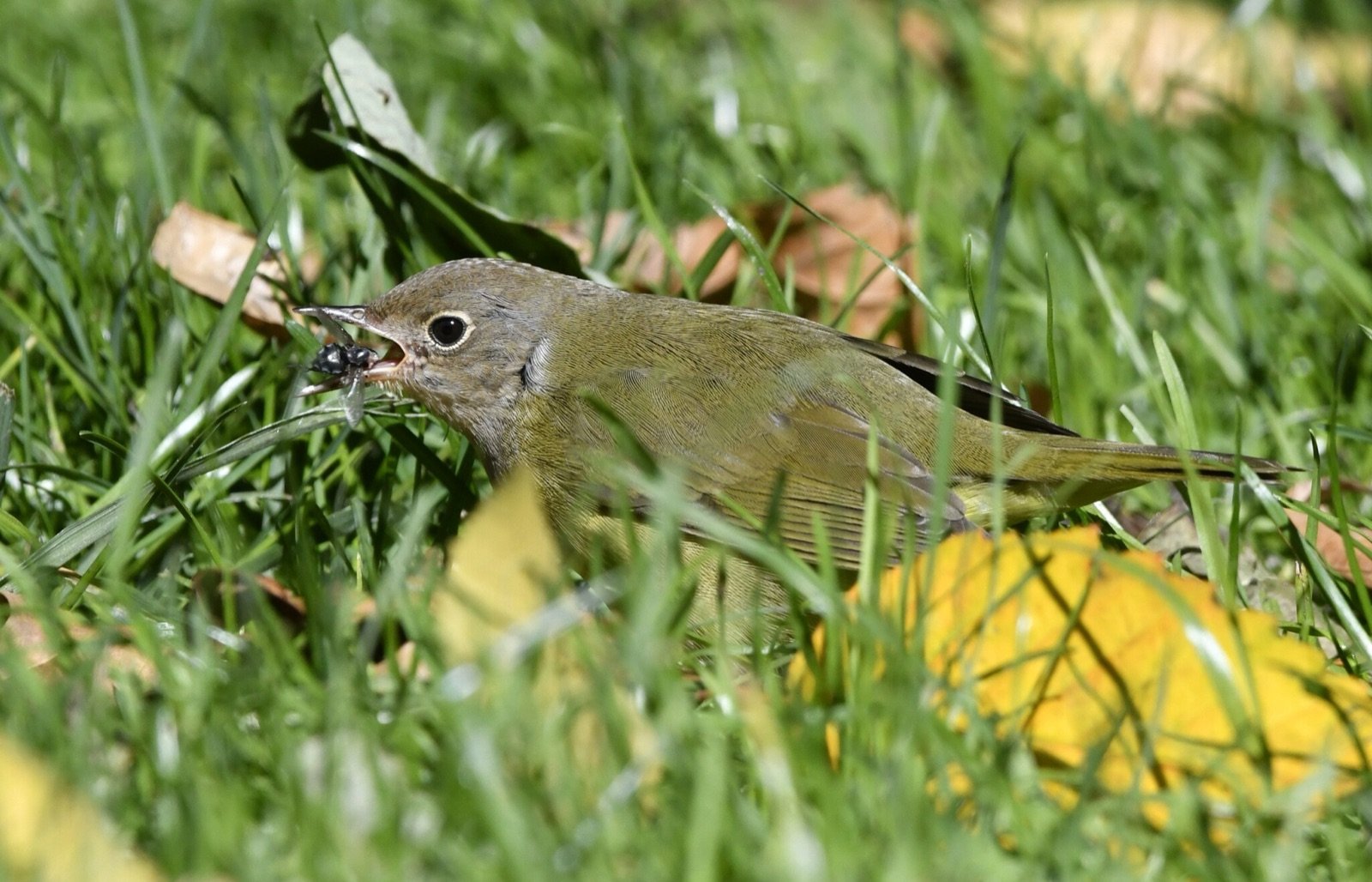
Start with the eye ring. Both sexes show a complete one, and a large pale ring is often the first mark you notice on a bird skulking in the undergrowth.
Size: about 13 cm long, weighing about 14 g.
Males: olive above, yellow below, with a slate gray hood and no black on the chest. The chest band is more olive.
Females: grayish brown hood, pale buff throat, and a browner chest band.
Wild birds have pink legs, a long tail and a thin, pointed bill. The undertail coverts are long and almost reach the tail tip, and the legs and toes are large. Together, the full eye ring, long undertail and sturdy legs separate it from its look-alike.
What it sounds like
Recording: Daniel J. Layton, CC BY 4.0, source, read 4 Nov 2026.
Behaviour and diet
This is a solitary, secretive warbler that stays low in thick cover. Unlike most warblers, which hop, it walks on the ground and bobs its tail. It moves slowly through dense underbrush and often stands still in shadow, which makes it easy to overlook. These habits are described for the species across its whole range, so treat them as useful clues rather than Costa Rican details. It mostly gleans insects and spiders from leaf litter and dense undergrowth.
Where it lives
In Costa Rica it is expected at low to middle elevations on either slope. It prefers secondary growth and brushy forest edges, especially damp spots, and stays in low vegetation. The three old records came from Pacific lowlands and valleys: Puerto Jiménez, La Pacífica and San Isidro del General. Farther south, in winter, the species uses clearings and edges of humid tropical forest in northern South America.
When to see it
The three Costa Rican sightings fell between October and March.
Similar birds
The species to rule out in Costa Rica is the Mourning Warbler (Oporornis philadelphia). The Connecticut always has a full eye ring. In females, a well defined brownish chest band below the hood is another clue, while in the Mourning Warbler this band is absent or only faintly marked. Long undertail coverts and large legs and toes also point to the Connecticut.
Names and lore in Costa Rica
Reinita Ojianillada is the name used in Costa Rica, Ecuador and Panama. Other countries differ: Reinita de Connecticut, Reinita Pechigrís in Colombia and Chipe de Connecticut in Mexico.
Status and conservation
The AOCR official list gives it status A, accidental, and a Costa Rican bird site calls it a very rare or casual migrant and winter visitor with only 3 sightings.
Photography tips
This skulker walks slowly through dense underbrush, so photographing it takes luck and patience. Its large pale eye ring is often the first field mark you notice, and it often stands still in shadow.
How we know this 15 sources, each read on the date shown
- AOCR Lista Oficial de las Aves de Costa Rica read 2026-11-04
https://listaoficialavesdecostarica.wordpress.com/lista-oficial/lista-oficial-online/ - Aves de Costa Rica read 2026-11-04
https://avesdecostarica.com/Oporornis-agilis.html - Wikipedia read 2026-11-04
https://en.wikipedia.org/wiki/Connecticut_warbler - Connecticut Audubon read 2026-11-04
https://ctaudubon.org/news/connecticut-warbler/ - Encyclopedia of Life (Wikipedia summary) read 2026-11-04
https://eol.org/pages/45511083/articles?locale_code=show_all - Wikipedia (es) read 2026-11-04
https://es.wikipedia.org/wiki/Oporornis - Wikipedia (es) Aves de Costa Rica read 2026-11-04
https://es.wikipedia.org/wiki/Anexo:Aves_de_Costa_Rica - Kern Audubon Society read 2026-11-04
https://www.kernaudubonsociety.org/bird-of-the-week-connecticut-warbler/ - Birds of the World (Cornell) read 2026-11-04
https://birdsoftheworld.org/bow/species/conwar/cur/foodhabits - BWD Magazine read 2026-11-04
https://bwdmagazine.com/species/connecticut-warbler/ - Birds of the World (Cornell) read 2026-11-04
https://birdsoftheworld.org/bow/species/conwar/cur/sounds - All About Birds (Cornell) read 2026-11-04
https://www.allaboutbirds.org/guide/Connecticut_Warbler/maps-range - Birds of the World (Cornell), Movements page, Spanish read 2026-11-05
https://birdsoftheworld.org/bow/species/conwar/cur/movement?lang=es - Birdwatching in Costa Rica bird list read 2026-11-05
https://birdwatchingincostarica.com/bird-lists/ - Creagrus, New World Warblers read 2026-11-05
https://creagrus.com/parulids.html