Family Parulidae
Nashville Warbler
Leiothlypis ruficapilla
In Spanish: Reinita Cachetigrís
- Migrant
A rare gray-hooded winter visitor at the far edge of its range.
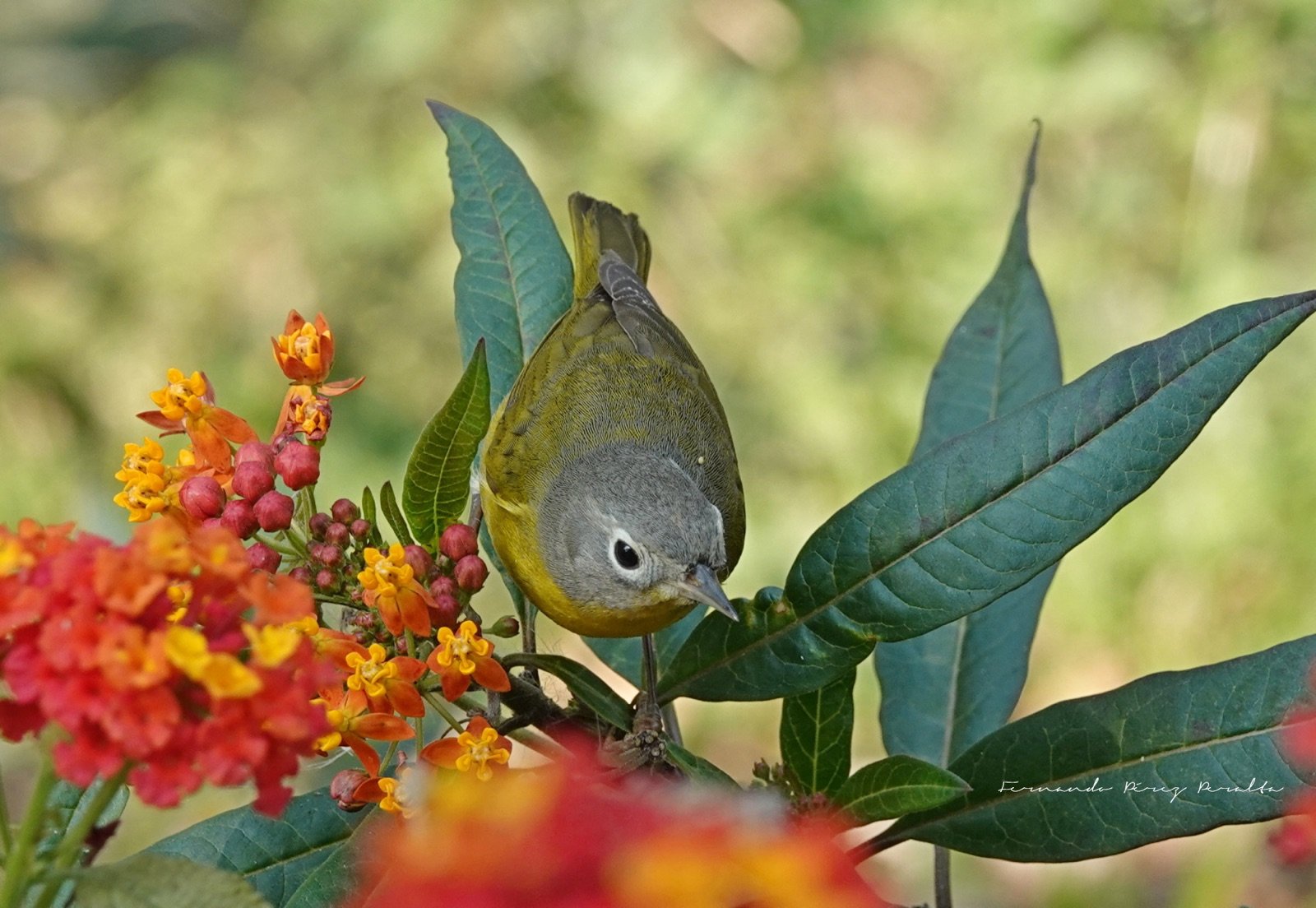
The Nashville Warbler is a small warbler with a gray head, a white eye ring and a yellow underside. In Costa Rica it is an occasional winter wanderer, not a regular visitor, so any sighting is a real find.
Most of these birds winter in central and southern Mexico, and Costa Rica sits at the far southern edge of that range, which fits its scarcity here. A Costa Rican birding blog calls it quite rare, and its author had not found one in the country.
That makes it a bird to hope for rather than expect. Knowing its look and its calls lets you pick one out if it turns up in a mixed flock.
How to find it
Check mixed-species flocks, since this warbler often travels in the middle of them on its wintering grounds. Listen for its persistent contact calls, especially the high, quick, upslurred pink, to locate it in the canopy. Search shrubby tangles and regrowing forest rather than intact forest. Watch for a small bird teetering on the tips of leaves and branches as it forages. Once you have a gray-headed warbler in view, confirm the white eye ring and the yellow belly.
How to recognise it
Look for a gray head with a white eye ring, a green back, and yellow on the throat, breast and belly. The eye ring is complete and stands out against the gray hood, which gives the bird a big-eyed look.
Males and females look much alike. Males do not change color much in the nonbreeding season, so the bird can be identified year-round.
A small patch of reddish feathers on the crown gives the bird its Latin name. It is usually hidden among the gray head feathers, so do not rely on it in the field.
Check the underparts closely. A Nashville has a white lower belly between a yellow breast and yellow undertail coverts.
What it sounds like
Behaviour and diet
The Nashville Warbler picks insects from the lower parts of trees and shrubs and often flicks its tail. It teeters on the tips of leaves and branches while it searches for food. In winter it also takes berries and nectar.
On the wintering grounds it forms loose flocks and sometimes joins mixed-species feeding flocks, so those flocks are worth checking. It is often at the center of large mixed flocks, where its persistent contact calls help birders locate it in the forest canopy.
Where it lives
Range-wide, it likes shrubby tangles and regrowing forest. It is never found in intact forest, though in winter it uses many kinds of habitat.
Most Nashville Warblers winter in central and southern Mexico, and Costa Rica lies at the far southern edge of the wintering range. Records here are scattered across very different places, from the Pacific coast at Chomes in Puntarenas, a site at 5 m elevation, to the Central Valley and the Cartago area.
When to see it
Range-wide, it leaves its breeding grounds from October and returns north in March; this is general migration timing, not specific to Costa Rica. In Costa Rica, two birds in the Central Valley on 2 October 2007 show that an early autumn arrival is possible, and a winter-season report cites a bird in February.
Similar birds
Tennessee Warbler has a dark eyeline and a whitish belly, and it is a more regular migrant in Costa Rica, so check the belly and eye ring. Orange-crowned Warbler, a rare visitor, is duller yellow with no eye ring. Check the undertail: yellow coverts mean Orange-crowned or Nashville, white ones mean Tennessee. MacGillivray's Warbler is extremely rare in Costa Rica, so a gray-headed warbler with an eye ring is more likely a Nashville.
Names and lore in Costa Rica
Costa Ricans know it as Reinita Cachetigrís, the same name used in Panama and Puerto Rico. In Mexico it goes by names such as chipe cabeza gris.
Status and conservation
The AOCR list gives its status as M, a migrant, and in practice it is a rare winter visitor, while globally it is rated Least Concern with a decreasing population.
How we know this 14 sources, each read on the date shown
- Birds for Beer (Costa Rica birding blog) read 2026-11-04
https://birdsforbeer.com/2018/05/26/from-costa-rica-to-minnesota-12-migrant-warblers/ - Wild Adirondacks read 2026-11-04
https://wildadirondacks.org/adirondack-birds-nashville-warbler-oreothlypis-ruficapilla.html - Cornell Birds of the World read 2026-11-04
https://birdsoftheworld.org/bow/species/naswar/cur/introduction - American Bird Conservancy read 2026-11-04
https://abcbirds.org/birds/nashville-warbler/ - Wikipedia read 2026-11-04
https://en.wikipedia.org/wiki/Nashville_warbler - Animal Diversity Web read 2026-11-04
https://animaldiversity.org/accounts/Vermivora_ruficapilla/ - Cornell Lab, All About Birds read 2026-11-04
https://www.allaboutbirds.org/guide/Nashville_Warbler/sounds - Wikipedia (Spanish) read 2026-11-04
https://es.wikipedia.org/wiki/Leiothlypis_ruficapilla - Cornell Lab, All About Birds read 2026-11-04
https://www.allaboutbirds.org/guide/Nashville_Warbler/species-compare/ - Cornell Lab, All About Birds read 2026-11-04
https://www.allaboutbirds.org/guide/Nashville_Warbler/id - Recent records of new and rare bird species in Costa Rica (ResearchGate) read 2026-11-04
https://www.researchgate.net/publication/236176245_Recent_records_of_new_and_rare_bird_species_in_Costa_Rica - 10,000 Birds read 2026-11-04
https://www.10000birds.com/looking-for-lost-warblers-at-parque-rio-loro-costa-rica.htm - Lista Oficial de las Aves de Costa Rica (AOCR) read 2026-11-04
https://listaoficialavesdecostarica.wordpress.com/lista-oficial/lista-oficial-online/ - North American Birds, Vol. 60 Issue 2 read 2026-11-04
https://digitalcommons.usf.edu/cgi/viewcontent.cgi?article=2374&context=nab