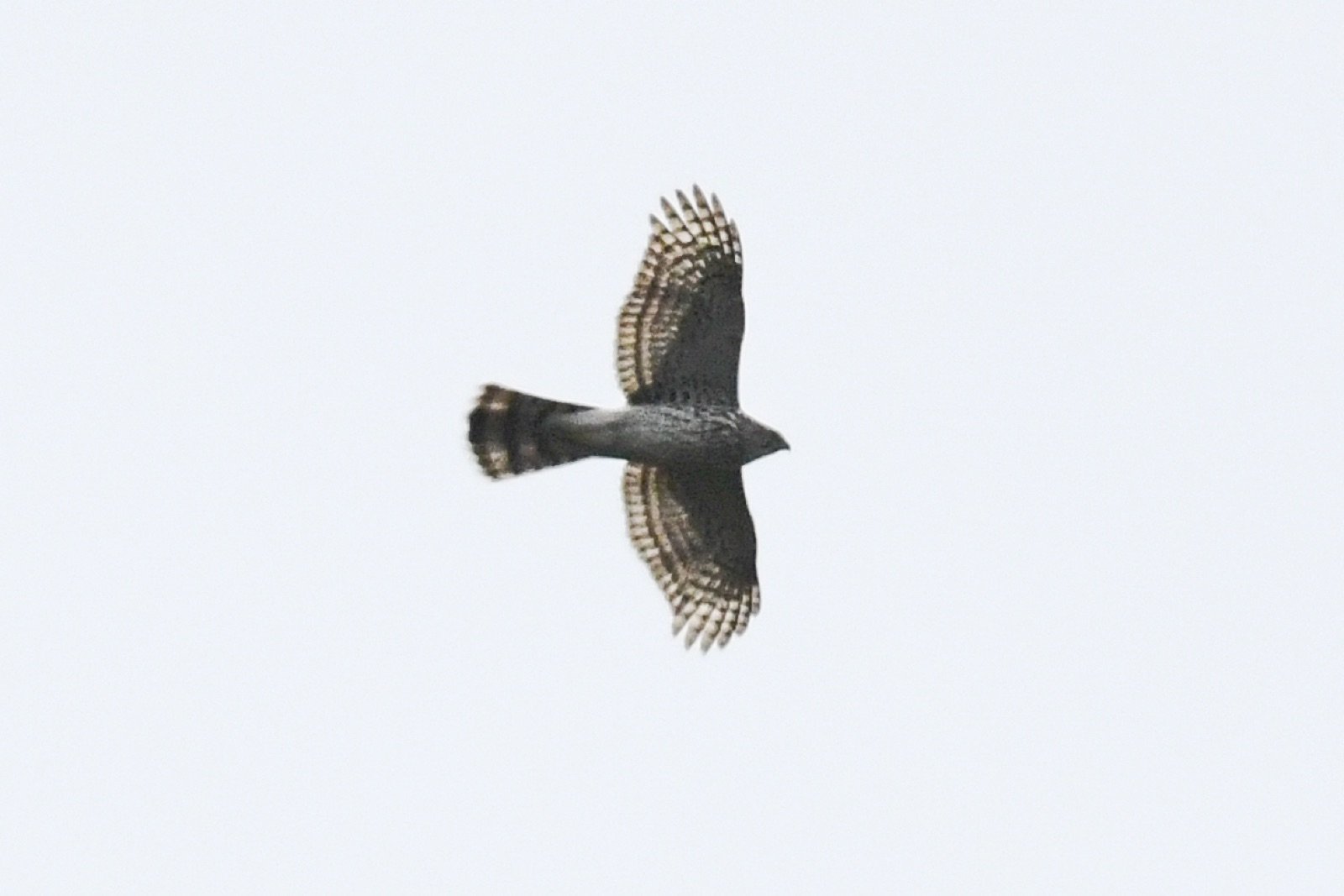
Family Accipitridae
Cooper's Hawk
Astur cooperii
In Spanish: Gavilán de Cooper (Camaleón)
- Migrant
A rare northern hawk that winters in the high mountains, from Tilarán to Talamanca.
Cooper's Hawk, Gavilán de Cooper in Spanish, is a visitor from the north. In Costa Rica it is a very rare migrant and winter visitor, found only in the high mountains, so it is a bird to hope for rather than expect.
It reaches the country rarely but regularly in the non-breeding season. It breeds far to the north, and Costa Rica sits near the southern end of its winter range. Most winter birds stay farther north, commonly reaching Honduras, while Colombia gets only occasional birds.
For a beginning birder it is a good lesson in careful looking, because it is easily confused with the smaller Sharp-shinned Hawk.
How to find it
Plan your search in the high mountains, between roughly 1500 and 3000 m, from the Tilarán range to Talamanca. Cerro de la Muerte is a named wintering area. Look for it perched or darting at forest edges rather than soaring in open sky, since it is built for dashing through dense woods. Overgrown pastures and secondary growth at height are worth scanning, along with hidden perches where it may wait in ambush. Because it is mostly silent in winter, rely on your eyes more than your ears.
How to recognise it
Adults are blue-gray above, with a white underside barred in rufous.
Adults have a dark cap over a paler nape.
The tail is long, with three dark bands and a white tip, and a Costa Rican raptor guide notes the tip is rounded.
Adult eyes are orange to red.
Juveniles are brown above and white below, with a streaked chest and yellow eyes.
These marks describe the species across its whole range, and they are the details to check on any hawk you suspect might be a Cooper's.
What it sounds like
Behaviour and diet
Across its range this is a hunter of birds. It takes mainly small to medium-sized birds and their chicks, and also small mammals and sometimes reptiles. It often ambushes from a hidden perch in vegetation.
It flies with stiff wingbeats and short glides. It usually flies alone, but sometimes soars with other raptors on thermals, so it is worth checking a sky with several birds in it.
Where it lives
In Costa Rica the hawk seems limited to high elevations. Its winter range is roughly 1500 to 3000 m above sea level, and the habitats named are páramo, dwarf forest, overgrown pastures and secondary growth.
It winters from the Tilarán range south to the Talamanca range, including Cerro de la Muerte. Possible migrants have been seen lower, as far down as the Central Valley at about 1100 m.
When to see it
Possible migrants have been seen in the Central Valley (about 1100 m) in late October, early November and in March.
Similar birds
The Sharp-shinned Hawk (Gavilán pajarero) is the main confusion. Cooper's has the larger head, slower wingbeats and a longer tail with a rounded tip, while the Sharp-shinned has a square tail tip. Close up, the Sharp-shinned has larger, more centered eyes and very thin, stick-like legs, and looks hooded where an adult Cooper's looks capped. In flight Cooper's holds its wings straight out, so its head looks longer in front of them.
Names and lore in Costa Rica
The Costa Rican common name is Gavilán de Cooper, and a second local name is Camaleón. In Spanish it is also called azor de Cooper. Elsewhere it is known as big blue darter and chicken hawk.
Status and conservation
The AOCR list marks it as a migrant (M); in Costa Rica it is a very rare winter visitor, while globally it is rated Least Concern with increasing numbers.
Photography tips
Look for it perched or darting at forest edges, not soaring in open sky. Its short rounded wings and long tail let it twist through branches, so expect quick, brief views.
How we know this 14 sources, each read on the date shown
- Aves de Costa Rica read 2026-11-04
https://avesdecostarica.com/Accipiter-cooperii.html - NatureServe Explorer read 2026-11-04
https://explorer.natureserve.org/Taxon/ELEMENT_GLOBAL.2.100417/Astur_cooperii - Hawk Mountain Sanctuary read 2026-11-04
https://www.hawkmountain.org/conservation-science/active-research/raptor-conservation-studies/conserve-the-corridor/coopers-hawk - Wikipedia read 2026-11-04
https://en.wikipedia.org/wiki/Cooper's_hawk - Animalia.bio read 2026-11-04
https://animalia.bio/es/coopers-hawk - Animalia.bio read 2026-11-04
https://animalia.bio/coopers-hawk?environment=13 - Ecoregistros read 2026-11-04
https://www.ecoregistros.org/sheet/Astur-cooperii - Animal Diversity Web read 2026-11-04
https://animaldiversity.org/accounts/Accipiter_cooperii/ - ICT Costa Rica, Rapaces infographic read 2026-11-04
https://www.ict.go.cr/en/documents/infogramas-1/espa%C3%B1ol/2232-aves-rapaces/file.html - All Birds of the World wiki read 2026-11-04
https://allbirdsoftheworld.fandom.com/wiki/Cooper's_Hawk - Chesapeake Bay Program read 2026-11-04
https://www.chesapeakebay.net/discover/field-guide/entry/coopers-hawk - Gavilán de Cooper blog read 2026-11-04
http://gavilancooper.blogspot.com/ - The Peregrine Fund read 2026-11-04
https://peregrinefund.org/explore-raptors-species/hawks/coopers-hawk - EcoRegistros read 2026-11-04
https://www.ecoregistros.org/ficha/Accipiter-cooperii&idlugar=31992