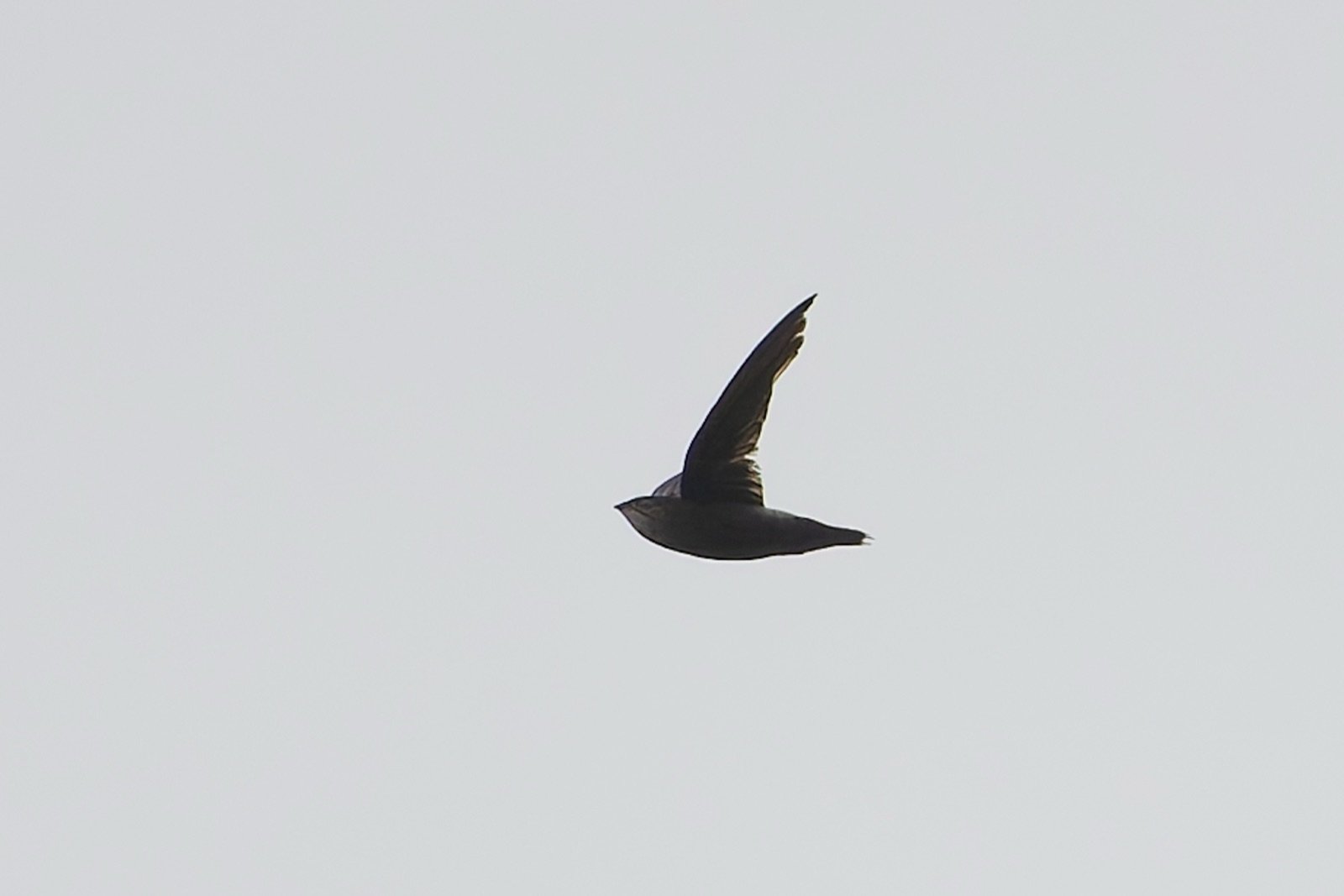
Family Apodidae
Costa Rican Swift
Chaetura fumosa
In Spanish: Vencejo de Rabadilla Clara
- Resident
- Regional endemic
A small sooty swift with a pale rump band, abundant around the Golfo Dulce.
The Costa Rican Swift (Vencejo de Rabadilla Clara, Chaetura fumosa) is a small swift of the southern Pacific. It is a common to abundant resident of the lowlands and foothills, and its range runs from Quepos and the upper General Valley southward.
It is especially numerous around the Golfo Dulce area, and the national list marks it R-END, a resident endemic. Beyond Costa Rica it reaches only into Chiriquí Province in western Panama.
Most birders meet it as a dark shape high overhead, so knowing where you are and what to check on the rump goes a long way.
How to find it
Look up: birders often see it only high overhead, just a couple of times on a trip. Choose the southern Pacific, the Golfo Dulce area or the Osa Peninsula, where it is numerous. Scan the open sky over forest, pasture and farmland, and check any mixed flock of swifts and swallows, since it often feeds with them. Early morning and late afternoon are the likelier times to see it lower. Take time to see the pale rump band. Region helps too: near Esquinas, in Piedras Blancas National Park, it is the only Chaetura swift present, so a small swift with a pale rump there is this species.
How to recognise it
This is a small swift, about 11 cm long.
Look for these marks:
- plumage mostly sooty black, with a blue gloss
- a pale throat
- a pale band across the rump
- a black bill and black feet
The pale rump band is the mark to work for, because several small swifts share the same dark body. Compared with most Band-rumped Swift forms, this species has a wider, darker rump band instead of a narrow white patch, plus a clear pale throat patch. Bill and feet are rarely visible on a bird in fast flight, so watch a group pass rather than judging a single flash. Tour leaders have had to study a few birds carefully in the lowlands to be sure of that band.
Behaviour and diet
The Costa Rican Swift catches insects in flight. It often feeds in flocks mixed with other swifts and swallows, so scan the whole flock rather than only the dark shapes that stand out.
Groups usually number 5 to 10 birds, and after the breeding season they gather into flocks of up to 50. Its nest and eggs have not been described, and nothing is known yet about its breeding behaviour.
Where it lives
In Costa Rica it is a bird of the southern Pacific lowlands and foothills, from Quepos and the upper General Valley southward, and it is especially numerous around the Golfo Dulce area. It is not found elsewhere in the country.
Across its range it uses tropical moist lowland forest, pastures, open country and farmland. It is also listed for moist foothill and montane forest, and one database gives forest and open country from the lowlands up to about 1500 m. A call was recorded at about 100 m elevation in Piedras Blancas National Park, Puntarenas.
Similar birds
Other small Chaetura swifts in Costa Rica include Gray-rumped Swift, Chimney Swift and Vaux's Swift. Gray-rumped is the common Chaetura of the Caribbean lowlands and foothills, while this is a southern Pacific bird, so region is a useful clue. Chimney and Vaux's are northern migrants, and Vaux's has a paler throat and rump than the Chimney. Vaux's is mostly seen at middle elevations, for example at a roost tree at Wilson Botanical Garden.
Names and lore in Costa Rica
The Costa Rican Spanish name on the national list is Vencejo de Rabadilla Clara. Elsewhere in Spanish the species is usually called Vencejo Costarricense.
Status and conservation
Listed as a resident endemic (R-END) on the AOCR list, it is rated Least Concern, with a stable population estimated at 20,000 to 49,999 mature birds.
Photography tips
Expect a fast, high target. Like its relative the Band-rumped Swift, it likely feeds high above the ground for most of the day, so early morning and late afternoon are your better chances when it drops lower. Watch a few birds carefully so you can confirm the pale rump band.
How we know this 16 sources, each read on the date shown
- Aves de Costa Rica (Apodidae) read 2026-11-04
https://www.avesdecostarica.org/apodidae.html - xeno-canto read 2026-11-04
https://xeno-canto.org/274408 - Wikipedia read 2026-11-04
https://en.wikipedia.org/wiki/Costa_Rican_swift - Bird Watching Costa Rica read 2026-11-04
https://www.birdwatchingcostarica.com/ave/costa-rican-swift/ - Avibase read 2026-11-04
https://avibase.bsc-eoc.org/species.jsp?avibaseid=AEFB81579C0FD9FD - BirdLife DataZone read 2026-11-04
http://datazone.birdlife.org/species/factsheet/costa-rican-swift-chaetura-fumosa - Birds of Costa Rica (birdsofcolombia.org) read 2026-11-04
https://www.birdsofcolombia.org/costarica/Chaetura.html - Birding Craft read 2026-11-04
https://birdingcraft.com/wordpress/2020/10/12/gray-rumped-swift-another-endemic-for-central-america/ - Avibase read 2026-11-04
https://avibase.bsc-eoc.org/species.jsp?avibaseid=7DBCF8E458A82450 - Field Guides tour report 2019 read 2026-11-04
https://fieldguides.com/triplists/cr119LIST.pdf - Exotic Birding Osa checklist read 2026-11-04
http://www.exoticbirding.com/costarica/osa-peninsula/checklist.html - Field Guides tour report 2024 read 2026-11-04
https://fieldguides.com/triplists/cr124PRINT.html - Wikipedia read 2026-11-04
https://en.wikipedia.org/wiki/Costa_Rican_Swift - Wikipedia (Spanish) read 2026-11-04
https://es.wikipedia.org/wiki/Chaetura_fumosa - Oiseaux.net read 2026-11-05
https://oiseaux.net/birds/costa.rican.swift.html - Birds of the World (Cornell) read 2026-11-05
https://birdsoftheworld.org/bow/species/corswi/cur/introduction