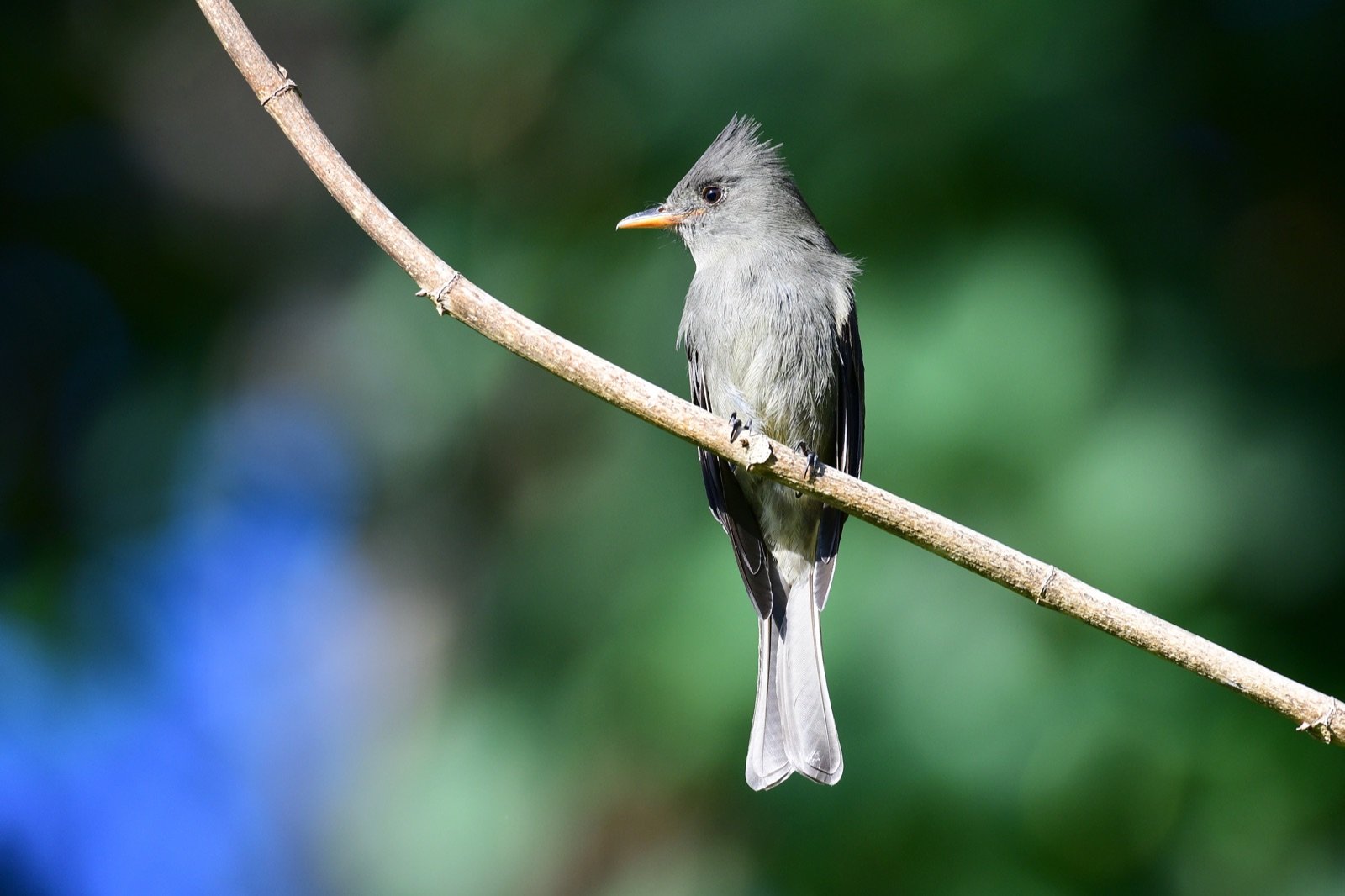
 Dark Pewee
Family Tyrannidae
Dark Pewee
Contopus lugubris
In Spanish: Pibí Sombrío (Tontillo)
- Resident
- Regional endemic
A sooty, crested flycatcher of highland forest edges and clearings.
The Dark Pewee (Pibí Sombrío, also called Tontillo) waits on an exposed treetop perch, darts out after an insect and usually returns to the same spot. It is endemic to Costa Rica and western Panama, which makes it one of the birds that rewards a highland trip.
In Costa Rica it lives in humid mountain forest at roughly 1200 to 2150 m. On a trip we build, the Savegre Valley near San Gerardo de Dota is a place to look for it on a short walk, alongside other highland birds.
It is not easy everywhere. A birding writer ranks it with the pygmy-owl and the jay among the toughest highland endemics around Cerro de la Muerte, so it helps to learn its shape and voice before you go.
How to find it
Look for a single bird on a conspicuous perch at a forest edge or in a clearing, and check treetops first. Because it often sits quietly for long spells, give each likely perch a little time. Listen as well as look: on one Field Guides trip a guide heard one calling for a long time at Rio Macho, and the group then tracked it down and got good scope views. Around Savegre, one tour searched the waterfalls road, and another group strolled the river bank in the afternoon and spotted one. On the Providencia Road off Cerro de la Muerte, the best birding is said to be near the top, where traffic is light.
How to recognise it
This is a large, dark pewee with a clear crest. Look for these marks:
Sooty gray overall, only slightly paler on the throat and belly.
A pale throat.
A faint single wing bar, and little other marking.
A crest more obvious than on other pewees.
Males and females look alike.
It is the only all-dark crested flycatcher in its range, so a good view usually settles the name. The crest is said to rise when the bird is excited or alarmed. A birding forum weighed a dark Savegre bird against Tufted Flycatcher, and the advice was that an all-dark head, face and nape fits a pewee better, and a larger bill also helps.
What it sounds like
Behaviour and diet
The Dark Pewee perches high in an exposed spot, often a treetop, and flies out to catch insects, usually returning to the same perch afterward. It often sits quietly for long spells before darting out for prey.
Outside the breeding season it is usually seen alone. It makes altitudinal movements during the year.
It can also be bold. It often harasses the Emerald Toucanet, mostly when the pewee is nesting, and it defends its nest aggressively, even chasing off larger birds.
Where it lives
In Costa Rica it lives at mid to high elevations, roughly 1200 to 2150 m. It uses humid mountain forest edges, openings and semi-open areas with scattered trees, so borders and clearings are better places to look than the closed interior.
It ranges from the Tilarán mountains southward. In the Central Volcanic range it is mostly on the Caribbean side, and in the Talamanca range it occurs on both slopes. A Costa Rican natural history page lists conservation areas for it: Arenal, Central Volcanic Range, Amistad Caribe, Amistad Pacífico, Huetar Norte, Osa, Central Pacific and Tortuguero. It is also listed at Cloudbridge Nature Reserve, a private reserve in the highlands.
When to see it
It breeds from March to June. The nest is an open cup of moss and lichen, placed 5 to 18 m up on a branch.
Similar birds
Its crest and all-dark plumage set it apart from other pewees. Tufted Flycatcher can cause doubt at Savegre, but an all-dark head, face and nape and a larger bill point to the pewee. Yellowish Flycatcher and Ochraceous Pewee were searched for along the same waterfalls road.
Names and lore in Costa Rica
The Costa Rican list name is Pibí Sombrío, and the nickname Tontillo is listed beside it. Some sources also write Pibí oscuro.
Status and conservation
The AOCR list marks it as a resident endemic (R-END), found only in Costa Rica and western Panama, and it is rated Least Concern globally.
Photography tips
It often sits quietly on a perch for long spells before darting out for prey, so patience pays. Check treetop perches at edges and clearings, and wait for it to return to its favourite spot.
How we know this 16 sources, each read on the date shown
- Cloudbridge Nature Reserve bird list read 2026-11-04
https://www.cloudbridge.org/wp-content/uploads/2020/04/Bird-Species-List-Costa-Rica-13-April-2020.pdf - Flickr (Costa Rica natural history text) read 2026-11-04
https://www.flickr.com/photos/jobando/34414452576 - Wikipedia read 2026-11-04
https://en.wikipedia.org/wiki/Dark_pewee - Earthlife read 2026-11-04
https://earthlife.net/dark-pewees/ - Birds of the World read 2026-11-04
https://www.hbw.com/species/dark-pewee-contopus-lugubris - Flickr (field guide text) read 2026-11-04
https://www.flickr.com/photos/crunchie-carruthers/53860809140 - quetzalbycar.com read 2026-11-04
https://www.quetzalbycar.com/locations/savegre-area - Birding Ecotours read 2026-11-04
https://www.birdingecotours.com/tour/birding-tour-costa-rica-escape/ - Field Guides trip list, Costa Rica 2017 read 2026-11-04
https://fieldguides.com/triplists/cos17.html - Birding Craft blog read 2026-11-04
https://birdingcraft.com/wordpress/2012/05/09/ - Birdwatching Spain read 2026-11-04
https://birdwatchingspain.net/observacion-aves-costa-rica/?lang=es - BirdForum read 2026-11-04
https://www.birdforum.net/threads/ochraceous-pewee-or-tufted-flycatcher-costa-rica-25-02.437114/ - Wingspan Bird Tours blog read 2026-11-04
http://www.wingspanbirdtours.com/blog/costa-rica-tour-day-12-91f0d724-a491-4afd-9a85-0d795436f39a - Birding Craft blog read 2026-11-04
https://birdingcraft.com/wordpress/2022/01/17/a-high-octane-birding-itinerary-for-costa-rica/ - Aves Ibéricas, Aves Costa Rica read 2026-11-04
https://www.avesibericas.es/costaricaaves6.htm - Ecoregistros read 2026-11-04
https://www.ecoregistros.org/sheet/Contopus-lugubris