Family Tyrannidae
Eastern Kingbird
Tyrannus tyrannus
In Spanish: Tirano Norteño (Viuda Negra)
- Migrant
A migrant that streams down the Caribbean coast in the thousands
The Eastern Kingbird (Tirano Norteño) is a bird you meet on the move. In Costa Rica it is a passage migrant on both slopes, passing through in two windows rather than staying.
Southbound birds come from late August or early September to late October. Northbound birds come from late March to mid-May. Along the Caribbean coast it is often very abundant, and a tour group on the beach near Puerto Viejo de Talamanca watched hundreds actively migrating with swallows and Dickcissels.
For a beginning birder it is a rewarding species to plan around, because the big movements are easy to see once you know when and where to look.
How to find it
Plan a visit for one of the two migration windows and head for the Caribbean coast, where the flow is heaviest. Scan the sky at dawn, when the flow of migrants is strongest. Flocks often fly in and perch in the canopy, so watch the tops of trees and snags near the coast. Look through the swallow flocks overhead, because kingbirds mix with them. At Tortuguero the biggest flocks came in the morning, especially once the rain stopped.
How to recognise it
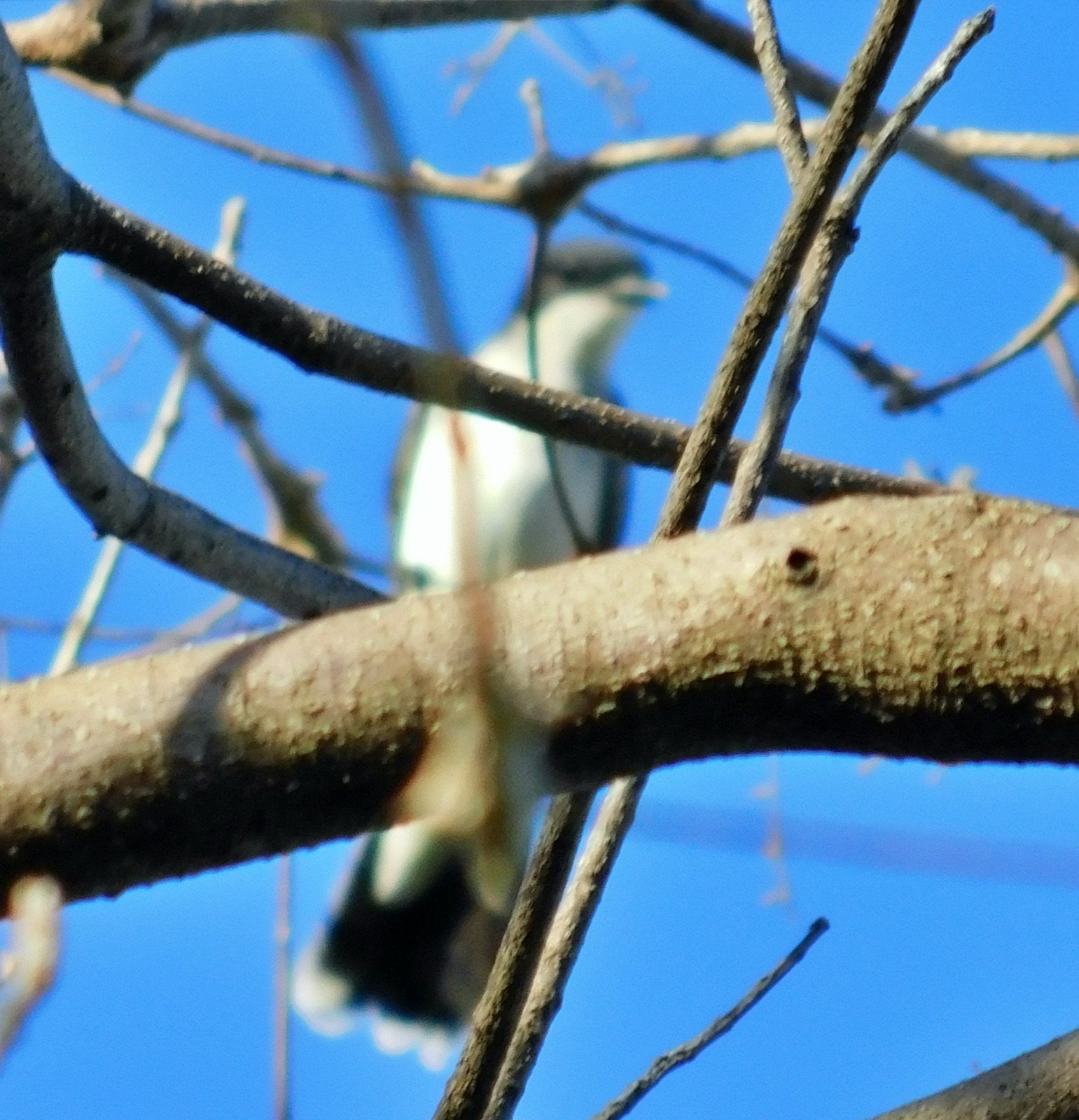
Adults are gray to blackish above, with a white belly and chest. The long black tail has a white tip, and the wings are long and pointed.
A red crown patch exists but is rarely seen, so do not count on it as a clue. On a perched bird, look for the dark back against the white front, then check the tail tip.
These details come from the species across its whole range, and they hold for the birds that pass through Costa Rica. In flight, flocks of hundreds look a lot like swallows as they mix with the swallow waves overhead, so the white-tipped tail is worth waiting for when a bird lands.
What it sounds like
Recording: Zac Peterson, CC BY 4.0, source, read 4 Nov 2026.
Behaviour and diet
The Eastern Kingbird waits on an open perch and flies out to catch insects in flight. Across its range it is aggressive in defending its territory, even against much larger birds.
Migrants in Costa Rica are calmer. They rest briefly in trees, catch insects in flight, and pick berries and arillate seeds. They roost in isolated clumps of trees or in tall coarse grass.
Where it lives
In Costa Rica it is a passage migrant on both slopes. It is often common in the Pacific lowlands and in the Caribbean lowlands away from the coast, and along the Caribbean coast it is often very abundant.
On migration it ranges from the lowlands up to about 1700 m in the central mountains. Large numbers gather in scrub along the Caribbean coast to feed on Cordia curassavica fruit.
When to see it
Southbound birds pass from late August or early September to late October, and October is a peak time on the south Caribbean coast. Northbound birds pass from late March to mid-May, and April is described as high time for spring migration.
Similar birds
Tropical Kingbird, the common resident kingbird, has a yellow belly and a plain brown tail, while the Eastern has a white belly and a white tail tip. Fork-tailed Flycatcher looks similar, but the Eastern Kingbird has a square tail with a white tip. Western Kingbird is paler with a bright yellow belly, and it is a rarer migrant in Costa Rica.
Names and lore in Costa Rica
Costa Ricans use Tirano Norteño for this bird, and the AOCR list adds Viuda Negra. Other Spanish names elsewhere include tirano oriental, tirano dorso negro and tirano viajero.
Status and conservation
The AOCR list marks it as a migrant (M), a passage migrant on both slopes that is often common to very abundant.
Photography tips
Flocks often fly in and perch in the canopy, so watch the tops of trees and snags near the Caribbean coast. Scan the sky at dawn, when the flow of migrants is heaviest, and keep an eye on open perches for a bird that flies out after insects and returns.
How we know this 16 sources, each read on the date shown
- Ecos del Bosque (Guía de Aves de Costa Rica) read 2026-11-04
https://ecosdelbosque.com/fauna/tyrannus-tyrannus - BC Conservation Data Centre (citing Stiles and Skutch 1989) read 2026-11-04
https://a100.gov.bc.ca/pub/eswp/speciesSummary.do;jsessionid=0237a15c6d04a7dca250c659791eaceac7ec8af7fc3a028bf8753812744df802.e3uMah8KbhmLe34NaN4KaNyTaNj0n6jAmljGr5XDqQLvpAe?id=16726 - Naturalista Costa Rica (Wikipedia text) read 2026-11-04
https://costarica.inaturalist.org/taxa/16782-Tyrannus-tyrannus - Viking Eco Tours read 2026-11-04
https://www.vikingecotours.com/animals/eaki - Aves de Peru read 2026-11-04
https://avesdeperu.org/tyrannidae/tirano-norteno-tyrannus-tyrannus/ - Valery Schollaert read 2026-11-04
https://valeryschollaert.wordpress.com/tyran-tritri-tyrannus-tyrannus/ - Wikipedia (es) read 2026-11-04
https://es.wikipedia.org/wiki/Tyrannus_tyrannus - Birding Craft read 2026-11-04
http://birdingcraft.com/wordpress/category/caribbean-slope/ - Birding Craft read 2026-11-04
https://birdingcraft.com/wordpress/2023/03/27/costa-rica-birding-news-march-and-april-2023/ - Birding Club of Costa Rica read 2026-11-04
https://birdingclubcr.org/bccr-adventures-new/caribbean-lowlands.html - Eagle-Eye Tours read 2026-11-04
https://www.eagle-eye.com/blog/costa-rica-caribbean-mountains-to-coast-2025-trip-report-oct-1-12/ - Birding Craft read 2026-11-04
https://birdingcraft.com/wordpress/2018/10/22/recent-birding-in-thesouthern-caribbean-lowlands-of-costa-rica/ - 10,000 Birds read 2026-11-04
https://www.10000birds.com/millions-of-red-eyed-vireos-eastern-kingbirds-chimney-swifts-in-costa-rica-all-heading-north.htm - Audubon Field Guide read 2026-11-04
https://www.audubon.org/field-guide/bird/tropical-kingbird - iNaturalist guide (NPS) read 2026-11-04
https://www.inaturalist.org/guide_taxa/364335 - Observatorio Ambiental de Bogotá read 2026-11-04
https://oab.ambientebogota.gov.co/fauna/tirano-norteno/