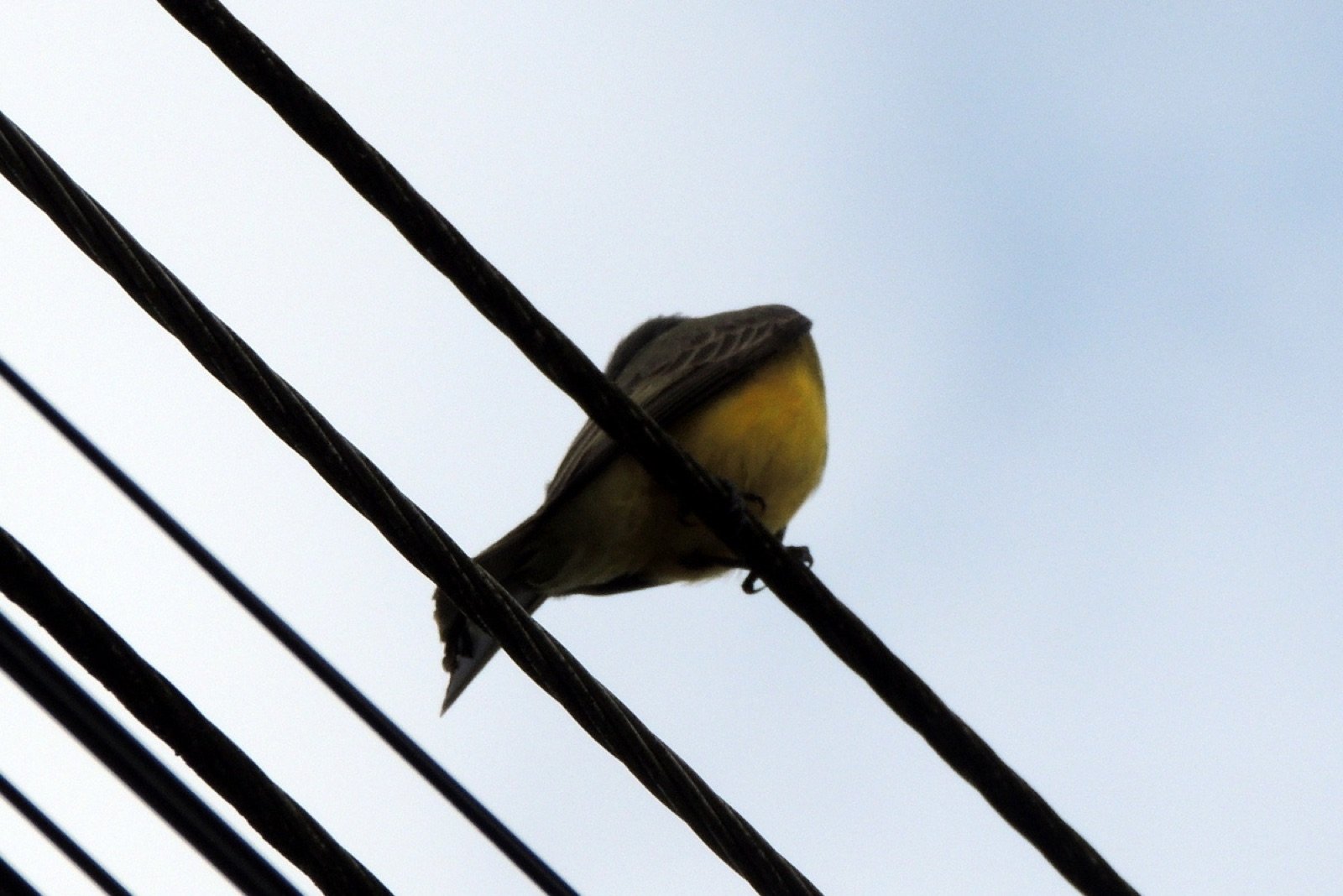
Family Tyrannidae
Western Kingbird
Tyrannus verticalis
In Spanish: Tirano Occidental (Pecho Amarillo)
- Migrant
Pale-breasted winter visitor, easily missed beside the Tropical Kingbird.
The Western Kingbird (Tirano Occidental) is a migratory visitor from North America. In Costa Rica it is found mainly in the North Pacific, with a few scattered records in the Central Valley.
It is a sporadic winter resident, and numbers at one site can swing from fairly common one year to rare or absent the next. That makes it a bird to look for with patience.
It is also easily overlooked, because its plumage and behaviour are so close to other Tyrannus kingbirds, mainly the Tropical Kingbird (Pecho Amarillo). Knowing the small differences turns a yellow-bellied shape on a wire into a good bird.
How to find it
Check open country with scattered trees, roadsides and wires, where it perches in the open. Power lines and fence posts at the road edge are worth scanning, and birds gather in groups that feed on fruit trees. Aim for the Pacific slope in winter, especially the North Pacific. Orotina, on the Central Pacific side, is one place visitors can look for it in the Pacific lowlands. Scan every yellow-bellied kingbird rather than assuming it is a Tropical, and check the pale breast, shorter bill and square, white-edged tail. Roosts shared with Fork-tailed and Scissor-tailed Flycatchers are worth a look too.
How to recognise it
Adults have a pale gray head with a darker mask and a pale grayish olive back. The throat and breast are pale gray, the belly is yellow, and the black tail has white outer edges.
A small reddish crown patch is normally hidden. Birds raise it only during courtship or when facing off against other species, so do not count on seeing it.
These marks describe the species in general. In Costa Rica the useful comparison is with the Tropical Kingbird: the Western is paler below, has a shorter bill, and has a square tail with white edges.
What it sounds like
Recording: Andrew Meeds, CC BY 4.0, source, read 4 Nov 2026.
Behaviour and diet
It watches from exposed perches such as trees, shrubs or wires, then flies out to catch insects. It also eats fruit in fall and winter.
In Costa Rica it often joins the communal winter roosts of Fork-tailed and Scissor-tailed Flycatchers, so a roost may hold several flycatcher species at once. In Heredia, Western Kingbirds squabbled with Tropical Kingbirds and other birds, and the two kingbird species were seen in aggressive encounters.
Where it lives
In Costa Rica it prefers open areas with scattered trees. It is recorded from sea level to about 1000 m west of the Central Valley, and a study in Heredia extended its known elevation range in the country from 1000 m up to 1350 m.
Most records are on the Pacific slope south to the Térraba region. Conservation areas listed for it include Guanacaste, Arenal, Amistad Pacífico, Cordillera Volcánica Central, Osa, Pacífico Central and Tempisque.
When to see it
It is a sporadic winter resident, present from late October or November until April.
Similar birds
The Tropical Kingbird (Pecho Amarillo) is the look-alike. The Western is paler below with a shorter bill and a square, white-edged tail. A Costa Rican natural history account adds that the outer 3 primaries in females, or 4 in males, have thin tips, another feature that separates it from the Tropical. In Heredia the two were seen in aggressive encounters, so watching how they interact may help.
Names and lore in Costa Rica
Costa Rica, Mexico and Panama use the name tirano occidental. In Costa Rica the Tropical Kingbird that it resembles is known as Pecho Amarillo, and the AOCR lists the Western as Tirano Occidental (Pecho Amarillo).
Status and conservation
On the AOCR list it is marked M, a migratory visitor from North America that is found in Costa Rica as a sporadic winter resident.
Photography tips
Perches in the open make it approachable for the camera: look along roadsides, wires and fence posts in open country with scattered trees. Photograph the underparts and tail so the pale breast and square, white-edged tail show clearly against a Tropical Kingbird.
How we know this 11 sources, each read on the date shown
- Dialnet (Costa Rican journal article) read 2026-11-04
https://dialnet.unirioja.es/servlet/articulo?codigo=8905193 - Flickr post quoting Costa Rican natural history text (Orotina) read 2026-11-04
https://www.flickr.com/photos/jobando/32617218028 - National Geographic read 2026-11-04
https://www.nationalgeographic.com/animals/birds/facts/western-kingbird - Illinois Department of Natural Resources read 2026-11-04
https://dnr.illinois.gov/education/wildaboutpages/wildaboutbirds/wildaboutbirdsflycatchers/wabwesternkingbird.html - All Birds Wiki read 2026-11-04
https://allbirdsoftheworld.fandom.com/wiki/Western_Kingbird - ArgentiNat (Wikipedia text) read 2026-11-04
https://www.argentinat.org/taxa/16791-Tyrannus-verticalis - Wikipedia (es) read 2026-11-04
https://es.wikipedia.org/wiki/Tyrannus_verticalis - Birding Craft read 2026-11-04
https://birdingcraft.com/wordpress/2018/11/26/horizontes-good-birding-in-guanacaste/ - Birding Craft read 2026-11-04
https://birdingcraft.com/wordpress/2021/01/26/a-day-of-productive-birding-in-costa-rica/ - Enchanting Costa Rica read 2026-11-05
https://enchanting-costarica.com/nature-and-adventures/birdwatching-in-guanacaste-discover-the-extraordinary-birdlife-of-hacienda-guachipelin/ - Arboretum UFM read 2026-11-05
https://arboretum.ufm.edu/animales/tyrannus-verticalis/