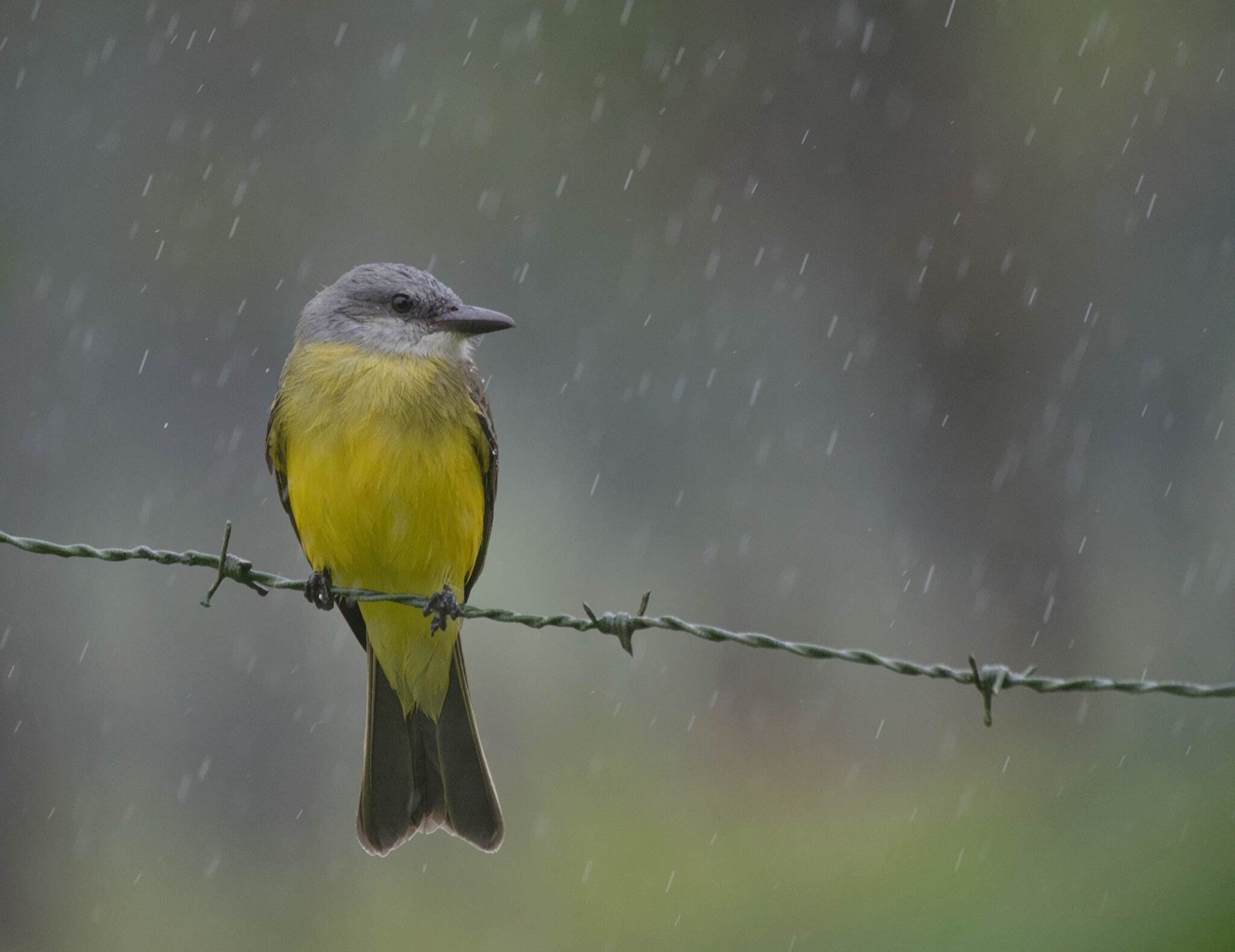
Family Tyrannidae
Tropical Kingbird
Tyrannus melancholicus
In Spanish: Tirano Tropical (Pecho Amarillo)
- Resident
Gray head, yellow belly, and a favourite perch on the nearest power line.
The Tropical Kingbird (Tirano Tropical, or Pecho Amarillo) is a medium-sized flycatcher that often sits in the open to watch over its territory. That habit makes it one of the easiest birds for a beginner to find.
Stiles and Skutch describe it as an abundant resident across Costa Rica from the lowlands to about 1850 m, so you do not need a special trip to meet it.
On a trip we build, hotel gardens near San José are a typical first stop. A morning bird walk near the airport is an easy introduction that can turn up this kingbird along with other common species.
How to find it
Look along roads and on utility lines, where it often perches on wires and dead branches in the open. In Costa Rica it is a common sight on powerline cables. In open areas of a Guanacaste golf course, especially around the driving range, it is often on electrical wires or fence posts. Go out at dawn, since it sings early: a resort bird was heard singing from an overhead wire. Gardens are worth a look too, as one Turrialba-area garden had a pair breeding with a juvenile seen. A sharp, repeated 'kip' tells you it is close.
How to recognise it
Look for a gray head, an olive-green back and a bright yellow belly. The chest is yellow, not gray.
The tail is dull brown with a notch at the tip, and the bill is fairly heavy. Males and females look alike.
A Costa Rican golf course guide describes a pale yellow belly, grayish olive upperparts and a dirty white throat. It calls the bird less vibrant and smaller than the Great Kiskadee.
Young birds look different from adults. Juveniles have pale buff edges on the wing coverts, and a Costa Rica photographer notes the juvenile can look like another species. Because the bird sits in the open, binoculars help you see these details.
What it sounds like
Recording: Rodolfo Salinas Villarreal, CC BY 4.0, source, read 4 Nov 2026.
Behaviour and diet
It watches from an exposed perch, then flies out to catch insects in the air. It usually returns to the same perch to eat.
It eats mostly insects such as beetles, flies and grasshoppers. In the tropics it also eats many berries and small fruits. A Costa Rica study found it rarely eats small frogs.
It stays in the upper tree levels, so it seldom joins understory mixed flocks. It sometimes nests near wasp nests, which helps deter predators, and pairs cooperate to chase away brood-parasitic birds.
Where it lives
In the tropics it lives in almost any open or semi-open habitat, from savannas and farms to towns and cities.
In Costa Rica it is especially common in the lowlands and mid elevations, including the Monteverde area. It is an abundant resident from the lowlands to about 1850 m, and uncommon up to 2500 m.
Reports come from Alajuela, the Pacific coast near Tárcoles, the Osa Peninsula, Caño Negro, the Turrialba region and Guanacaste.
When to see it
It is a resident, so it is present all year. It breeds between March and July, when the male defends the nest area aggressively and pairs are easy to notice. The nest is a shallow, loose cup of vine bits, grass and stems, 1.8 to 12 m up in an exposed spot, sometimes low over water. The usual clutch is 2 or 3 eggs, incubated for about 15 days.
Similar birds
It is almost identical to Couch's Kingbird, which is best told apart by voice. Couch's is listed as a rare or accidental visitor in Costa Rica, so it is unlikely to be the problem. A brown, slightly forked tail and a fairly heavy bill help separate it from the Pale-billed Kingbird (Tirano Pálido).
Names and lore in Costa Rica
Costa Ricans commonly call it Pecho Amarillo, which means yellow chest, though a photographer living in the country calls this an unofficial local name. A Guanacaste golf course bird guide says it is also known locally as Cristo-fue.
Status and conservation
The AOCR lists it as a resident (R), and the IUCN rates the species Least Concern as widespread, common and adaptable.
Photography tips
Its habit of perching on power lines can make it easy to photograph, depending on the sunlight. It likes high, exposed perches from which it watches its territory. Bring binoculars to see plumage details, even though the bird is easy to see.
How we know this 20 sources, each read on the date shown
- Monteverde Travel read 2026-11-04
https://monteverdetravel.com/tropical-kingbird-monteverde-birdwatching/ - Audubon Field Guide read 2026-11-04
https://www.audubon.org/field-guide/bird/tropical-kingbird - Simple English Wikipedia read 2026-11-04
https://simple.wikipedia.org/wiki/Kingbird - Cornell Lab, All About Birds read 2026-11-04
https://www.allaboutbirds.org/guide/Tropical_Kingbird/overview - Charlie Doggett, Retired in Costa Rica read 2026-11-04
https://www.charliedoggett.net/tag/tropical-kingbird/ - Flickr (Rosa Gamboias) read 2026-11-04
https://www.flickr.com/photos/rgamboias/34702942745 - Wikipedia read 2026-11-04
https://en.wikipedia.org/wiki/Tropical_kingbird - Diversidad y un poco de todo read 2026-11-04
https://www.diversidadyunpocodetodo.com/tirano-melancolico-tyrannus-melancholicus/ - Wikipedia (Spanish) read 2026-11-04
https://es.wikipedia.org/wiki/Tyrannus_melancholicus - Fauna Chirimoyo read 2026-11-04
https://fauna.chirimoyo.org/aves/tyrannus-melancholicus - Bird Watching Trips read 2026-11-04
https://www.birdwatchingtrips.co.uk/bird-blog/costa-rica-come-and-join-us - North Branch Nature Center read 2026-11-04
https://northbranchnaturecenter.org/adult-programs/adventures-afar/costa-rica-2026 - Birds for Beer read 2026-11-04
https://birdsforbeer.com/2018/05/21/yellow-birds-nesting-in-a-costa-rican-garden/ - Ecos del Bosque read 2026-11-04
https://ecosdelbosque.com/fauna/tyrannus-melancholicus - La Iguana Golf Course local bird guide read 2026-11-04
https://www.golflaiguana.com/wp-content/uploads/sites/9272/2023/10/Wildlife_page.pdf - Birding Depot read 2026-11-04
https://birdingdepot.com/tropical-kingbird/ - Aves de Costa Rica read 2026-11-04
https://avesdecostarica.com/Tyrannus-melancholicus.html - Animalia.bio read 2026-11-04
https://animalia.bio/tropical-kingbird - Avibase Costa Rica checklist read 2026-11-04
https://avibase.bsc-eoc.org/checklist.jsp?region=CR - Aves de Santa Cecilia read 2026-11-04
https://biodiversidadquinchia.com/index.php/aves/33