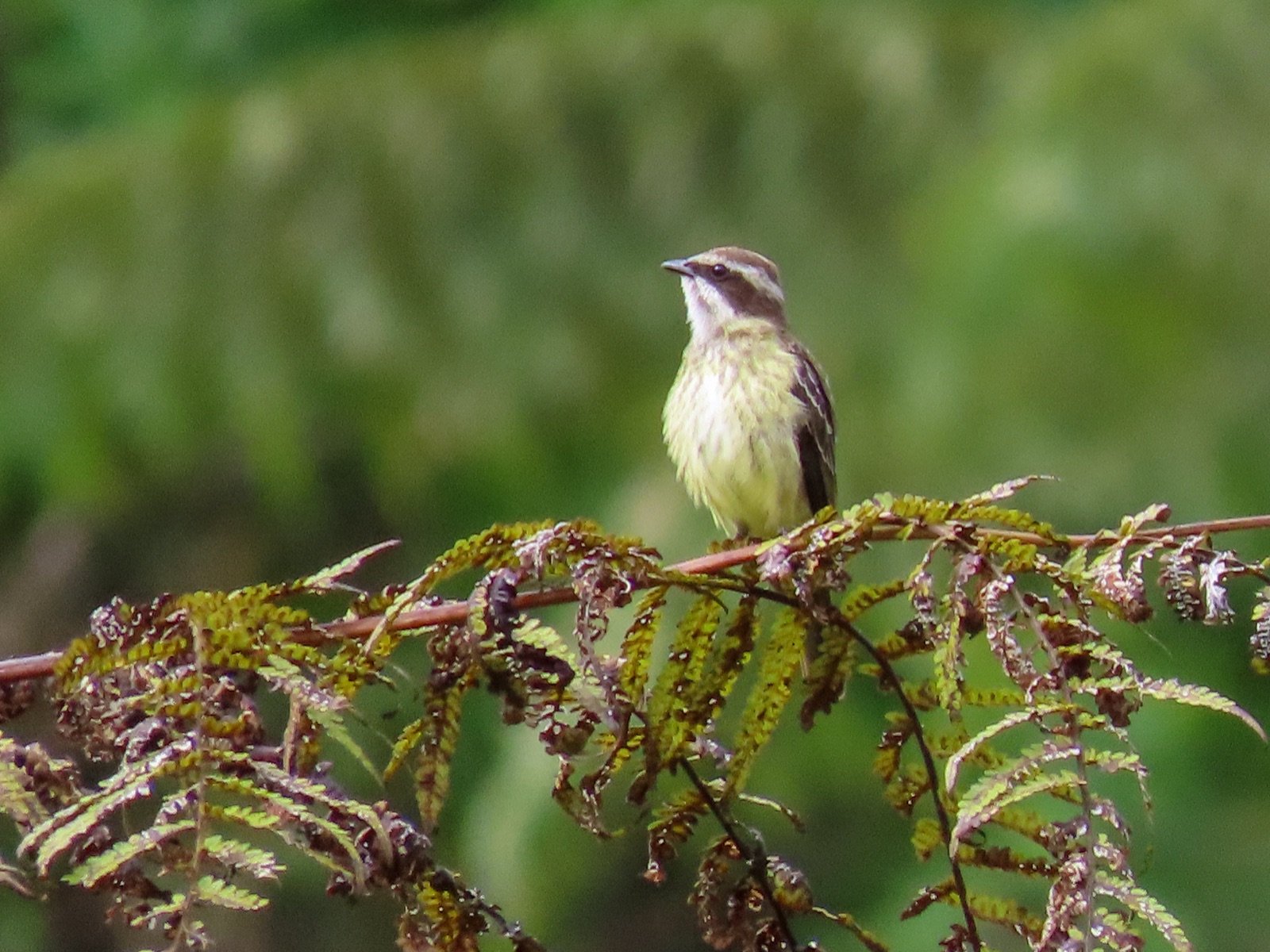
Family Tyrannidae
Piratic Flycatcher
Legatus leucophaius
In Spanish: Mosquero Pirata (Pecho Amarillo)
- Resident
A small treetop flycatcher that takes over other birds' nests
The Piratic Flycatcher (Mosquero Pirata) earns its name honestly. It builds no nest of its own. It harasses the owners of closed or hanging nests until they leave, then throws out the eggs and moves in.
In Costa Rica it is common on both slopes, from the lowlands up to about 1500 m. The challenge is seeing it well, because it sits high on exposed treetop branches.
It is also a breeding migrant, so timing matters. Learn its thin rising whistle and you will often find it before you see it.
How to find it
Scan the tops of tall trees at forest edges, in pastures with scattered trees and in secondary growth. Listen for the repeated high whistle from an exposed perch, then look up toward the highest branches. It stays high, so it is hard to see well, and a scope or good binoculars will help. Its return early in the year is announced by loud calling, which makes the first weeks after arrival a good time to listen. A tree heavy with fruit, such as a fig, is also worth watching.
How to recognise it
This is a small brownish flycatcher, about 15 cm long. Start with the face, because it is the easiest part to read against the sky:
- a long whitish eyebrow
- a dark mask through the eye
- a white throat with a white cheek stripe
- a short, broad, dark bill
The pale underparts carry blurry brown streaks on the breast. Adults have a yellow patch hidden on the crown, but it is hard to see in the field, so do not count on it. Young birds lack this patch altogether.
What it sounds like
Recording: Arthur de Jesús Chavarría Pérez, CC BY 4.0, source, read 4 Nov 2026.
Behaviour and diet
It sits on exposed high branches in treetops and catches insects, dragonflies included, in flight. It is usually seen in pairs.
Nest piracy is the habit that defines it. It favors the roofed nests of Myiozetetes flycatchers and the hanging nests of oropendolas and Icterus orioles. A study at Golfito, in southwest Costa Rica, found it taking over finished domed nests of Social and Gray-capped Flycatchers, built in open sites 5 to 9 m up.
Where it lives
In Costa Rica it uses open areas with scattered trees, tall second growth, forest edge, gallery forest and partly cleared land, hunting from exposed perches in the treetops. Costa Rican accounts also list savannas, coffee plantations, pastures, scrub, young second growth and tree plantations, as well as forest edge and canopy.
It is common on both the Caribbean and Pacific slopes from the lowlands up to about 1500 m, and less frequent up to 1850 m.
When to see it
It is a breeding migrant. It reaches southern Costa Rica in late January or early February and the north about two weeks later, then leaves in late September or early October. It breeds in Costa Rica from March to June, and in the Golfito study the first birds appeared in January with nesting beginning in March.
Similar birds
It can look like the much larger Sulphur-bellied Flycatcher. The Streaked Flycatcher is also similar, but the Piratic has no heavy bill, broad malar stripe or cinnamon rump and tail.
Names and lore in Costa Rica
In Costa Rica the bird is called mosquero pirata. Other countries use different names, such as atrapamoscas pirata in Colombia, mosquitero listado in Nicaragua and tuquito chico in Argentina.
Status and conservation
The AOCR list gives it as a rare resident and migrant (RR,M), yet it is considered common in Costa Rica and the IUCN lists it as Least Concern.
Photography tips
Because it stays high, plan for a long lens or a scope and look for the highest exposed branches at forest edges and in pastures with scattered trees. Listen for the repeated high whistle first, then trace it to its perch. Look near the nests of oropendolas, orioles and Myiozetetes flycatchers, since these are the ones it takes over.
How we know this 13 sources, each read on the date shown
- Wikipedia (Spanish) read 2026-11-04
https://es.wikipedia.org/wiki/Legatus_leucophaius - EcuRed read 2026-11-04
https://www.ecured.cu/Legatus_leucophaius - Ecos del Bosque (citing Stiles and Skutch) read 2026-11-04
https://ecosdelbosque.com/fauna/legatus-leucophaius - Universidad de Costa Rica (Sandoval and Barrantes 2009) read 2026-11-04
https://www.kerwa.ucr.ac.cr/items/70f32cfb-ecfe-4a41-823d-5e3c3334e954 - Wikipedia read 2026-11-04
https://en.wikipedia.org/wiki/Piratic_flycatcher - Wikipedia read 2026-11-04
https://en.wikipedia.org/wiki/Piratic_Flycatcher - Flickr (Historia Natural, Mastatal) read 2026-11-04
https://www.flickr.com/photos/jobando/34127698926 - BirdForum gallery read 2026-11-04
https://www.birdforum.net/gallery/piratic-flycatcher.703986/ - Avesphoto read 2026-11-04
http://avesphoto.com/website/WD/species/FLYPIR-2.htm - Animalia (from Wikipedia) read 2026-11-04
https://animalia.bio/piratic-flycatcher - Birds for Beer read 2026-11-04
https://birdsforbeer.com/2019/01/26/first-piratic-flycatcher-of-the-year/ - Hotel Rivel read 2026-11-04
https://hotelrivel.online/the-not-so-swashbuckling-pirate-a-look-at-the-piratic-flycatcher/ - Ornitologia Neotropical (Sandoval & Barrantes 2009) read 2026-11-04
https://digitalcommons.usf.edu/cgi/viewcontent.cgi?article=1876&context=ornitologia_neotropical