Family Laridae
Elegant Tern
Thalasseus elegans
In Spanish: Pagaza Elegante
- Migrant
A shaggy-crested, orange-billed tern that visits the Pacific coast.
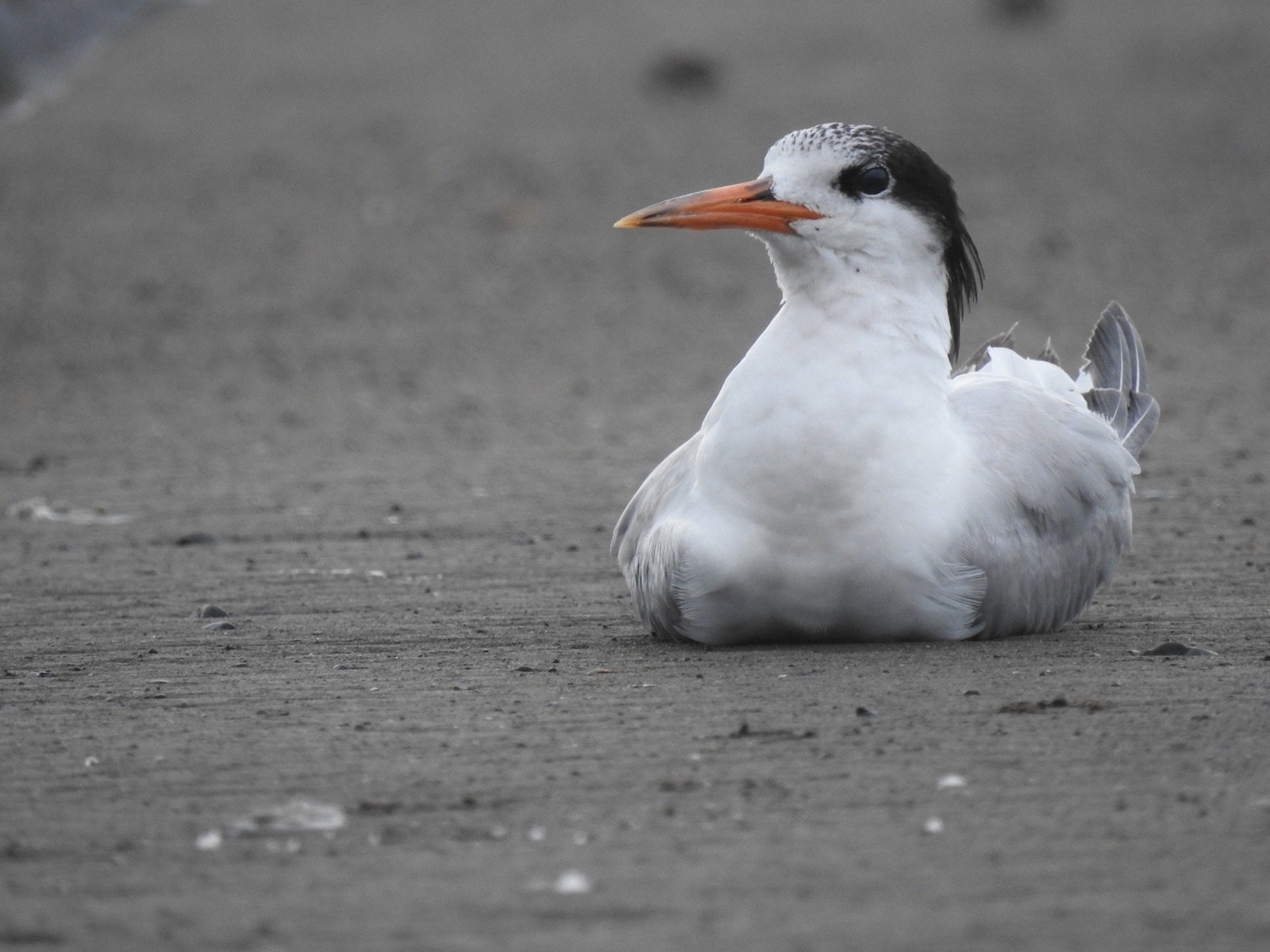
The Elegant Tern (Pagaza Elegante) is a medium-large tern with a long, slim, slightly drooping orange bill, pale gray upperparts, white underparts and black legs. In Costa Rica it is a visitor, and the Pacific coast is where to look for it.
It breeds only in southern California and western Mexico, so the birds you meet here have travelled south. Costa Rica sits at the southern end of the northern-summer range that non-breeding birds use along the Pacific coast.
The Gulf of Nicoya around Puntarenas is the place to start. On a trip we build, a morning or late afternoon at the water's edge there, with a scope and a tide table, is a good way to meet it beside Royal Terns and Brown Pelicans.
How to find it
A good spot is the lighthouse at the tip of Puntarenas. Scan the water with a scope from one of the overlooks, because birds come closer to shore where the inner and outer Gulf of Nicoya meet. Morning and late afternoon are best.
Time your visit to Chomes and Puerto Morales for high tide. At low tide the terns look like distant silhouettes on the mud flats, but at high tide they move into the nearby salt and shrimp ponds. One birder found a group in the salt ponds near Puerto Morales, reached by a turn at a small roadside sign for fresh shrimp. Watch for noisy feeding flocks over the water.
How to recognise it
Start with the bill: long, slim and slightly drooping, orange in colour. Across the species it ranges from yellowish to reddish orange, often with a yellow tip.
The upperparts are pale gray, the underparts white and the legs black.
Breeding adults wear a black cap from the forehead to the nape, and the shaggy crest is the longest of any tern. In Costa Rica, birds finish their head molt into the black breeding cap by March or April.
From late summer into winter the forehead turns white. The black from the crest still runs through the eye, leaving a small black smudge in front of it. In winter the crest and head sides, out to around the eye, are solid black.
What it sounds like
Behaviour and diet
The Elegant Tern feeds by plunge-diving for fish, almost always over the sea, and usually dives straight down rather than hovering first. A Costa Rican natural history account adds that it dives for shrimp too.
Off Puntarenas, one visit found gulls and terns, including Elegant Terns, over the water while pelicans dived together for fish. At high tide around Chomes and Puerto Morales, terns move into nearby salt and shrimp ponds, where one group was found with a few other species.
Where it lives
This is a bird of the sea edge. Habitats named for Costa Rica include estuaries, harbors, sandy and rocky beaches, salt works, coastal lagoons and salt ponds.
Non-breeding birds spend time along the Pacific coast, mainly from central California south to Costa Rica. A Costa Rican species account lists the Osa, Tempisque, Pacífico Central, Guanacaste and Arenal conservation areas in its distribution. Around the Gulf of Nicoya, the terns spread over huge mud flats at low tide.
When to see it
A Costa Rican species account says it passes through in autumn (September to October) and spring (April to early June), and is an uncommon, rather local winter resident along the Pacific coast. Some non-breeding birds stay through the northern summer, and it is a regular but very uncommon summer visitor around the Gulf of Nicoya. A Costa Rica guide expects it in winter and was surprised to see a young one at Puntarenas in summer.
Similar birds
Royal Tern is the main look-alike. The Elegant is smaller with a thinner bill, while the Royal is larger, thicker-billed and shows more white on the forehead in winter.
Check the head: on a Royal the black crest stops at the eye, whereas on the Elegant it runs through the eye to leave a small smudge in front. The Elegant also has a longer crest and a more deeply forked tail. Seen from below, it shows more dark on the underside of the primaries (outer wing feathers).
Names and lore in Costa Rica
Besides the official Pagaza Elegante, the Spanish names Charrán elegante and Gaviotín elegante are also used for this species. Charrán elegante is the usual name in Mexico.
Status and conservation
The official Costa Rican bird list for 2025-2026 gives the Pagaza Elegante the status M, and the IUCN lists the species as Near Threatened.
Photography tips
Choose high tide at Chomes and Puerto Morales, when the terns come into the ponds instead of staying as distant silhouettes on the mud flats. At Puntarenas, morning and late afternoon are best, and a scope from the overlooks brings birds closer.
How we know this 14 sources, each read on the date shown
- Wikipedia read 2026-11-04
https://en.wikipedia.org/wiki/Elegant_tern - Birds of the World (Cornell Lab) read 2026-11-04
https://birdsoftheworld.org/bow/species/eleter1/cur/appearance - iNaturalist (Wikipedia-based summary) read 2026-11-04
https://www.inaturalist.org/taxa/144542-Thalasseus-elegans - Birds Colombia read 2026-11-04
https://birdscolombia.com/2022/05/24/gaviotin-elegante-elegant-tern-thalasseus-elegans/ - Animal Diversity Web read 2026-11-04
https://www.animaldiversity.org/accounts/Sterna_elegans/ - Lista Oficial de las Aves de Costa Rica (AOCR) read 2026-11-04
https://listaoficialavesdecostarica.wordpress.com/lista-oficial/lista-oficial-online/ - Birding Craft read 2026-11-04
https://birdingcraft.com/wordpress/2015/11/05/tips-for-birding-in-costa-rica-at-chomes-and-puerto-morales/ - Birding Craft read 2026-11-04
https://birdingcraft.com/wordpress/category/mangroves/feed/ - Costa Rica Focus read 2026-11-04
https://www.costaricafocus.com/birding-beaches-costa-rica-birdwatching-tour/ - Birding Craft read 2026-11-04
https://birdingcraft.com/wordpress/2019/11/20/looking-for-year-birds-in-the-pacific-lowlands-of-costa-rica/ - Birding Craft read 2026-11-04
http://birdingcraft.com/wordpress/category/seabirding/ - Flickr (Costa Rican species account, INBio style text) read 2026-11-04
https://www.flickr.com/photos/jobando/49269129677 - iNaturalist Mexico read 2026-11-04
https://mexico.inaturalist.org/taxa/144542-Thalasseus-elegans - Birds of the World read 2026-11-04
https://birdsoftheworld.org/bow/species/eleter1/cur/introduction