Family Ardeidae
Fasciated Tiger-Heron
Tigrisoma fasciatum
In Spanish: Garza-Tigre de Río (Martín Peña, Pájaro Vaco)
- Resident
A stocky heron that stands like a rock beside fast foothill streams.
The Fasciated Tiger-Heron (Garza-Tigre de Río) lives along fast, rocky streams and rivers in forested, hilly country, mostly on the Caribbean slope. It stands so still at the water's edge that it can pass for a stone.
It is resident only in certain localities, shy and probably scarce, so patience matters more than speed. On a trip we build, guests watch rivers in the Sarapiquí area and stop along rocky rivers on the road toward Braulio Carrillo.
How to find it
Check the edges of fast, rushing streams, and scan midstream rocks for a bird standing on a boulder or gravel. Scan rocky rainforest rivers with care, since it may stand just around a bend or sit still behind a big river rock. In the Sarapiquí area, scanning the river from a riverside lodge or from the Chilamate bridge gives a good chance, and a boat trip also works. One source notes it is no more common there than elsewhere, but the river is easy to watch. It can also turn up on many rocky, forested rivers at middle elevations, and one birder found one on the Balsas River near San Luis. It is stealthy and probably scarce, so finding one may take a while.
How to recognise it
Adults have a black crown, gray sides to the face and a blackish neck with fine pale stripes.
The bare facial skin and the sides of the throat are yellow, and the eyes are yellow too. The belly is dull rufous. The bill is short, stout and mostly black.
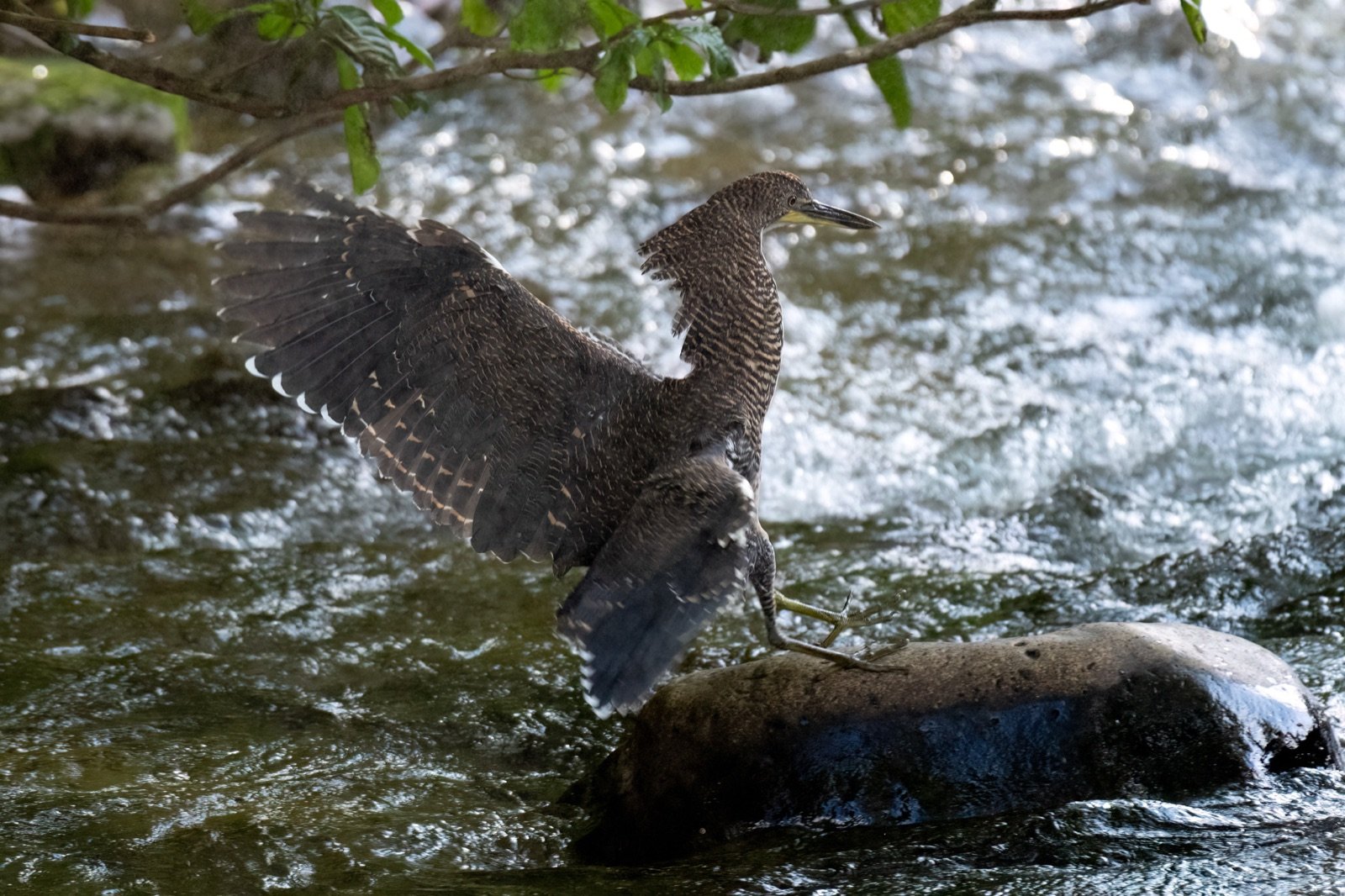
Across its range it is the smallest of the three tiger-herons, about 58 to 64 cm long, and its bill is shorter and stouter than in the others. It is stockier than other herons, with shorter legs that may help it keep its balance on slippery river rocks. Juveniles are pale brown with dark patterning.
Behaviour and diet
It walks slowly among the rocks or waits at the water's edge for fish and large aquatic insects. It is often seen standing motionless on boulders or gravel in midstream while hunting, which is why it so easily looks like a rock in the river.
It is shy. When startled it flies around a river bend or to a tree at the edge of the water. When it feels threatened, it stretches its neck and body almost fully upright to get a wider view of its surroundings.
Where it lives
In Costa Rica it lives mainly on the Caribbean slope, from the Cordillera de Guanacaste (Bijagua) south to Panama. It keeps to streams and rivers in the foothills, mostly at 250 to 800 m, and prefers fast, rocky water in forested, hilly country. A national museum catalogue lists it as resident at 100 to 900 m.
Trout introduced into some highland streams have let local populations reach up to 2,400 m, as on the Río Los Ángeles, north of Cerro de la Muerte.
When to see it
A national museum catalogue gives the rainy season as its breeding period.
Similar birds
The Rufescent Tiger-Heron looks somewhat similar but prefers still water at lower elevations. Adults are easy to tell apart, but juveniles of both are pale brown with dark patterning and almost impossible to separate in the field, so habitat is the best clue: this species is on fast rocky streams. The Bare-throated Tiger-Heron is larger with a yellow bare throat, while the Fasciated has a white feathered throat.
Names and lore in Costa Rica
Costa Ricans also call it Martín Peña or Pájaro Vaco. The official Spanish name, Garza-Tigre de Río, points to its river habitat.
Status and conservation
Listed as a resident (R) on the AOCR list, it is uncommon and local across its range and rated Least Concern by the IUCN.
Photography tips
Scan the midstream rocks for a possible subject, since it is often seen standing motionless on boulders or gravel while hunting fish. Because it holds still for so long, a patient watch from a bridge or bank can pay off.
How we know this 17 sources, each read on the date shown
- Aves de Costa Rica read 2026-11-04
https://avesdecostarica.com/Tigrisoma-fasciatum.html - Flickr (Costa Rica natural history text) read 2026-11-04
https://www.flickr.com/photos/jobando/30310604850 - Museo Nacional de Costa Rica read 2026-11-04
https://www.museocostarica.go.cr/wp-content/uploads/Investigaciones/historia-natural/garzas/diversidad/catalogo-garzas-cr-mncr.pdf - Outside My Window read 2026-11-04
https://www.birdsoutsidemywindow.org/2026/02/05/seven-streaked-and-spotted/ - World Bird Photos read 2026-11-04
https://www.worldbirdphotos.com/photo/heron-fasciated-tiger-tigrisoma-fasciatum-juvenile-costa-rica/ - La Marta Refugio de Vida Silvestre read 2026-11-04
https://lamarta.org/garza-tigre-o-martin-pena/ - Birding Craft read 2026-11-04
https://birdingcraft.com/wordpress/2021/05/20/the-rocky-river-heron/ - Wikipedia read 2026-11-04
https://en.wikipedia.org/wiki/Fasciated_tiger_heron - Birds of the World read 2026-11-04
https://birdsoftheworld.org/bow/species/father1/cur/introduction?lang=es - Aves de Peru read 2026-11-04
https://avesdeperu.org/ardeidae/garza-tigre-oscura-tigrisoma-fasciatum/ - Birdingcraft read 2026-11-04
https://birdingcraft.com/wordpress/2011/01/27/the-costa-rican-riverbird-flush/ - Field Guides trip list read 2026-11-04
https://fieldguides.com/triplists/cos24.html - Birds for Beer read 2026-11-04
https://birdsforbeer.com/2017/07/22/fasciated-tiger-heron-in-the-garden/ - Flickr (natural history entry, Sarapiquí) read 2026-11-04
https://www.flickr.com/photos/jobando/29976661173 - Birds of Costa Rica (birdsofcolombia.org) read 2026-11-04
https://www.birdsofcolombia.org/costarica/Tigrisoma.html - Bird Watching Costa Rica read 2026-11-04
https://www.birdwatchingcostarica.com/ave/fasciated-tiger-heron/ - Birds of the World (Cornell) read 2026-11-04
https://birdsoftheworld.org/bow/species/father1/cur/introduction