Family Icteridae
Giant Cowbird
Molothrus oryzivorus
In Spanish: Vaquero Grande
- Resident
Glossy black brood parasite that lingers near oropendola colonies.
The Giant Cowbird, Vaquero Grande in Costa Rica, is a large blackbird relative with a habit that shapes where you look: it lays its eggs in the nests of oropendolas and caciques. The best clue to finding it is often a colony of those big nesters.
In Costa Rica it occurs on the Caribbean slope, the central plateau and the Pacific slope in the Golfo Dulce region, and it is recorded up to about 1700 m elevation. It is not a bird of one corner of the country.
For a beginning birder it is a rewarding puzzle, because at first glance it can pass for a dark oropendola.
How to find it
Start with oropendola colonies. They are often in open trees beside roads, so you can pull over and scan them for cowbirds perched nearby. Watch the tops of trees holding nests, because the cowbirds hang around waiting for a chance to slip into an unguarded nest. Look also for it walking on the ground in pastures, farms, fields, wet areas and forest edges. It often visits feeders on farms and can be seen perched on cattle.
How to recognise it
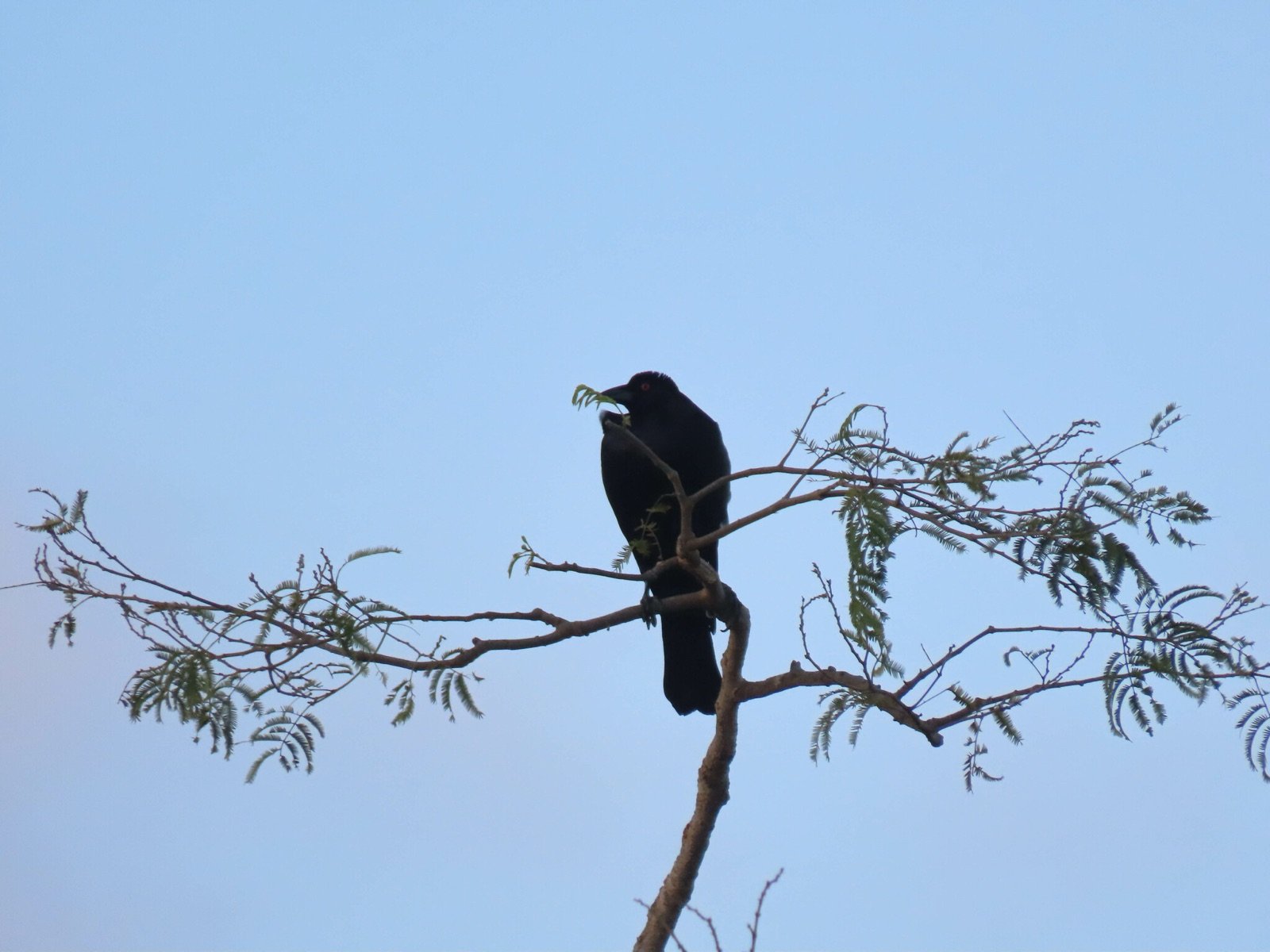
The male is large and glossy purplish black. A ruff of neck feathers makes his head look small, and the iris is red to yellow. Males are about 33 to 37 cm long.
The female is smaller, about 28 to 32 cm, and a duller black. She lacks the neck ruff, so her head looks less small.
Both sexes have long pointed wings and a fairly long tail with a nearly square end.
Young birds are duller and sootier black, with a pale ivory-yellow bill and a yellow or brown eye.
What it sounds like
Recording: Niels Krabbe, CC BY-SA 4.0, source, read 5 Nov 2026.
Behaviour and diet
The Giant Cowbird is a brood parasite. It lays eggs in the nests of oropendolas and caciques, which are large colonial nesters.
It eats fruit, nectar and arthropods, and one bird had eaten rice.
It flies in a distinctive undulating way and is often seen walking on the ground, alone or in small groups. At Santa Rosa, in Guanacaste, a birder photographed cowbirds perched near Montezuma Oropendola nests being built.
Where it lives
Across its range it likes partly open country with scattered trees, farmland, second growth and plantations. It is usually near colonies of oropendolas or caciques, in the tropical and lower subtropical zones.
In Costa Rica it is recorded up to about 1700 m. It occurs on the Caribbean slope, the central plateau and the Pacific slope in the Golfo Dulce region. A photo labelled Vaquero Grande was taken at Boca Tapada, in the north.
Similar birds
It is only a little smaller than a female Montezuma Oropendola, so it can look like a dark oropendola. Look for the all black plumage and the neck ruff. Females lack the ruff, so lean on the dull black plumage, the smaller size and the setting beside a colony.
Names and lore in Costa Rica
In Costa Rica and Nicaragua the usual Spanish name is Vaquero Grande. Elsewhere you may hear vaquero gigante in Mexico, and vaquero pirata, tordo gigante or chamón gigante in Colombia.
Status and conservation
Listed as a resident (R) on the AOCR list and rated Least Concern by the IUCN because its population is very large.
Photography tips
Watch the tops of trees holding oropendola nests, where the cowbirds wait for a chance at an unguarded nest. Colonies in open roadside trees let you pull over and scan for cowbirds perched nearby.
How we know this 13 sources, each read on the date shown
- Planet of Birds (Birds of the World text) read 2026-11-04
https://planetofbirds.com/passeriformes-icteridae-giant-cowbird-molothrus-oryzivorus/ - Flickr (Jobando photo caption) read 2026-11-04
https://www.flickr.com/photos/jobando/32195367590/ - Birds Colombia (from Wikipedia text) read 2026-11-04
https://birdscolombia.com/2016/05/17/chamon-gigante-molothrus-oryzivorus/ - Wikipedia (Spanish) read 2026-11-04
https://es.wikipedia.org/wiki/Molothrus_oryzivorus - Animalia (from Wikipedia text) read 2026-11-04
https://animalia.bio/giant-cowbird - Cornell Birds of the World read 2026-11-04
https://birdsoftheworld.org/bow/species/giacow/cur/introduction - STRI Panama Biota read 2026-11-04
https://panamabiota.org/stri/taxa/index.php?taxauthid=1&taxon=3318&clid=88 - Field Guides trip list, Costa Rica 2018 read 2026-11-04
https://fieldguides.com/triplists/cos18.html - Flickr (Hacienda Tenorio photo) read 2026-11-04
https://www.flickr.com/photos/jobando/28333128245/ - Birds for Beer read 2026-11-04
https://birdsforbeer.com/2021/01/21/in-my-costa-rican-garden-montezuma-oropendola/ - Meadowhawk blog read 2026-11-04
https://meadowhawk.wordpress.com/2023/04/22/costa-rica-birding-the-rinconcito-lodge/ - Tico Times read 2026-11-04
https://ticotimes.net/2024/01/17/costa-rica-bird-watching-meet-the-montezuma-oropendola - Anywhere.com (La Selva) read 2026-11-04
https://www.anywhere.com/costa-rica/attractions/la-selva-reserve#glass-frog