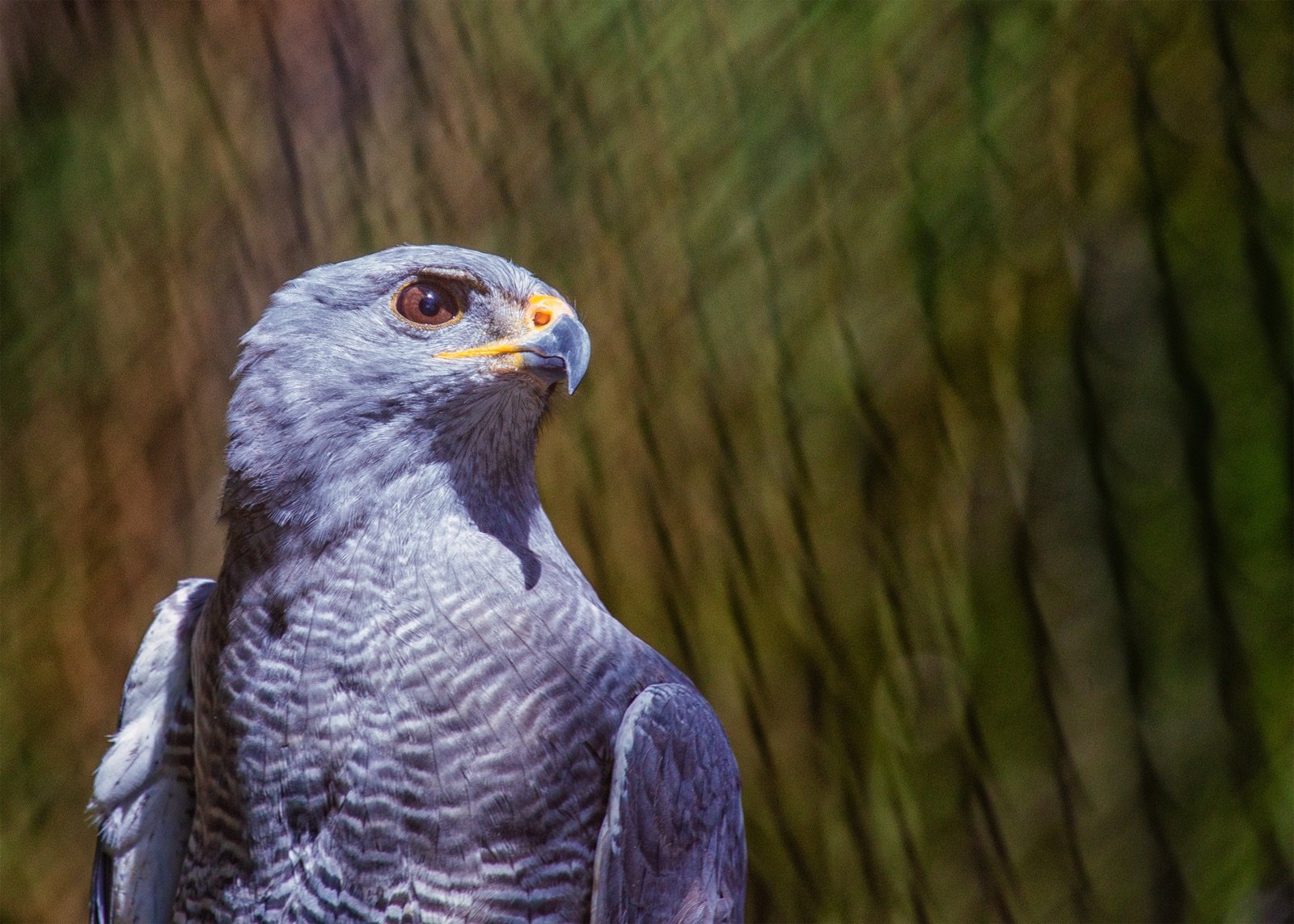
 Gray Hawk
Family Accipitridae
Gray Hawk
Buteo plagiatus
In Spanish: Gavilán Gris (Gavilán Pollero)
- Resident
A pale gray hawk of the dry north, often on roadside wires.
The Gray Hawk (Gavilán Gris, Buteo plagiatus) is a compact, pale gray hawk with a black tail crossed by three white bands and orange legs. In Costa Rica it is a bird of the north and northwest, at the southern end of its range.
It is one of the raptors regularly seen on roadside wires, which makes it a friendly bird for a beginner. Costa Rica's tourism board lists Palo Verde National Park and the dry Guanacaste lowlands as places where it is seen, and on a trip we build through that country it is a hawk worth scanning for from the road.
How to find it
Look along forest edges and in semi-open country, and check roadside wires as you travel. It often calls, so listen for a clear whistle. Scan broken forest, tree edges and clearings for a gray hawk sitting upright. In the hot mid-morning, watch the sky when vultures rise on thermals, since Gray Hawks sometimes soar with them, though they are just as often seen at habitat edges. Loud mobbing by songbirds can give away a hidden hawk. A Guanacaste biologist says he sees Gray Hawks often while driving the roads of Guanacaste.
How to recognise it
Adults are pale gray with plain gray upperparts and no pattern. The tail is black with three white bands, and the legs are orange.
It is a compact hawk with short, rounded wings and a long tail. It flies with quick flaps and short glides.
Young birds look quite different. They are brown above and streaked or spotted below. They show a bold face pattern, paler underwings and a small white patch at the base of the upper tail.
What it sounds like
Recording: Adriana Nelly Correa Sandoval, CC BY 4.0, source, read 4 Nov 2026.
Behaviour and diet
The Gray Hawk eats mostly lizards and small snakes, dropping onto them from an exposed perch, and it is usually seen alone. It ambushes prey from a perch in scattered trees.
Costa Rican researchers have recorded one catching a Squirrel Cuckoo, and another taking a Variegated Squirrel, a mammal of more than 500 grams. Songbirds react to it: a Tropical Kingbird chased a hunting Gray Hawk, and kiskadees and Brown Jays joined in with alarm calls.
Where it lives
In Costa Rica the Gray Hawk is a bird of the north and northwest. It prefers broken forest, scattered trees and forest edges to solid forest, so look in semi-open country rather than inside rainforest or cloud forest.
Across its wider range it lives in riverside scrub forest and also uses forest edges, river edges, savanna, clearings and farmland. A raptor-migration study lists it as a common resident of lowland habitats.
Similar birds
The southern Costa Rican bird, including the Osa area, was once treated as the same species and is now the separate Gray-lined Hawk (Buteo nitidus). Expect Gray Hawk only in the north. The two are hard for most people to tell apart, though the Gray-lined has a few more gray bars on the upperparts and a slightly wider white tail band. The Gray Hawk's alarm call is longer and lower, with a more nasal tone. Young Gray Hawks look like young Broad-winged and Red-shouldered Hawks, but have a stronger face pattern, paler underwings and a small white patch at the tail base.
Names and lore in Costa Rica
The official Spanish name is Gavilán Gris, and the AOCR list gives Gavilán Pollero as the common Costa Rican name. Pollero means chicken-hawk, a name often given to hawks that take poultry. Other Spanish names in use across the range include aguililla gris, halcón gris and azor mexicano, and gavilán saraviado is also listed.
Status and conservation
The AOCR list marks the Gray Hawk as a resident (R), and the IUCN lists it as Least Concern.
How we know this 15 sources, each read on the date shown
- Wikipedia (Spanish) read 2026-11-04
https://es.wikipedia.org/wiki/Buteo_plagiatus - Birds & Breakfast Costa Rica read 2026-11-04
https://birdsandbreakfast.com/es/gavilan-gris/ - Caribbean Journal of Science (BioOne) read 2026-11-04
https://bioone.org/journals/caribbean-journal-of-science/volume-54/issue-1/cjos.v54i1.a2/Two-New-Prey-for-the-Gray-Hawk-Buteo-plagiatus-Schlegel/10.18475/cjos.v54i1.a2.short - The Tico Times read 2026-11-04
https://ticotimes.net/2024/05/22/costa-rica-birdwatching-meet-the-gray-hawk - Earbirding read 2026-11-04
http://earbirding.com/blog/archives/tag/buteo-plagiatus - Birding Craft read 2026-11-04
https://birdingcraft.com/wordpress/2022/02/13/a-day-in-the-life-of-gray-hawk-in-costa-rica/ - Birding Craft read 2026-11-04
https://birdingcraft.com/wordpress/category/raptors/ - Instituto Costarricense de Turismo (ICT) read 2026-11-04
https://www.ict.go.cr/es/documentos-institucionales/desarrollo-tur%C3%ADstico/infogramas-de-aves/1974-aves-guanacaste-sur/file.html - Manchester Birding Forum read 2026-11-04
https://manchesterbirding.activeboard.com/mobile.spark?p=topic&topic=64349768 - Lista de Aves (based on the AOCR official list) read 2026-11-04
https://lacarolinalodge.com/wp-content/uploads/2019/10/Lista-de-Aves-LCL.pdf - Ropero Aventuras read 2026-11-04
https://roperoaventuras.com/2016/04/07/gavilan-saraviado-o-busardo-gris-buteo-nitidus/ - Wikipedia read 2026-11-04
https://en.wikipedia.org/wiki/Buteo_plagiatus - JungleDragon read 2026-11-04
https://www.jungledragon.com/specie/10512/gray_hawk.html - Hawk Mountain Sanctuary read 2026-11-04
https://www.hawkmountain.org/conservation-science/active-research/raptor-conservation-studies/conserve-the-corridor/gray-hawk - Trek Zone read 2026-11-04
https://trek.zone/es/el-salvador/animales/buteo-plagiatus