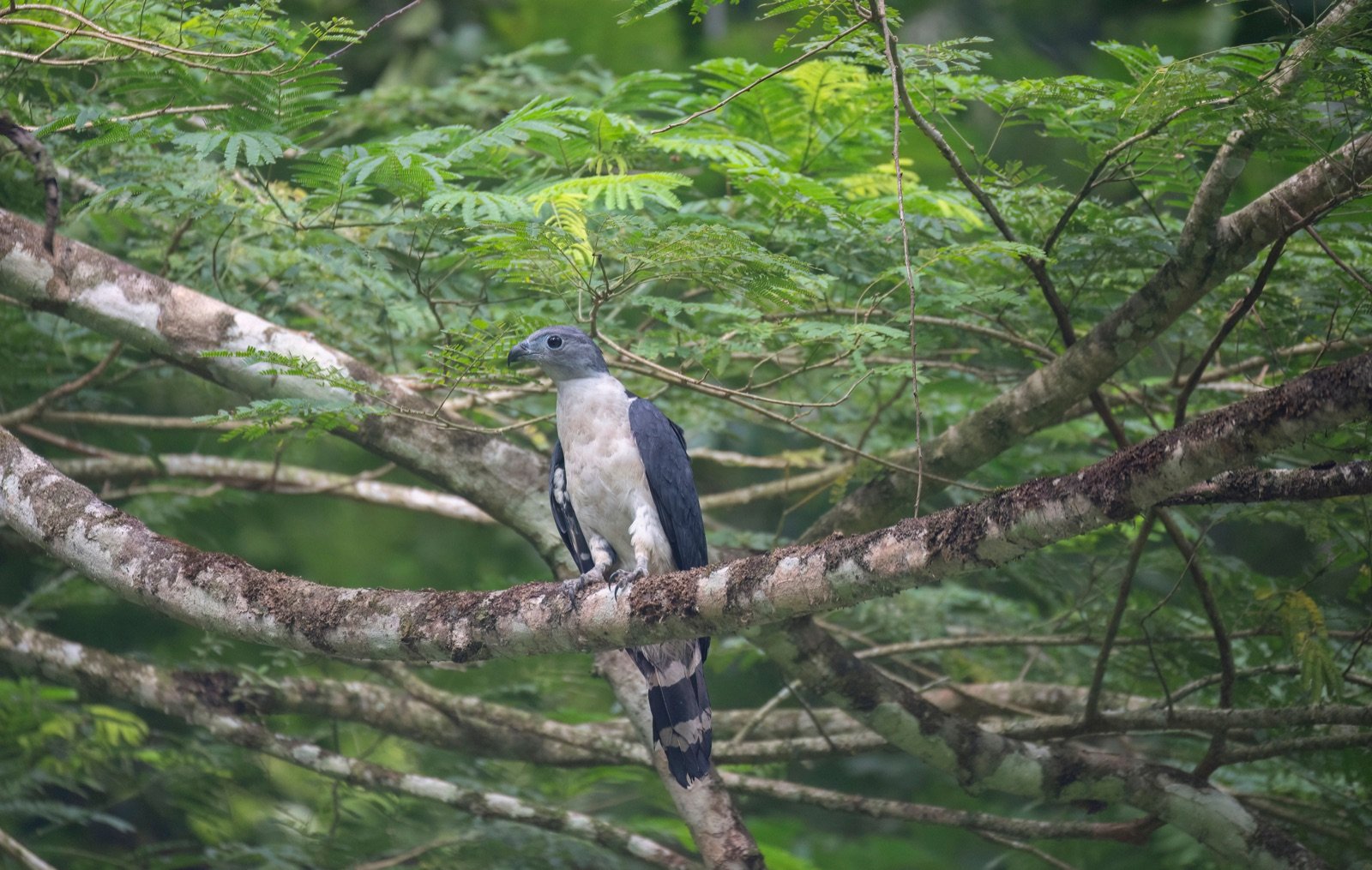
 Gray-headed Kite
Family Accipitridae
Gray-headed Kite
Leptodon cayanensis
In Spanish: Gavilán Cabecigrís
- Resident
A quiet canopy raptor with a small gray head and a white chest.
The Gray-headed Kite (Gavilán Cabecigrís) is an uncommon, local resident of lowland and foothill forest on both slopes of Costa Rica. Adults look unlike any other Costa Rican bird, with a gray head, white chest and black wings in solid blocks.
It hunts quietly, usually inside the forest canopy, so it rewards patient scanning of the treetops and of high exposed perches. Young birds mimic larger raptors, which makes them a fine puzzle for a beginner.
On a trip we build around the Carara area or the road toward Sarapiquí and the Caribbean lowlands, it is one of the rainforest raptors worth watching for.
How to find it
Scan exposed high perches as well as the canopy, because this kite often sits in the open before swooping on prey. Watch the sky above the forest for broad, rounded wings and a longish tail, with several flaps then a glide. Forest edges, secondary forest and semi-open areas near forest are all worth checking. The Carara National Park area is a consistently good place for raptors. A suggested raptor route toward Sarapiquí and the Caribbean lowlands lists this kite as a chance among the rainforest raptors. With young birds, lean on shape and behaviour rather than plumage.
How to recognise it
Adults are blackish above and white below, with a pale gray head. The head is small and dove-like. The wings are very broad, the bill and legs are small, and the tail is fairly long.
The eye is dark. The bare skin at the bill base and the legs are bluish gray. The tail has wide, even bands of light gray and black. The legs are short, so a perched bird looks as if its belly rests on the branch.
Young birds vary a lot. Some have a mostly white head and underparts with a dark crown and eye stripe. Others are mostly blackish. Both have a yellowish eye and yellow legs. They are often easier to identify by shape and behaviour than by plumage.
In flight the broad, rounded wings and longish tail look like an accipiter's. The bird flaps several times, then glides.
What it sounds like
Recording: Rodrigo Paiva Lazaro, CC BY 4.0, source, read 4 Nov 2026.
Behaviour and diet
It hunts quietly, usually inside the forest canopy. It mostly eats eggs and nestlings of small birds, plus wasp and ant broods, and it also takes small reptiles and some insects. One observer in lowland Costa Rica saw one hunting by walking along high branches in the forest.
It also often sits on an open high perch and swoops down on its prey. The nest is a thin platform of sticks set in a high fork in the forest canopy.
Where it lives
In Costa Rica it is an uncommon, local resident of lowland and foothill forest on both the Caribbean and Pacific slopes, up to about 750 m elevation. It lives in the canopy and edges of forest, in secondary forest, and in semi-open areas near forest.
A Turrialba naturalist gives its range as generally up to about 900 m. He saw one at Guayabo National Monument, which is higher than its usual range.
When to see it
Breeding is given as March to June, with the nest high in the forest canopy.
Similar birds
Young birds mimic larger raptors. The pale form looks like a Black-and-white Hawk-Eagle, and the dark form looks like a Black Hawk-Eagle. Local birders near Monteverde judged a puzzling juvenile to be either a Gray-headed or a Hook-billed Kite, so young birds of these two can be confused. Elsewhere in its range, a rufous-phase young bird with a reddish neck, white throat, black moustache stripes and a long black crest closely resembles an adult Ornate Hawk-Eagle.
Names and lore in Costa Rica
The Costa Rican Spanish name is Gavilán Cabecigrís. Ticos also write it as Gavilán Cabecigris, without the accent.
Status and conservation
It is an uncommon and local resident in Costa Rica (R on the AOCR list), listed as Least Concern by the IUCN with a decreasing population trend, and it is in CITES Appendix II.
Photography tips
Check exposed high perches as well as the canopy, since it often sits in the open before it swoops. A soaring bird over a river or forest edge, as photographed on the Osa, gives a clear view of the broad wings and banded tail.
How we know this 17 sources, each read on the date shown
- Aves de Costa Rica read 2026-11-04
https://www.avesdecostarica.com/Leptodon-cayanensis.html - All-Creatures.org (Barry Kent MacKay) read 2026-11-04
https://www.all-creatures.org/art/mackay-146.html - Birds for Beer read 2026-11-04
https://birdsforbeer.com/2020/10/20/the-beautiful-gray-headed-kite/ - BirdForum gallery read 2026-11-04
https://www.birdforum.net/gallery/gray-headed-kite.534494/page-2 - Birda read 2026-11-04
https://app.birda.org/species-guide/8111/Grey-headed_Kite - Avesphoto read 2026-11-04
http://www.avesphoto.com/website/WD/species/KITGYH-3.htm - Dibird read 2026-11-04
https://dibird.com/species/grey-headed-kite/ - Fauna Decomisada, Costa Rica read 2026-11-04
https://faunadecomisada.go.cr/guia-de-especies/aves/accipitridae/leptodon-cayanensis - Tico Times read 2026-11-04
https://ticotimes.net/2024/04/22/birds-of-costa-rica-meet-the-gray-headed-kite - Animalia.bio read 2026-11-04
https://animalia.bio/gray-headed-kite - BirdForum read 2026-11-04
https://www.birdforum.net/threads/costa-rica-dec-2023-monteverde-area-raptor.475390/ - Wikipedia read 2026-11-04
https://en.wikipedia.org/wiki/Gray-headed_kite - Birding Craft read 2026-11-04
https://birdingcraft.com/wordpress/tag/raptors/ - Cloudbridge Nature Reserve bird list read 2026-11-04
https://www.cloudbridge.org/wp-content/uploads/2020/04/Bird-Species-List-Costa-Rica-13-April-2020.pdf - Featherscan read 2026-11-04
https://www.featherscan.com/birds/gray-headed-kite - Nests and behavior of the Gray-headed Kite (ResearchGate) read 2026-11-04
https://www.researchgate.net/publication/292654788_A_description_of_nests_and_behavior_of_the_Gray-headed_Kite - Wikipedia read 2026-11-04
https://en.wikipedia.org/wiki/Leptodon_cayanensis