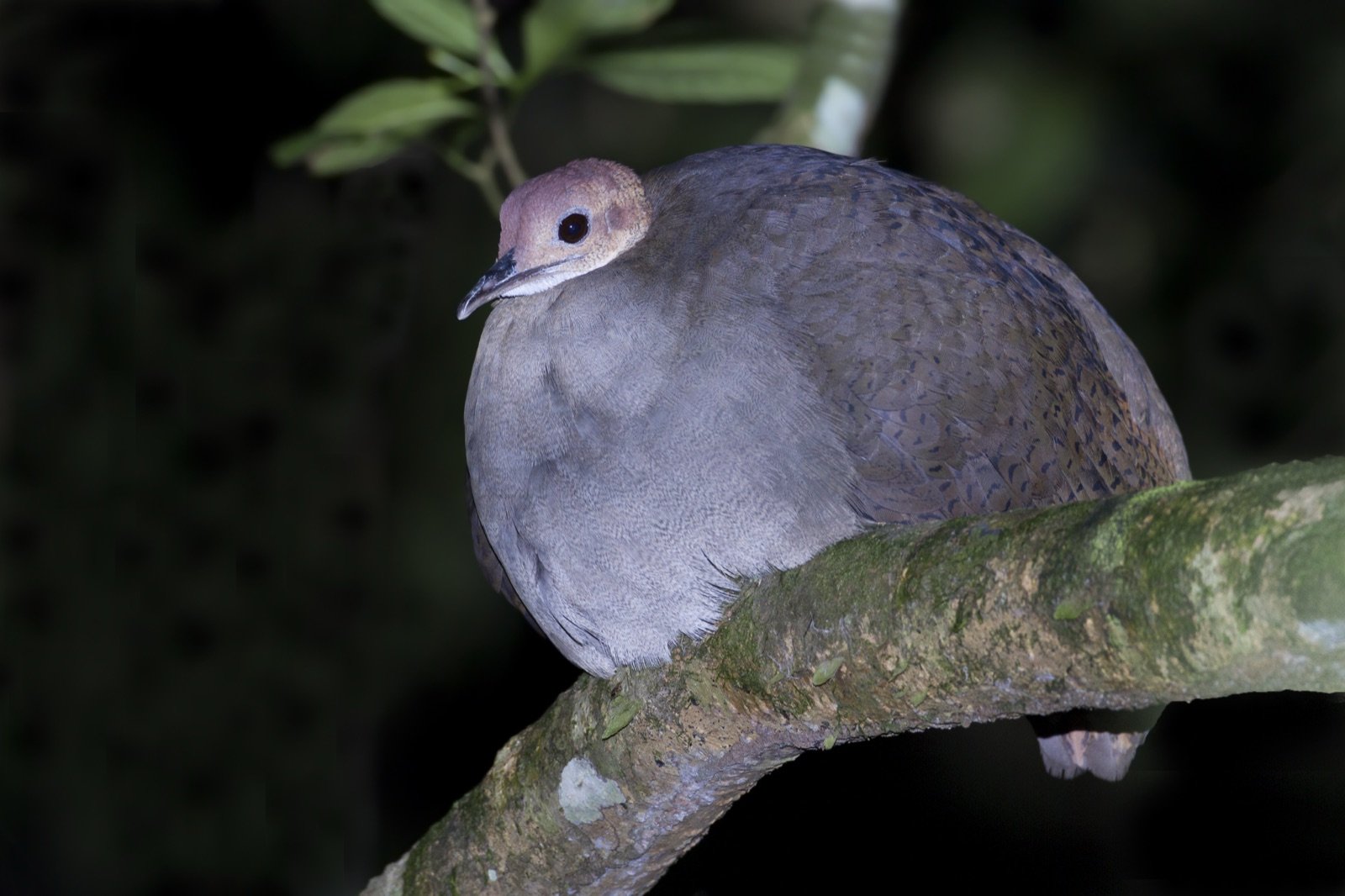
 Great Tinamou
Family Tinamidae
Great Tinamou
Tinamus major
In Spanish: Tinamú Grande (Gallina de monte, Perdiz, Gongolona, Yerre)
- Resident
A plump, brown forest-floor walker, often heard and sometimes tame at Carara and La Selva.
The Great Tinamou is a brown, chicken-sized bird of the forest floor, and most visitors meet it first as a voice: deep, tremulous whistles drifting through the trees at dusk.
Seeing one takes patience, but protected forest can change that. At Carara National Park the birds are tame, and the Quebrada Bonita trail is where they are usually found. La Selva comes a close second.
Around Carara and the Tárcoles, it is a bird to listen for calling from the forest edge, alongside Scarlet Macaw and Collared Aracari. Walk slowly, stop often and listen.
Where to see it
How to find it
Walk slowly and quietly, stop often, and scan the understory. Watch for tinamous at ant swarms and under fruiting trees. Track singing birds at dawn and dusk. At Carara one guide heard at least six birds but saw only one, foraging at a small ant swarm, and it stayed in view for about ten minutes. Where hunting happens the bird is very shy, so expect little luck outside protected areas. Move carefully to avoid flushing one.
How to recognise it
Think of a brown tinamou with grayish legs that looks bigger than a chicken. It is a plump bird with a very thin neck and a small head. Adults are dark olive brown above, barred and flecked with black, and paler below. The throat is whitish, which helps with identification. The crown is black or chestnut, and birds in the southern Pacific show chestnut there. Its shape is what you notice first: a dumpy, round body on a forest floor, carried on a slender neck.
What it sounds like
Behaviour and diet
It forages while walking on the forest floor, taking seeds, fruit and small animals such as insects, spiders, lizards and frogs. It sometimes joins army ant swarms to catch the insects fleeing them. When startled it flushes explosively at close range and crashes off through the understory. The male incubates the eggs and raises the chicks. The female lays eggs on the leaf litter and leaves the care to him, and no nest is built. In protected forest, where people do not bother them, the birds can be very tame and stroll calmly beside trails in full view.
Where it lives
In Costa Rica it is a common resident of lowland forest, where forest remains. It lives in humid and very humid tropical forest, and in primary forest and old second growth. The Caribbean slope is covered from the lowlands up to 1500 m, with foothills up to about 1000 to 1500 m. On the Pacific side it occurs in the south as far as Carara, and in some areas on the Guanacaste volcanoes. A nesting bird was photographed among the buttress roots of a tree in the San Cristobal sector of Guanacaste National Park.
When to see it
A Costa Rican natural history page gives the breeding season as December to August, with eggs laid on the leaf litter.
Similar birds
The large size and loud, quavering song separate it from most other lowland tinamous that share its range. The Little Tinamou is only robin-sized and mostly plain brown, and prefers thick second growth. The Highland Tinamou is reddish below, especially on the throat, while the Great Tinamou has a whitish throat.
Names and lore in Costa Rica
Costa Ricans call it gallina de monte, gongolona, perdiz and congolona, besides the formal name tinamú grande. Gallina de monte is also used for other tinamous. Near protected areas, some rural homes keep these birds alongside their chickens: people collect wild eggs for a broody hen to hatch, and the grown birds are later eaten.
Status and conservation
It is a resident (R) on the AOCR list, and the IUCN lists it as Near Threatened because of ongoing deforestation.
Photography tips
If startled at close range, an unnoticed bird bursts from the undergrowth on noisy wingbeats and flies a short way, so move carefully. At La Selva a visitor photographed a very tame bird that walked right past on a trail. Dim dawn light and light rain were the conditions when one group finally saw one there.
How we know this 24 sources, each read on the date shown
- Birding Craft read 2026-11-04
https://birdingcraft.com/wordpress/2016/03/09/looking-for-tinamous/ - Trek.zone read 2026-11-04
https://trek.zone/en/costa-rica/animals/great-tinamou - Academia.edu (Historia natural del Tinamú Grande) read 2026-11-04
https://www.academia.edu/40331757/Historia_natural_del_Tinam%C3%BA_Grande_Tinamus_major_ - Ecos del Bosque read 2026-11-04
https://ecosdelbosque.com/fauna/tinamus-major - Area de Conservacion Guanacaste read 2026-11-04
https://www.acguanacaste.ac.cr/educacion/programa-de-educacion-biologica/mural-bioalfabeticemonos/533-bioalfabeticemonos-abril-2014 - Birding Craft read 2026-11-04
https://birdingcraft.com/wordpress/tag/great-tinamou/ - The Tico Times read 2026-11-04
https://ticotimes.net/2023/10/04/costa-rica-wildlife-meet-the-great-tinamou - MC Curation (quoting Cornell description) read 2026-11-04
https://mccuration.com/great-tinamou-gallery/ - Aves de Costa Rica read 2026-11-04
http://www.avesdecostarica.com/Tinamus-major.html - Aves de Costa Rica read 2026-11-04
https://www.avesdecostarica.com/Tinamus-major.html - Field Guides Birding Tours, Costa Rica 2018 report read 2026-11-04
https://fieldguides.com/triplists/cos18.html - Flickr (La Selva photo note) read 2026-11-04
https://www.flickr.com/photos/pcoin/98573929/ - WINGS Birding Tours read 2026-11-04
https://wingsbirds.com/tours/costa-rica-spring - Field Guides Birding Tours, Costa Rica 2024 report read 2026-11-04
https://fieldguides.com/triplists/cos24PRINT.html - Field Guides Birding Tours, Costa Rica 2023 report read 2026-11-04
https://fieldguides.com/triplists/cr123.html - Costa Rica Focus read 2026-11-04
https://www.costaricafocus.com/birding-tours/grand-costa-rica-bird-watching-tour/ - Eagle-Eye Tours trip report read 2026-11-04
https://www.eagle-eye.com/blog/costa-rica-birding-tour-trip-report-jan-22-feb-7-2025/ - Birdquest read 2026-11-04
https://www.birdquest-tours.com/birding-tours/costa-rica-ultimate/ - Naturalist Journeys read 2026-11-04
https://www.naturalistjourneys.com/tours/2027/02/22/costa-rica-birding-across-the-continental-divide - Flickr (Historia Natural, Parque Nacional Carara caption) read 2026-11-04
https://www.flickr.com/photos/jobando/43081792645 - BirdForum Opus read 2026-11-04
https://www.birdforum.net/opus/Great_Tinamou - Asociación Ornitológica de Costa Rica read 2026-11-04
https://avesdecostarica.weebly.com/tinamidae.html - Animal Diversity Web (Naturesongs) read 2026-11-04
https://animaldiversity.org/collections/contributors/naturesongs/grti22/ - BirdNote read 2026-11-04
https://www.birdnote.org/podcasts/birdnote-daily/great-tinamou-eerie-voice-jungle