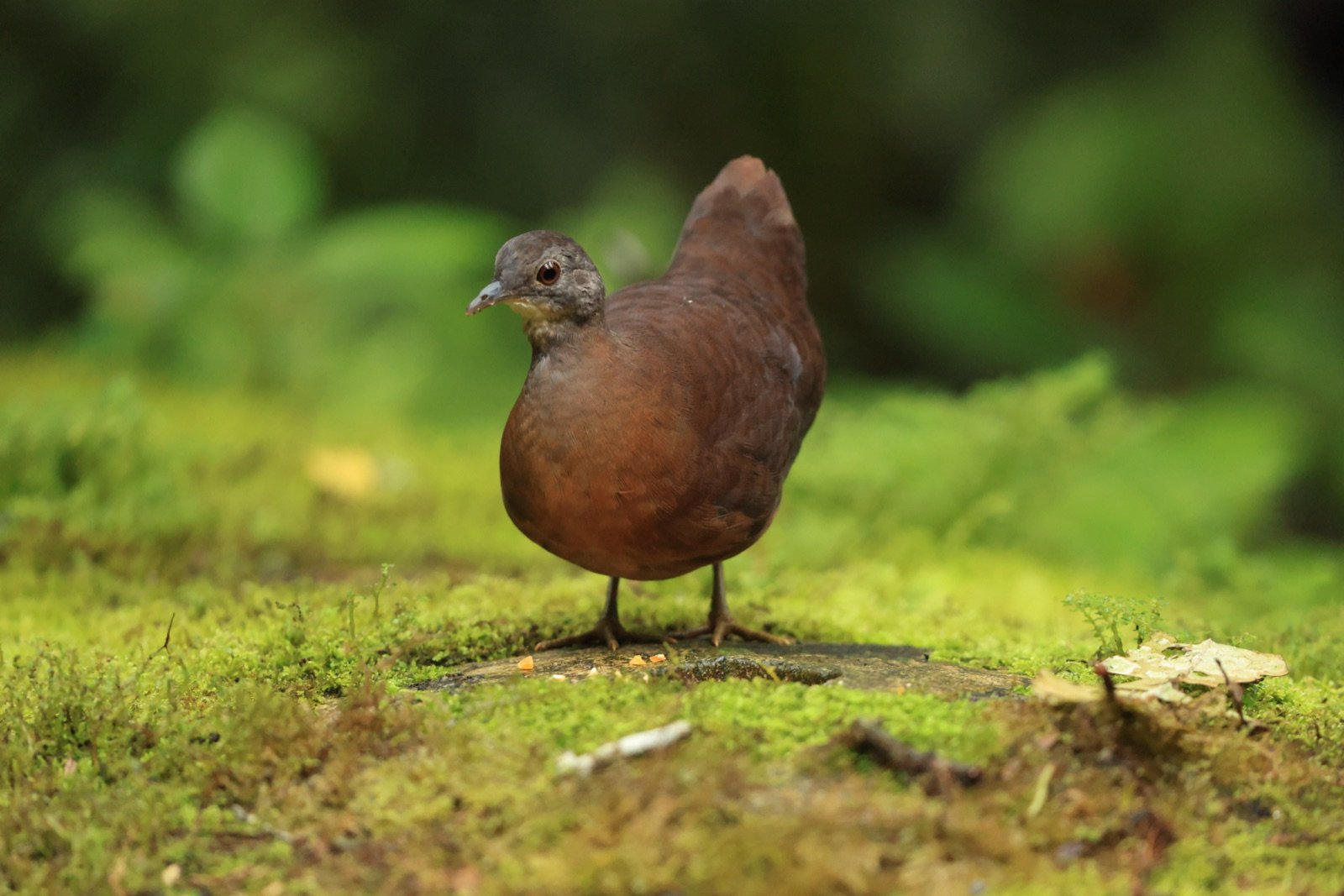
 Little Tinamou
Family Tinamidae
Little Tinamou
Crypturellus soui
In Spanish: Tinamú Chico (Gallina de monte Chica, Gongolona, Yerre, Ponchita)
- Resident
A shy, plain brown ground bird, found by its whinny.
The Little Tinamou is the smallest of Costa Rica's five tinamou species, a plump, nearly tailless brown bird about nine inches long. It is also the most widespread tinamou in the country, yet it is rarely seen, because it is solitary, shy and keeps to dense, tangled habitat.
Most meetings begin with the ear. On a trip we build, this is a bird to listen for at dawn and dusk in lowland and foothill second growth, and to keep in mind around gardens and feeders where one may walk into view.
How to find it
Listen for the call, because the bird is very hard to see in its dense, tangled habitat. Track down singing birds at dawn and dusk and bring a flashlight, since you may be able to sneak close to one near the trail. In lowland and foothill sites with second growth you will probably hear its loud whistles, and with patience it can eventually be seen. Peer into forest edge, or watch for one feeding below feeders or at shaded kitchen scrap spots behind lowland restaurants that border thick second growth.
How to recognise it
Look for a small, plump bird about the size of a quail, with almost no tail.
- Body: mostly dark brown, uniformly brown, with paler underparts.
- Head: blackish crown, dark grey cheeks, whitish throat.
- Plumage: adults show no barring.
- Sexes: females are a brighter rufous brown below than males.
- Legs: grey to olive to yellow, so do not rely on leg colour alone.
- Young birds: cinnamon brown above, speckled with black, and greyish brown below with bold but broken black barring.
What it sounds like
Behaviour and diet
This is a solitary, shy bird that people rarely see, except when it crosses a trail or an open patch. It eats mostly seeds and berries picked up from the ground, plus the occasional insect or small frog. Unlike some other tinamous that roost in trees, it sleeps on the ground in thick brush. It breeds nearly all year, possibly less from March to June. Across its range, the male incubates the eggs and raises the chicks alone, and the chicks run almost as soon as they hatch.
Where it lives
In Costa Rica it lives in dense, tangled second growth, weedy crops, sugarcane fields and forest edge in humid zones, and in the thick understory of broken forest. It is locally common from sea level up to about 1,500 m. It occurs along the Caribbean slope, the western and southern Nicoya Peninsula, and the Pacific slope from about Orotina southward. It is local on the Pacific side of the northern cordillera and rarely found west of the Central Valley.
Similar birds
Its tail is shorter than a similar-sized pigeon's, and Colinus quail are slimmer, crested and usually walk in groups. The other small tinamous in Costa Rica have red legs. The Great Tinamou is much bigger than a chicken with grayish legs, and the Thicket Tinamou of dry forest has barred upperparts and reddish legs.
Names and lore in Costa Rica
Costa Ricans call it gallinita de monte, gongolona (also spelled congolona), yerre and ponchita, besides Tinamú Chico. Gallina de monte, meaning mountain hen, is a general name for tinamous, and gallinita is the diminutive used here because the bird is so small.
Status and conservation
The AOCR lists it as a resident (R), and the IUCN rates it Least Concern with a very large range.
Photography tips
A Costa Rican guide's method: find a calling bird, pick a spot with a view into the understory, then wait for it to walk into sight. He also suggests a lodge garden where one visits.
How we know this 17 sources, each read on the date shown
- Aves de Costa Rica read 2026-11-04
https://avesdecostarica.com/Crypturellus-soui.html - The Tico Times read 2026-11-04
https://ticotimes.net/2024/07/13/costa-rica-birding-meet-the-little-tinamou - Birds Colombia (La Voz de las Aves) read 2026-11-04
https://birdscolombia.com/2018/01/28/tinamu-chico-little-tinamou-crypturellus-soui/ - Birda read 2026-11-04
https://app.birda.org/species-guide/76/Little_Tinamou - Wikipedia read 2026-11-04
https://en.wikipedia.org/wiki/Little_tinamou - Asociación Ornitológica de Costa Rica read 2026-11-04
https://avesdecostarica.weebly.com/tinamidae.html - Aves Costa Rica (avesibericas.es) read 2026-11-04
https://www.avesibericas.es/costaricaaves1.htm - Birding Craft read 2026-11-04
http://birdingcraft.com/wordpress/2009/10/21/how-to-see-tinamous-in-costa-rica/ - Birding Craft read 2026-11-04
https://birdingcraft.com/wordpress/tag/tinamous/ - Father Son Birding read 2026-11-04
https://fathersonbirding.com/bradens-costa-rica-report-4-osa-peninsula-adventure/ - WINGS Birding Tours read 2026-11-04
https://wingsbirds.com/tours/costa-rica-spring - Field Guides tour report read 2026-11-04
https://fieldguides.com/triplists/cos23bPRINT.html - Field Guides tour report read 2026-11-04
https://fieldguides.com/triplists/cos18.html - Área de Conservación Guanacaste read 2026-11-04
https://www.acguanacaste.ac.cr/paginas-de-especies/insectos-2/762-tinamidae/6461-i-tinamus-major-i-tinamidae - Field Guides tour report 2018 read 2026-11-04
https://fieldguides.com/triplists/cos18LIST.pdf - Peter Bono trip list read 2026-11-04
https://www.prba.com/tr_costaric.htm - Birdingcraft read 2026-11-04
https://birdingcraft.com/wordpress/2016/03/09/looking-for-tinamous/